_(1).webp "Biki Hussain, a young entrepreneur from Bihdia village, Kamrup, Assam")
Munni Begum/Guwahati
Rather than waiting for a government job, 22-year-old Biki Hussain of Bihdia village in Assam’s Kamrup district has created a new avenue for employment through beekeeping.
What began with a single beehive box has now grown into a thriving enterprise. Producing around 1.5 tonnes of pure and natural honey every year, Biki earns lakhs of rupees annually. He not only sells honey but also supplies honeybees and beekeeping boxes outside Assam, making him an inspiration for many unemployed young people in the state.
Biki received training in beekeeping from the Khadi and Village Industries Board in Mukalmua and the Agriculture Department in Khanapara.
After making several attempts to secure a government job, he realised that it’s better to start a business. At a time when adulterated honey laced with chemicals was widely sold in the markets. He thought of providing people with pure honey.
 Biki Hussain with his beehives
Speaking to Awaz-The Voice, Biki said, “Pure and natural honey is not easily available in the market these days. Although consumers want natural honey, in most cases they are forced to buy honey mixed with chemicals, which can cause various side effects in the human body. I decided to enter the beekeeping business to address this problem and supply people with healthy, pure honey.”
Biki began his journey with a capital of just ₹2,200, using the money to purchase a single beekeeping box. The growth wasn’t so easy. Sometimes the bees would fly away, while at other times the honeycombs would be destroyed.
Biki said, “Initially, many of the bees would fly away. Those incidents made me very sad, but I kept thinking that if I continued working with patience and dedication, I would surely see success one day.”
_during_a_training_on_bee_keeping.webp) Biki Hussain training women in apiary
Biki Hussain training women in apiary
Eventually, his patience paid off. Today, Biki has around 75 beekeeping boxes, and during the dry season, the number increases to 200. Each box generally contains eight honeycombs. By using portions of these combs to create new colonies, he has gradually expanded his business.
Biki primarily produces honey using the indigenous bee species Apis cerana indica. In addition, during the dry season, when production is higher, he purchases the Italian bee species Apis mellifera ligustica from West Bengal and Bihar.
Explaining the differences between the two species, Biki said, “The indigenous bees produce around 8 to 10 kilograms of honey per box, whereas the Italian variety can produce between 30 and 40 kilograms. However, the Italian bees do not survive for long during Assam’s humid monsoon season, while the indigenous bees adapt very well to our natural environment. Although production from the Italian variety is higher, many of the bees die during the monsoon because of a shortage of natural food. Therefore, we have to purchase new Italian bees every year.”
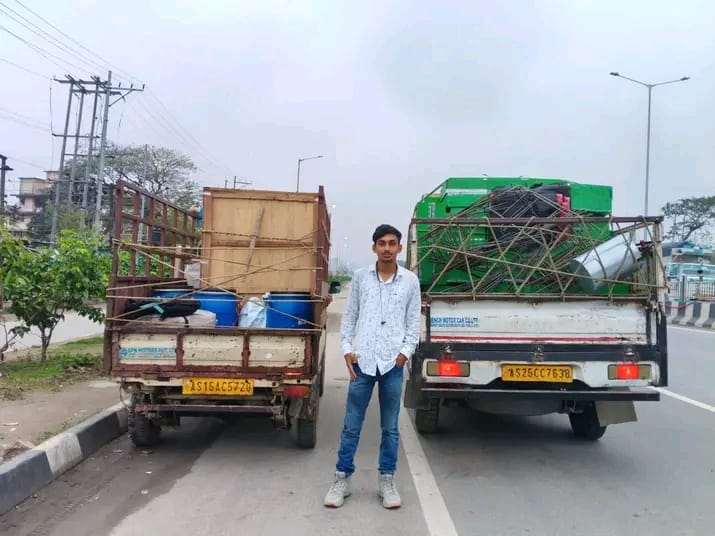
Biki sells honey under his brand, ‘North East Honey’. He also supplies honeybees, beekeeping boxes and other essential materials, and spices, to government departments, NGOs and Farmer Producer Organisations (FPOs).
At present, Biki offers several varieties and flavours of honey, including multiflora, mustard, litchi, jamun and Assam lemon honey.
He also supplies beekeeping materials to neighbouring states such as Arunachal Pradesh, Nagaland and Meghalaya. At the same time, he provides beekeeping training to many interested people, helping them find a path towards self-reliance.
Speaking about government assistance, Biki said that he received 10 beekeeping boxes from the Khadi Board and one box from the Agriculture Department as grants.
 Biki Hussain with a friend in mustard field and beehives ready to be sold
Explaining how honeybees reproduce, Biki said that a portion of the eight honeycombs in a box can be separated and placed in a new box, where a new colony is formed. Most remarkably, the bees in this new colony naturally create their own queen bee. By increasing the number of colonies through this natural process, Biki has been able to expand his honey production to its present scale.
During the monsoon, when adverse weather conditions lead to a shortage of natural food, the bees are fed sugar syrup to keep them alive. However, no honey is produced during this period. Biki makes it clear that genuine honey is produced only from the nectar of flowers and not from artificial feed.
Therefore, a favourable natural environment and an adequate supply of flowers are essential for producing pure honey.
In particular, nature becomes abundant with flowers from December to April, making this the period when honey production reaches its peak.
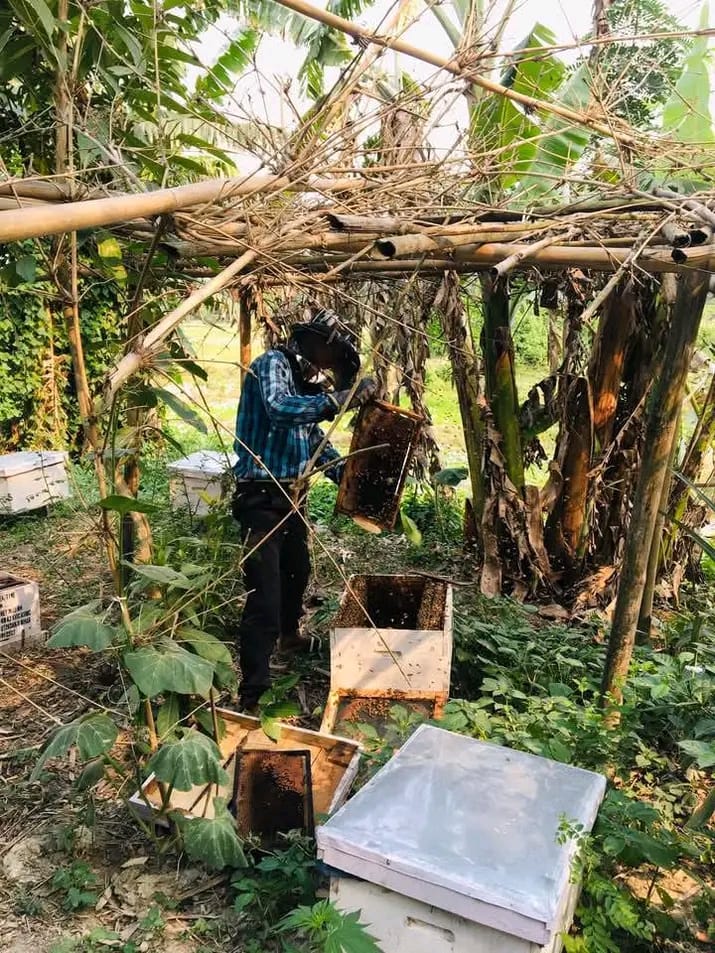
Speaking about the difficulties faced in beekeeping, Biki said, “A harmful insect known as the ‘Small Hive Beetle’ lays eggs inside the honeycombs, and the larvae that hatch from them can destroy the entire hive overnight. Apart from this, attacks by ants, bee-eating birds, lizards and hornets are common problems for beekeepers. Therefore, special attention has to be paid to protecting the bees and maintaining the cleanliness of the boxes. The honeycombs need to be thoroughly inspected every two days.”
Despite all these challenges, Biki now earns approximately ₹2–3 lakh a year through beekeeping. His business venture has also provided employment to two other people. Alongside running his business, Biki continues to pursue his MBA studies.
Pointing out that the number of beekeepers in Assam has still not increased as much as expected, Biki said, “There is immense potential in the field of beekeeping in Assam. If someone enters this profession with proper planning and training, they can certainly become self-reliant. It is possible to earn a good income not only by selling honey but also by selling new colonies, honeycombs and beekeeping boxes.”
ALSO READ: Armless swimmer Abdulqadir set to make his mark in Para Asian Games
Biki plans to expand his business even further in the future. At present, his honey sells at a market price of ₹600 per kilogram. A journey that began with just one box has today established him as a successful example of self-reliance.








_(1).webp "Abdulqadir Indorewala. Para Swimmer")




.webp)