




 Saquib Salim
On 26 January 1950, when India became a Republic, the world hardly believed that such a large population with a low literacy rate could pull off a successful election to the legislature. But the Election Commission of India (ECI) has successfully conducted elections since 1952, making India the largest democracy.
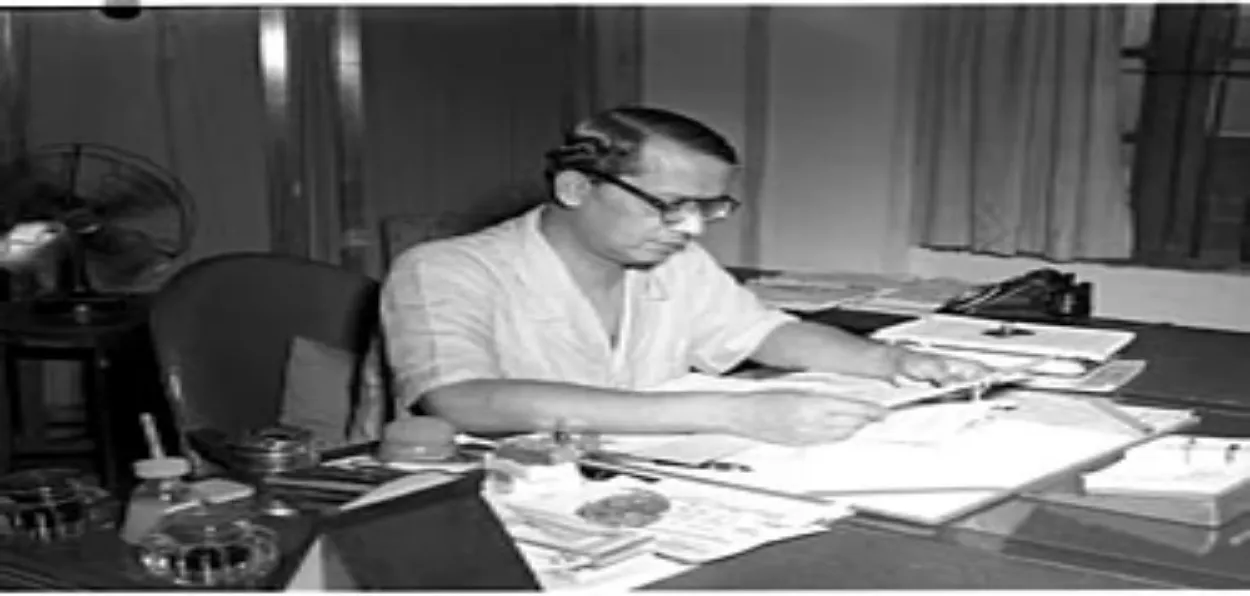
The ECI was constituted on 25 January 1950, and Sukumar Sen, an ICS officer, became the first Chief Election Commissioner of India.
His task was challenging – he had to deal with about 36.5 crore people, with a literacy rate of 16.6%, and 17.2 crore of them eligible to vote. Never in human history had such a large population voted.
In less than a year, ECI created constituencies, prepared electoral rolls, trained officials and persuaded millions of first time voters to participate in the first general election of 1951-52.
Sukumar Sen proved that the success of universal adult suffrage did not depend upon literacy alone and that the ordinary Indian possessed enough political sense to choose if the voting system was simple and neutral.
Sen conducted the first two general elections, in 1952 and 1957.
Sen’s reputation crossed the borders. In 1953, Sen was appointed Chairman of the Sudan Electoral Commission for that country's first parliamentary elections. The ECI, under Sen, thus became an example of how democracy could be administered in a newly independent and underdeveloped country.
The Commission at its inception was a single-member body. Its responsibilities, however, expanded with the electorate and competitiveness of politics.
The 1960s and 1970s witnessed the decline of one-party dominance and the emergence of regional forces. The political upheaval of the 1970s and the defeat of Congress in 1977 demonstrated that elections could transform Indian politics.
The Model Code of Conduct, which had originated as an informal code in Kerala in 1960, became increasingly important as competition intensified. Later, the voting age was reduced from 21 to 18 in 1988, enlarging the electoral college.
The decisive transformation in the public image of the ECI came with T.N. Seshan.
Seshan became Chief Election Commissioner on 12 December 1990 and remained in office until 11 December 1996.
Seshan used the Model Code of Conduct not as polite suggestions but as a practical tool of electoral administration. He confronted the misuse of official machinery, excessive campaign expenditure, illegal publicity, booth-capturing and other practices that had become associated with elections.
Election observers became increasingly important, and their position received statutory backing in 1996 through Section 20B of the Representation of the People Act, 1951.
The introduction and expansion of Electors’ Photo Identity Cards is also associated with the Seshan era. The idea was that the state should know who was voting and the voter should be protected against impersonation.
Seshan's insistence on expenditure limits, voters’ identification, central security forces and strict adherence to electoral rules made the ECI visible in a way it had never been before.
Yet Seshan's greatest legacy may have been psychological.
Before Seshan, political parties often appeared larger than the institution supervising elections. After Seshan, the Election Commission itself became a political institution, an institution capable of compelling political parties to change their behaviour.
There is a more interesting question than whether T.N. Seshan transformed Indian elections or the political weakness of governments in the 1990s gave Seshan more freedom to assert.
Seshan joined as CEC in December 1990, at a time when the era of single-party dominance at the Centre was giving way to coalition governments. The governments of V.P. Singh, Chandra Shekhar and, after the 1991 election, P.V. Narasimha Rao were dependent on coalition partners. The political system was increasingly fragmented, with regional parties becoming important players.
Amit Ahuja and Susan Ostermann have offered the clearest explanation of this relationship. They argue that the collapse of single-party dominance was a “necessary, but not sufficient” condition for the emergence of a powerful Election Commission.
Coalition governments dispersed executive power among alliance partners and created multiple veto players. As a result, “weaker governments became unlikely to limit” the ECI's autonomy.
Smaller and regional parties, which distrusted state governments and local administrative machinery, increasingly saw the ECI as a neutral referee.
 T N Seshan
But this does not diminish Seshan's achievements. Rather, it explains why his personality mattered so much. The Constitution had already given the Commission considerable powers, but Seshan was the CEC who chose to test their limits. David Gilmartin describes his project as an attempt to create an “electoral morality that transcended everyday politics.”
It was an epoch-making coincidence that in an era of weaker governments, the ECI became stronger. A powerful central majority might have possessed greater political capacity to resist an assertive CEC like Seshan. But coalition governments had fewer such options.
The next major revolution was technological. EVMs were first used experimentally in 1982 and were deployed across all 543 Lok Sabha constituencies in the 2004 general election. VVPAT technology was subsequently introduced to provide an additional paper trail. In 2024, the Supreme Court rejected a demand for 100 per cent VVPAT verification while retaining the existing safeguards.
On the orders of the Supreme Court, Parliament enacted the 2023 law to replace the CJI on the selection committee with a Union Cabinet Minister nominated by the Prime Minister, alongside the Prime Minister and Leader of Opposition.
It also prescribed a six-year term or age 65, whichever is earlier.
On 23 September 2026, a two-judge Supreme Court bench delivered differing opinions on the challenge to the 2023 appointment law and directed that the matter be placed before the Chief Justice for consideration of a larger Constitution Bench. Thus, as of October 2026, the law remains operative, but the constitutional debate over the independence of the appointment process remains unresolved.
The Election Laws (Amendment) Act, 2021 made other significant changes, including providing four qualifying dates in a year for electoral registration and creating a statutory framework for Aadhaar authentication of electoral-roll entries.
ALSO READ: Resolving allegiance to Ummah and nation
From Sukumar Sen to T.N. Seshan and from ballot papers to EVM, the history of the ECI is the history of an institution learning to adapt to a changing republic.










_(1)_(1).webp)
_(1).webp)