 Shankar Kumar
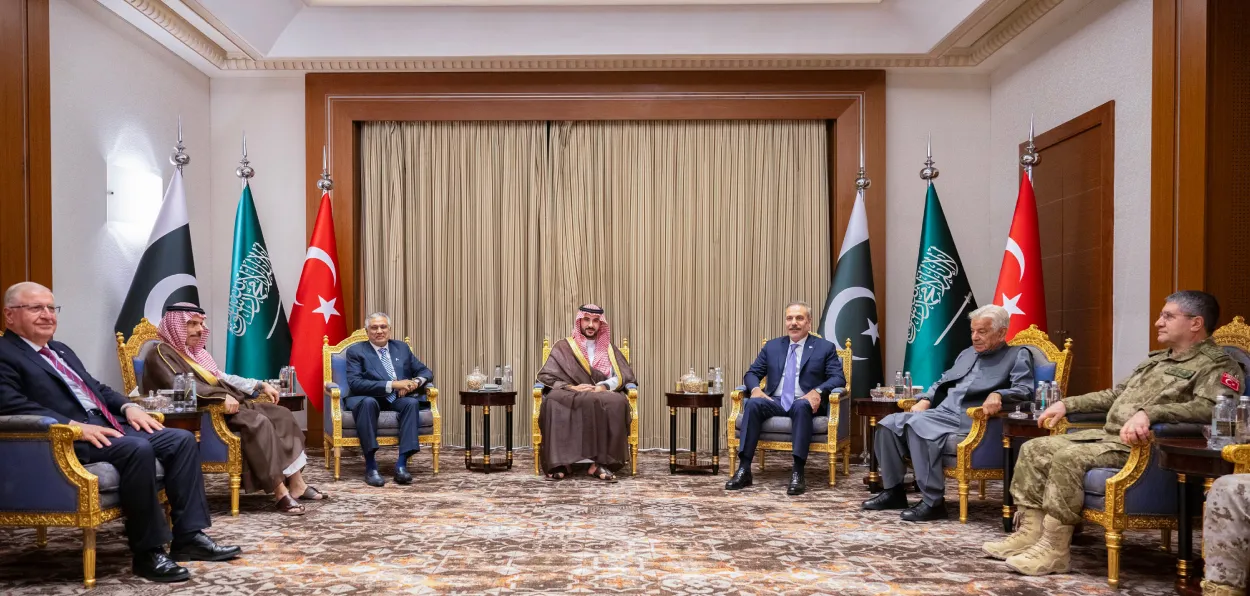
Three countries, Pakistan, Turkey, and Saudi Arabia, on October 5 agreed to activate their deterrence measures under the Mecca Pact they signed in early August. Activation demands rapid deployment of troops by Pakistan and Turkey in the Saudi Kingdom to counter attacks by Yemen’s Houthis.
This has, however, aggravated the Middle East situation with Houthis escalating drone and missile attacks, damaging airports and other critical infrastructures in Saudi Arabia.
Turkiye has announced it would not deploy its military against the Houthis. Amid this, a major question arises whether Pakistan will be able to fight the battle-hardened and Iran-aligned Houthis when, on its own soil, Islamabad is struggling to control home-grown insurgents.
Whether in Balochistan, Khyber Pakhtunkhwa or disputed territory of Pakistan-occupied Kashmir, Islamabad has only to stare at disappointment. Insurgent groups like Baloch Liberation Army (BLA), Balochistan Liberation Front (BLF), Baloch Republican Army (BRA) and Tehreek-e-Taliban Pakistan (TTP) have repeatedly exposed Pakistan’s security forces’ operational capabilities.
In 2025 alone, as per the Director General of the Inter-Services Public Relations (DG ISPR), the official spokesperson of the Pakistan armed forces, 1,235 soldiers were killed in operations against insurgents in Balochistan and other parts of the Pakistani territory.
From 2016 to 2025, more than 4,100 Pakistani security forces were killed during an offensive against insurgents in different parts of the country, data from South Asia Terrorism Portal revealed. While all this clearly highlights Pakistan’s tough fight against insurgents, what makes its problem more acute is its opening a front against Afghanistan under the Taliban.
Over the last five years, clashes along the Pakistan-Afghanistan border have resulted in significant casualties among the armed forces of both countries. With tensions between Islamabad and Kabul continuing to simmer, there is very little prospect of an immediate end to the hostilities.
Against this background, a major question is how Pakistan’s overstretched and militarily incapable armed forces will be able to strengthen countermeasure operations against Houthis. At the same time, it is important to assess whether Saudi Arabia has gained any military advantage from allowing Pakistani troops to be deployed on its soil.
In an interview with CNN a few days ago, Lieutenant General Ahmed Sharif Chaudhry, DG ISPR, said that Pakistani forces have already been present in the Saudi Kingdom across multiple capabilities and domains for decades.
Last year in September, Islamabad and Riyadh signed the Strategic Mutual Defence Agreement, pledging that any aggression against one would be considered an attack against both.
Despite this, how did Pakistani troops remain a mute spectator when Houthi let loose a barrage of attacks on Saudi Arabia from March 2026 onwards? From targeting airports to key oil pipelines, refineries, ships and several other critical infrastructures, Houthi-led attacks have posed a serious challenge to Saudi Arabia’s security.
The Iran factor
A New York Times report said Pakistan Air Force jets are reportedly taking part in strikes against Houthis in Yemen after the Mecca pact has been activated. The same NYT report further said that around 8,000 Pakistani troops are stationed in Saudi Arabia. However, Pakistan immediately issued a statement in which it vehemently denied that its fighter jets were taking part in strikes against Houthis' missile and drone installations in Yemen.
🚨🇸🇦🇾🇪 The Final Moments Before the Houthi Attack on Riyadh Airport! Footage shows people at King Khalid International Airport in Riyadh preparing to catch their flights, unaware that the situation could change dramatically within moments. https://t.co/b6elcK1NYJ
— Mojtaba Khamenei Commentary (@MojtabaKhamen) October 11, 2026
This denial from Pakistan is self-explanatory; Islamabad does not want to be dragged into a conflict with Houthis and turn the tables against its own interests. In truth, Islamabad seeks to maintain good relations with Saudi Arabia while at the same time remaining mindful of the harsh geopolitical reality that Iran is a major neighbour with which it shares a sizable land border.
Pakistan knows that its military’s participation in Yemen is bound to trigger tension with Iran and also have an impact on Islamabad’s domestic front. This is because Shia, who constitute 10-15% of the country’s population, may side with Tehran during conflict between the two neighbours. If this happens, it would lead to civil unrest within Pakistan.
This was the reason Pakistan, despite being part of the 2015 Riyadh-led Islamic Military Counter Terrorism Coalition (IMCTC), rejected Saudi Arabia’s call for support in its fight to halt the advance of Al Houthi rebels in Yemen. Pakistan’s parliament went ahead to vote against joining Riyadh-led military intervention in the West Asian country.
Given the situation, a question arises on the effectiveness of the Mecca pact. Pakistan asserts that the pact does not commit it to offensive military operations and it is purely defensive in nature.
If Pakistan limits its role to defensive assistance, intelligence sharing and the protection of critical infrastructure, the pact would still provide meaningful benefits to Riyadh. But that is not happening since Islamabad appears unprepared to bear the strategic costs of playing an effective role against the Houthis. Escalating attacks by the Houthis -– recent one was a missile attack on King Khalid International Airport in Riyadh --and drone attacks speak volumes about it.
ALSO READ: India can no longer escape the ripple effect of global tension
The key question is whether the Mecca Pact can deliver credible security guarantees to Saudi Arabia while Pakistan remains unwilling to risk a wider confrontation.
Shankar Kumar is a senior journalist who writes on foreign affairs and geostrategic issues

.jpg "Gujarat’s women entrepreneurs bring their craftsmanship to life during Navratri")