Bhakti Chalak
What comes to mind when you hear the word Afghanistan? Taliban fighters wielding large guns, bomb blasts, and people living under extreme oppression. Whether on television channels or in Western media, this is the image of Afghanistan that has been presented to the world for many years.
But what is the ground reality? To find out, 39-year-old Vishal Chavan, a traveller from Nashik, Maharashtra, spent 22 days in Afghanistan and later wrote a book about his experiences.
An IT consultant who has been running his own business for 18 years, Vishal inherited his passion for travel from his parents. He has visited 16 countries, including Singapore, Thailand, Malaysia and Vietnam, and shares his experiences through travel vlogs and content creation on YouTube and Facebook.
In a special interview with Awaz-The Voice, he spoke about his experiences during his 22-day stay in Afghanistan and how they challenged many of his preconceived notions about the country.
In 2025, Vishal travelled to Iran when the country had waived visa requirements for Indian visitors for 14 days. He flew from Mumbai to Mashhad, a city near the Afghan border. After exploring the city, he was researching on his laptop when he realised that Mashhad was close to Afghanistan.
 Vishal Chavan with his Nizambhai
Vishal had originally planned to travel from Iran to Azerbaijan, Armenia and Georgia. However, he changed his plans and decided to visit Afghanistan instead.
He approached the Afghan consulate in Mashhad for a visa. Initially, the authorities refused to grant him one, citing security concerns about a solo traveller visiting the Taliban-ruled country. Eventually, however, they issued him a visa.
Although Indians can enter Afghanistan from Iran without a visa under certain circumstances, Vishal encountered difficulties on the Iranian side. He also realised after entering Afghanistan that there were several factions within the Taliban regime. Ultimately, after paying a bribe of Rs 11,000, he obtained a visa sticker for his passport in just two hours.
Vishal's family was shocked to learn about his plans to visit Afghanistan. He had the Afghan visa in hand but no return ticket. After spending 10–15 days in Iran and exploring Tehran and Mashhad, he hired a taxi and travelled overland towards Herat, a major Afghan city.
 Vishal Chavan with an security man in Afghanistan
A man and a woman were already travelling in the taxi when Vishal boarded it near the border. He struck up a conversation with his fellow passenger, who turned out to understand Hindi.
Vishal says, "Nazim bhai was also headed to Herat. Since I was speaking excellent Hindi-Urdu, he thought I was Pakistani. But when I told him I had come from India, he was overjoyed. Then our conversation became even more wonderful. He was from Afghanistan and had come to Iran for business."
Vishal struck up a friendship with Nazim bhai, and his apprehensions about visiting Afghanistan began to fade. He had a smooth experience dealing with immigration officials. However, he noticed two Taliban fighters in traditional attire, with large AK-47 rifles slung across their shoulders. They spoke only Pashto and Persian.
 Vishal Chavan releasing his book
Vishal said, "Those two Taliban men were sitting with guns, looking extremely dangerous. From their gestures, I understood that they asked me where I was from. So, I said, 'Al Hind'. Because in the Middle East or Islamic countries, India is known as 'Hind'.
Nazim bhai did not even let Vishal book a hotel. Instead, he took him to his home. Setting aside his apprehensions about staying in a stranger's house in an unfamiliar country, Vishal accepted the invitation and arrived at Nazim bhai's luxurious four-storey house. Four cars were parked on the porch, suggesting that his host was a well-known and affluent person in the area.
While ordinary people often lacked basic conveniences such as electricity, wealthy residents had generators to ensure a regular power supply. Vishal was given a separate room with a heater and served excellent food and drinks. Nazim bhai also drove him around Herat in his car.
Foreign tourists visiting Afghanistan are required to obtain a special permit from the relevant ministry. The application requires details of the duration of the stay, the cities to be visited and the host. Vishal spent his first three days in the country without such a permit.
After bidding farewell to Nazim bhai, he boarded a night bus to Kandahar.
 Vishal Chavan in Afghanistan
In Kandahar, a stronghold of the Taliban, Vishal encountered a major problem. When he arrived at the bus stand early in the morning, Taliban fighters stopped him.
“They thought I was a Pakistani spy who had come there for recce."
"My facial features, and from my dress, they took me as a Pakistani. It is impossible to make a soldier from a civilian there because everyone is in civil dress. They detained me at the Kandahar bus stand for four hours."
During those four hours, the Taliban fighters photographed his laptop, camera, microphone and every other item in his bag. They also photographed his Aadhaar card, PAN card and even a copy of the income tax return receipt he had filed in India. The photographs were sent to senior officials for verification.
After four hours of intensive interrogation, the authorities released him and even gave him a gift.
"Four hours after the interrogation, those soldiers came back and released me. But perhaps there was some guilt in their minds. A man was roaming there, much like the ring sellers who sit on the banks of the Godavari in our Nashik. The Taliban men called him, bought a ring from him and gifted it and a bottle of attar (perfume) to me. It was a cultural shock for me."
 Vishal Chavan shows gifts given by the Taliban to him
Vishal believes there is a world of difference between the Afghanistan portrayed in Western media and the country he experienced.
He says, "The Afghan people and the Taliban fighters respect Indians from the bottom of their hearts. They have immense hatred for Pakistan in their minds. Therefore, wherever I went, I would tell them beforehand that I had come from India. At many places, shopkeepers and hoteliers didn't accept payments. They would just say that you are our guest."
Vishal also observed that there were strict restrictions on photographing or filming women in Afghanistan. He followed the rules, but footage captured during his vlogging showed women and young girls in major cities such as Herat and Kabul walking through markets without hijabs, shopping and going to work.
However, outside major cities such as Kabul, Herat and Mazar-e-Sharif, girls continue to have limited access to education.
Based on his experiences and conversations with locals, Vishal says that corruption, theft and kidnapping have declined since the Taliban came to power. According to accounts he heard locally, only two crimes had occurred across the entire country in the preceding four and a half years. One was bicycle theft, and the other was molestation.
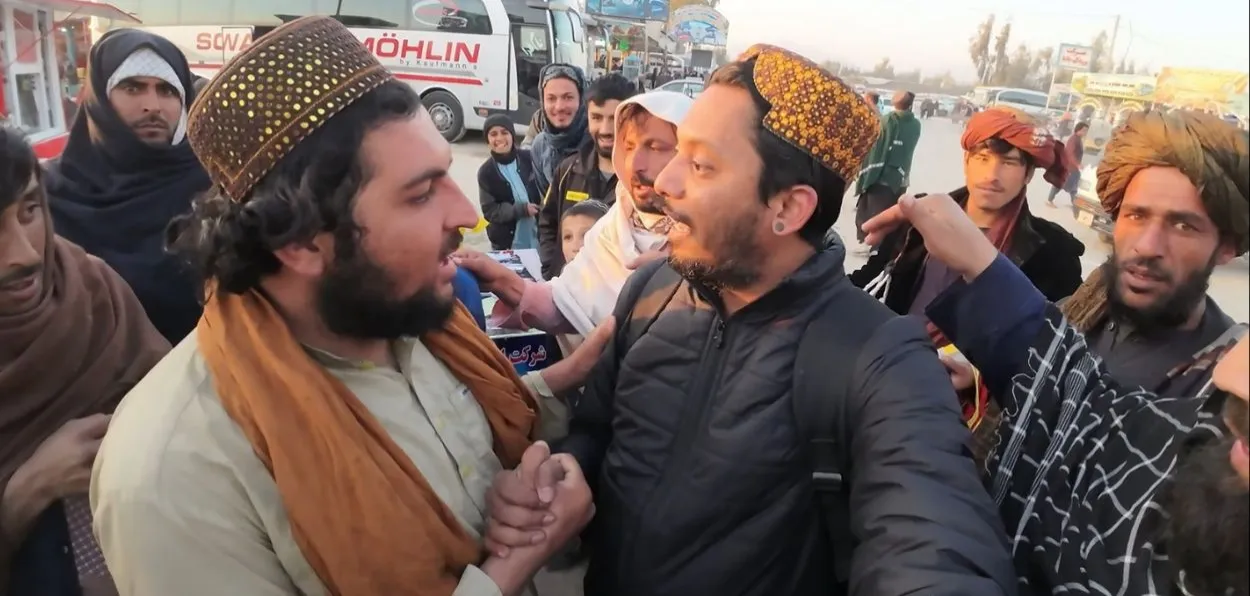
 Vishal Chavan with locals in Afghanistan
The person who stole the bicycle reportedly had both hands chopped off in the street, an act that, Vishal says, has instilled widespread fear of the law.
Illustrating the sense of security he experienced, Vishal says, "I had forgotten the ring gifted to me by the Taliban in a public hammam (bathhouse) in Kabul. When I remembered it two-three hours later and went there to search for it, I found it safely there."
Afghanistan's food culture is famous around the world. Kabuli pulao, a vegetarian dish called 'Shornokhor' made with Kabuli chana (chickpeas), and chapli kebabs are among the country's culinary attractions. As in other Central Asian countries, vegetarian options in Afghanistan are relatively limited.
Why did Vishal Chavan, who set out on his journey without much planning, stay in Afghanistan for 22 days? What was the quest that took him on a motorcycle into a remote village, 40 kilometres from Mazar-e-Sharif? He has documented the experiences, discoveries and encounters of those 22 days in his book, Nashikkar in Afghanistan.
ALSO READ: When mountains call you, age turns out to be just a number
Looking beyond the familiar images of guns and terror to explore Afghanistan's culture and the affection its people show towards Indians, Vishal's journey offers a perspective on a country that is often seen through the narrow lens of conflict and oppression. His experiences as a traveller from Nashik are certainly worth knowing.