Sabir Hussain
At 61, I wanted to challenge the notion that growing older meant gradually retreating from the things that made life exciting. Society often associates ageing with slowing down, lowering expectations and learning to live within an ever-shrinking comfort zone. I wanted to question that assumption - not through slogans, but by doing what I have always loved most: riding a motorcycle into the mountains.
For me, motorcycling has never been merely about the machine, the distance covered, or the thrill of negotiating a difficult pass. It is about freedom, discovery and the feeling of being completely alive on the open road. I did not want turning 60 to become a reason to give up that freedom.
I wanted to discover how far preparation, physical fitness, experience and a willingness to embrace uncertainty could take me at this stage of life. This was my way of exploring active ageing: not denying the years or pretending that the body remains unchanged, but refusing to let age alone dictate the limits of my ambitions. I wanted to show that adventure could remain a vital part of life after 60, provided we respected our limitations without surrendering to them. And there was no better place to test that conviction than Ladakh, whose high mountain passes, rugged trails and immense, unforgiving landscapes have drawn me back for decades.
This time, I would return on a motorcycle with my wife, Sudha, riding pillion - not simply to revisit a beloved destination, but to reaffirm that the appetite for adventure need not diminish with age.
Why Ladakh?
It’s because there is something deeply seductive about Ladakh that is difficult to explain and harder to resist. You leave its stark mountains and wind-swept valleys behind, yet part of you remains, suspended between the blue of its high-altitude lakes and the silence of its cold desert. Its ancient monasteries, soaring passes, rocky trails and icy water crossings feed adrenaline and stir the wanderlust. The landscape is so immense that, for a while, everything else falls away. One journey is never enough.
.JPG) The author in the middle of magnificient wilderness of Ladakh
The author in the middle of magnificient wilderness of Ladakh
I had promised myself that I would return. This autumn, I kept that promise, riding a Royal Enfield Himalayan 450 with my wife on the pillion. Neither of us was a spring chicken. That was precisely the point: to show that adventure need not end at a certain age. We trained for a month to prepare ourselves physically. This was not about pretending we were still 30, but about discovering what two people in their sixties could still do.
The ride was made possible by Royal Enfield, which provided the Himalayan 450 and the riding gear.
We left Delhi at first light on September 16. Fatigue caught up after 360 kilometres. Manali was still a town too far, so we stopped 40 kilometres short of Mandi.
Torrential rain held us up the next morning before we resumed the ride close to noon. By late afternoon, we crossed the Atal Tunnel into dry, sunny Lahaul. The following day, on the twisting road to Jispa, I misjudged a hairpin and dropped the motorcycle. A Border Roads Organisation bus and an SUV stopped to help. I was accustomed to falls; Sudha hurt a rib.
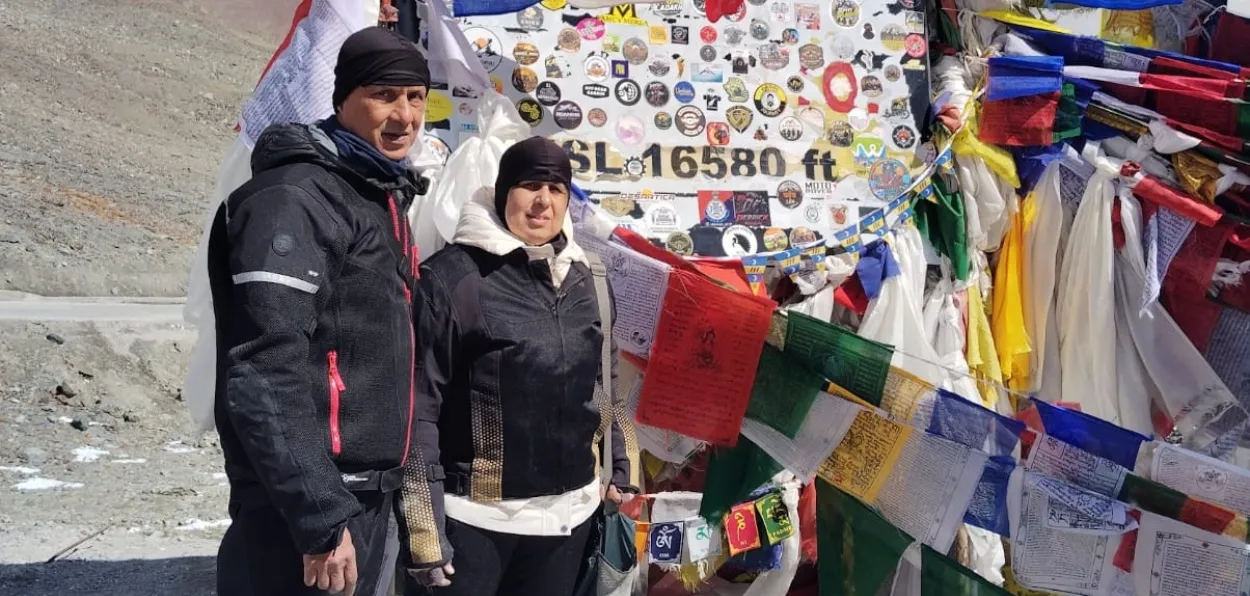
 Sabir Hussain at Khardung La (Pass)
In Jispa, we debated whether to take Baralacha La or Shinkula. A local warned us that the Gata Loops had deteriorated, while a group of Australians returning from Leh through Shinkula recommended the alternative.
‘That’s a great road. A blacktop, no water crossings, no snow. There are few switchbacks, but that’s par for the course. We had gone to Leh through Baralacha La, but the Gata Loops were really awful. And we didn’t want to come back through the same route.’
We chose Shinkula.
A rider named Tarun, in his mid-thirties, had arrived at our resort from Gurugram without a fixed itinerary. I invited him to join us. The road into Zanskar was demanding, rising sharply from Darcha in a series of hairpin bends. One such uphill hairpin brought me down. Our riding gear prevented serious injury, but Sudha’s rib pain worsened.
She could no longer ride. She took a cab towards Padum while Tarun and I rode towards Shinkula ahead of her car. At more than 16,500 feet, the pass opened into the vastness of Zanskar. Downhill, and an hour later, we stopped briefly for photographs at the base of Gonbo Rangjon, or God’s Mountain, a monolithic rock, before reaching Padum.
The next morning, Sudha continued by cab and reached Leh. Tarun and I rode through Zanskar’s deep canyons and mountains towards Leh, following a different rhythm from the journey we had begun together. We reached Leh a couple of hours after Sudha.
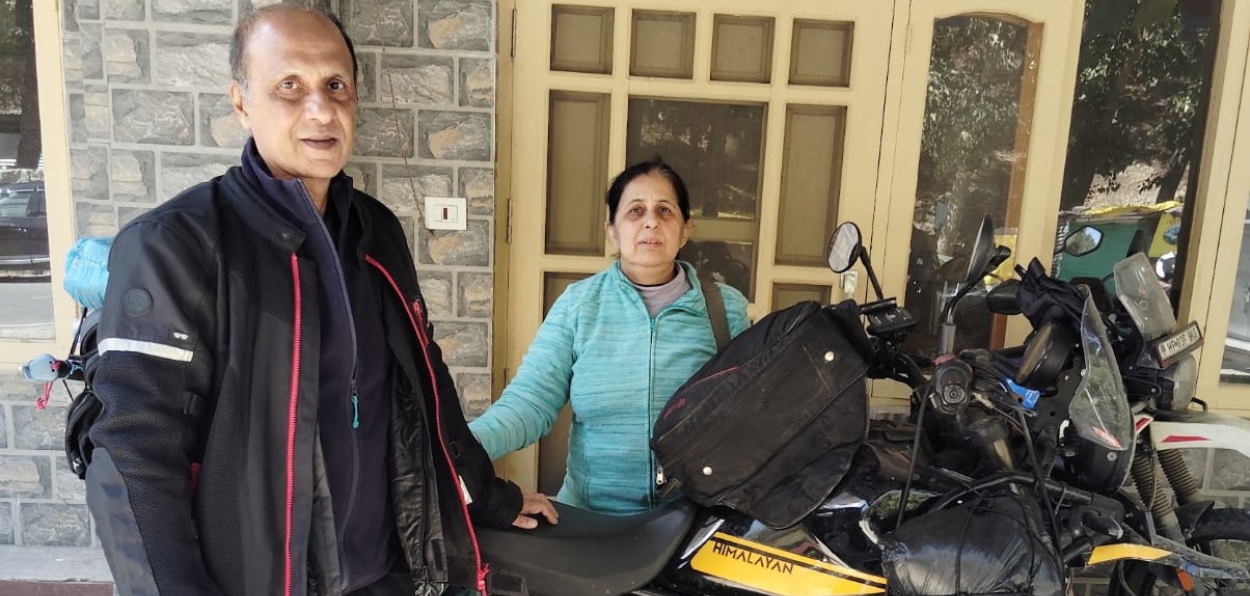 Sabir Hussian and his wife Sudha in Leh
Sudha had never been merely a passenger. She shared the discomfort, questioned the risks and absorbed the shocks. With her behind me, the road felt shared. Riding alone again felt strangely incomplete.
At a Royal Enfield showroom in Leh where I went to service the motorcycle, I met a group of young riders. One asked my age.
‘61,’ I replied.
‘That’s amazing,’ he said. ‘And you’re riding alone?’
‘No. My wife’s with me.’
‘Not many 60-year-olds visit Ladakh on a motorcycle. You really have some passion. And you are lucky your wife agreed to ride pillion with you.’
‘Well,’ I replied, ‘I will need stories to tell when I become a grandfather.’
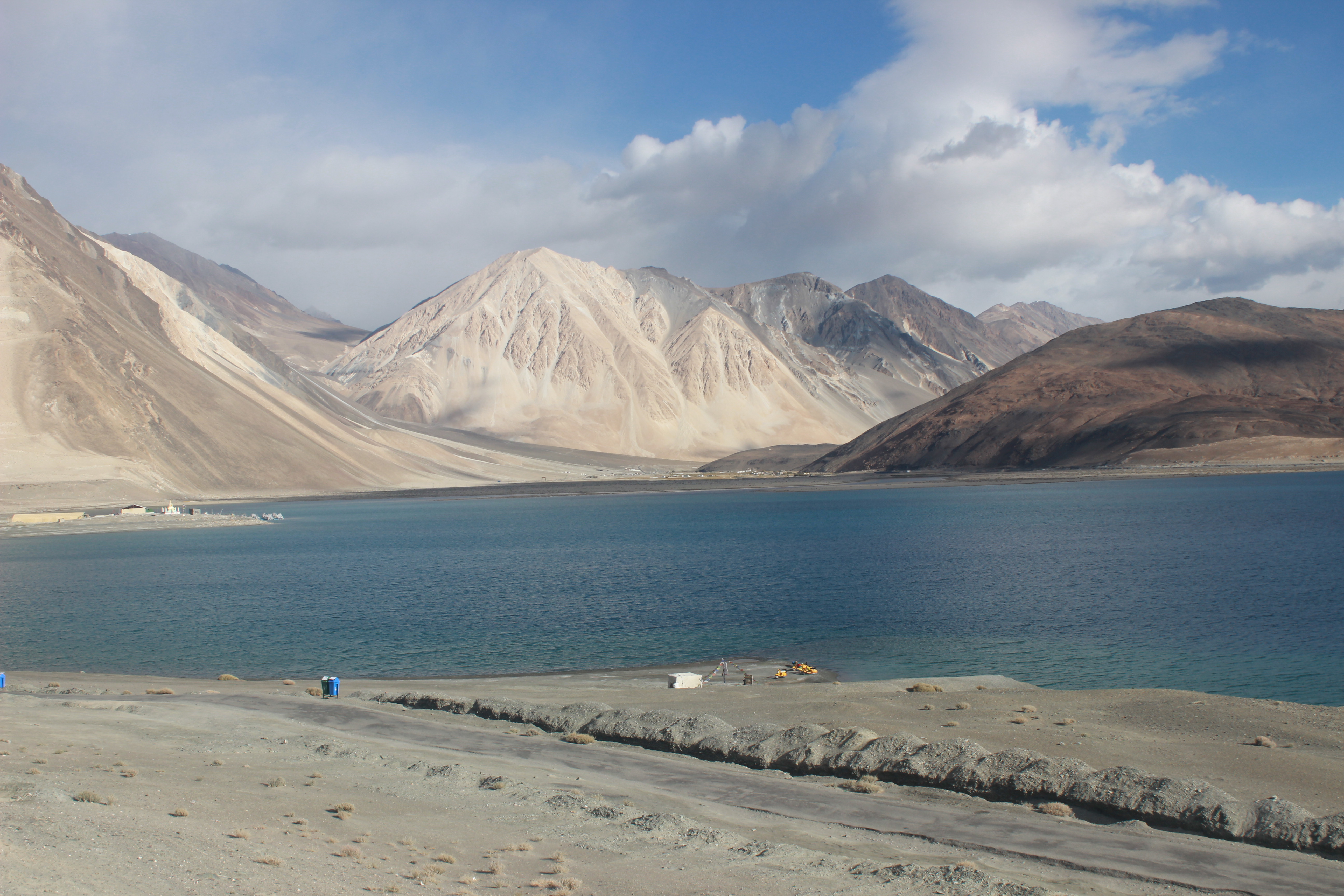 Pang Gong Tso
The surprise stayed with me. I did not meet a single Indian above 50 riding a motorcycle, although foreigners around my age, and even older, were happily riding Himalayan 450s across Ladakh. Perhaps we need to rethink what ageing asks of us - and what we assume it rules out.
From Leh, Tarun and I headed towards Turtuk while Sudha stayed back. A snowstorm closed Khardung La to two-wheelers, forcing us towards Pangong Tso through Chang La. A circuitous route, and six hours later, Pangong Tso mesmerised me once again. I felt the same wonder I had experienced on seeing Pangong for the first time in 1998. It had lost none of its magic. With different hues of blue under an impossibly indigo sky with scattered clouds that produce a magical effect of light and shade on the towering mountains, Pangong Tso remains a picture postcard stamped on my mind.
And then, what’s Ladakh without off-roads? The next morning, off-road stretches, water crossings and a sandstorm tested us on the way to Panamik. The Himalayan 450 kept going, true to its tagline: ‘Built for all roads. Built for no roads.’ We reached Panamik with our riding suits coated in generous layers of dust.
After a night at a cosy homestay, we rode towards Siachen Base Camp, on my bucket list since 1998. At last, I was there, with the Karakoram and Saltoro ranges around me and the Nubra River flowing nearby. Some of the best things in my life have come late. And the ride to Siachen Base Camp was one of them.
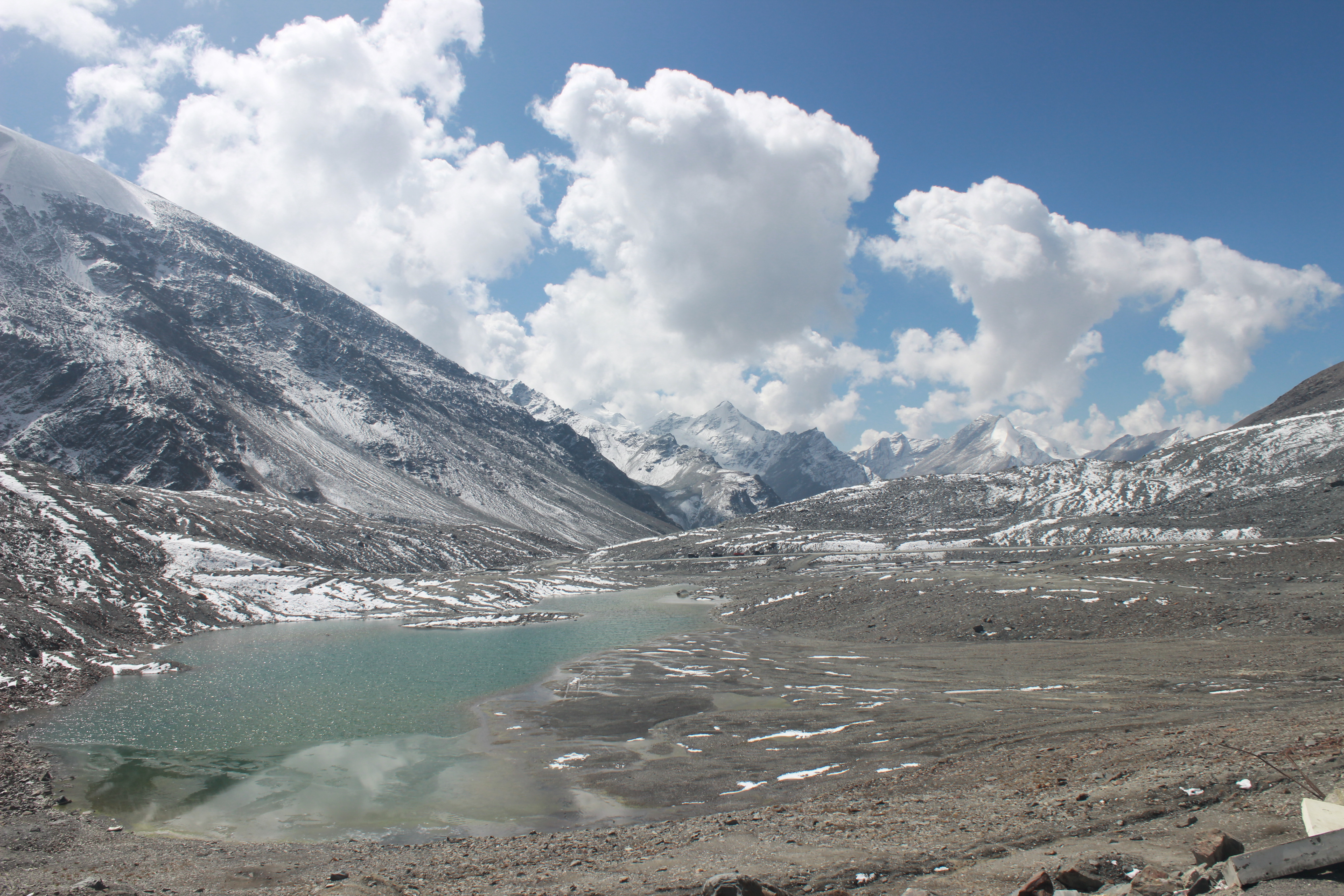 Enchanting landscape of Ladakh
I developed a mild fever the next morning. It began to worsen through the day, and crossing Khardung La - the holy grail of adventure motorcycling in India - became a workout as I battled fatigue.
By then, I was thinking less about where the road was taking me and more about what it had already given me. The journey had brought fear, pain, exhaustion and uncertainty, but also moments of wonder and gratitude. It had reminded me that fitness and preparation matter, that limitations must be respected, and that courage is not the absence of caution.
For Sudha and me, the ride was less about conquering roads than sharing them. Growing older need not mean becoming smaller in our ambitions. At 60, you know there are only so many bends left - and that is reason enough to see as many as possible.
The freedom to pursue adventure, I realised, was a greater flex than a fat bank balance or a flashy sports car in the garage.
This was my ninth ride through India’s far north, but Ladakh is calling again. Perhaps that is its greatest seduction: it makes you want to return, not merely to the mountains, but to the person you discover yourself to be on the road.
The author is a journalist and travel enthusiast






_(1).jpg "Visitors gather at the Santosh Mitra Square Durga Puja pandal, themed on the 150th anniversary of Vande Mataram and its historic role in India's freedom movement, ahead of the festival, in Kolkata")

.jpg "Gujarat’s women entrepreneurs bring their craftsmanship to life during Navratri")







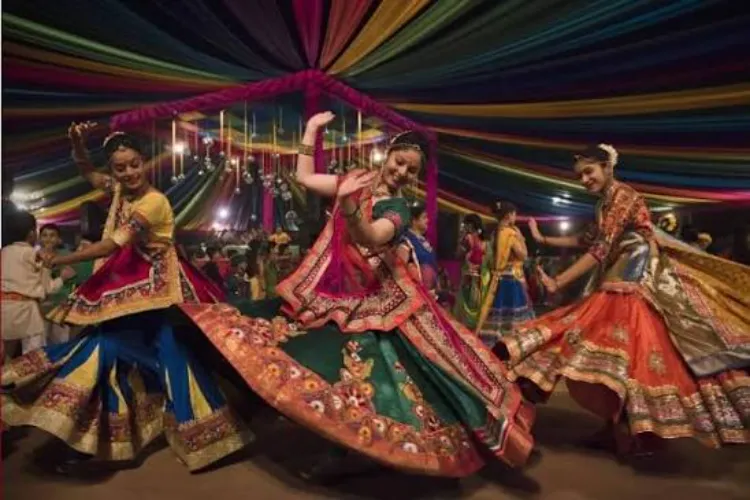
.jpg "Representational image")
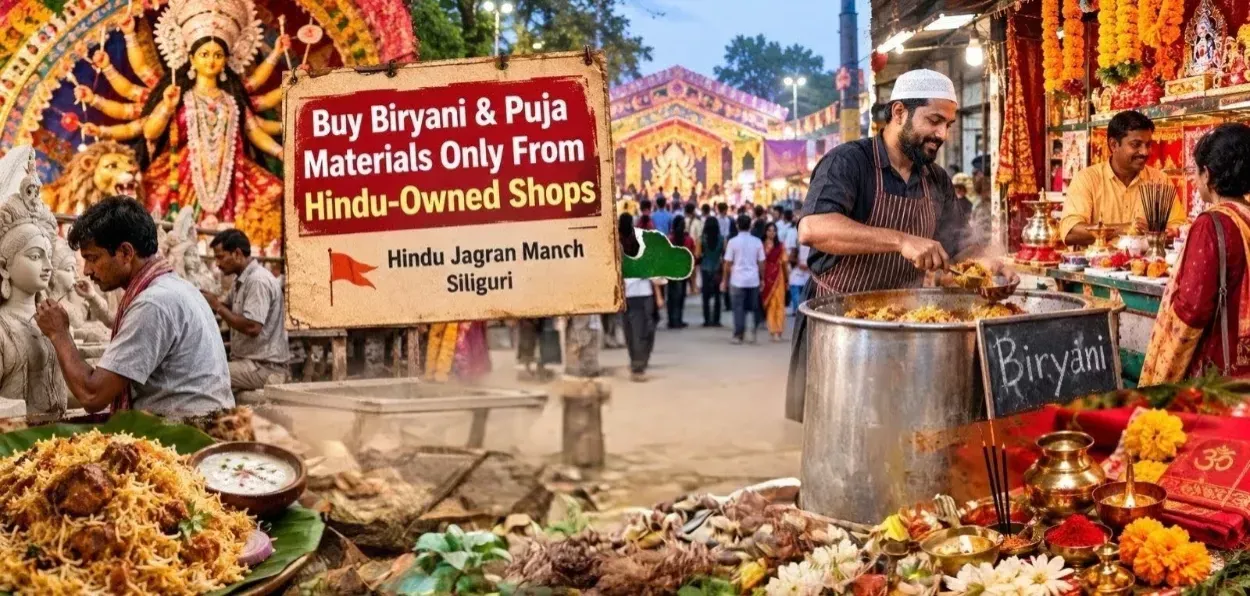
.webp)