




Jaipur
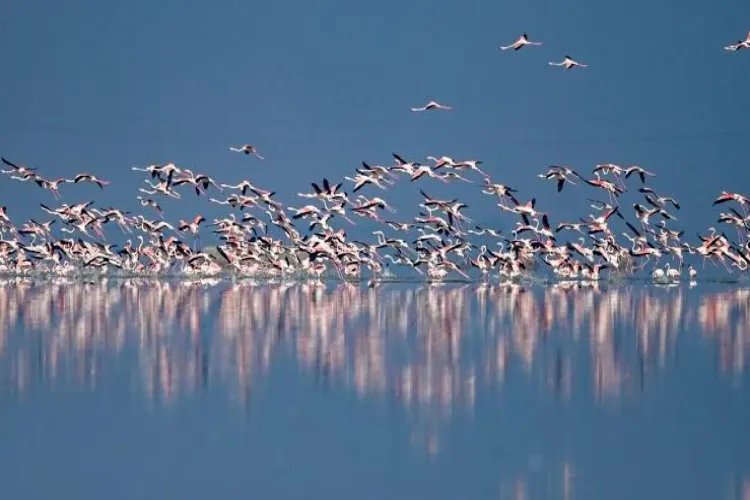
A large number of flamingo nests found in the drying bed of Rajasthan's Sambhar Lake have raised hopes that the wetland may have emerged as a successful breeding ground for the migratory birds outside Gujarat's Rann of Kutch.
A wildlife conservationist has claimed to have documented evidence of hatching of chicks for the first time at the site.
Wildlife photographer and conservationist Gaurav Dadhich said he documented successful breeding at the lake in August, when more than 4,000 mud nests were found in an area that usually remains submerged.
“The discovery is significant as the Rann of Kutch in Gujarat has long been recognised as the principal breeding ground for flamingos in India while the Sambhar Lake has largely been regarded as a feeding and resting habitat,” he said.
Sambhar is one of the country's most important inland saltwater wetlands.
However, flamingo breeding at Sambhar is yet to be formally established through scientific documentation.
According to Dadhich, the nesting colony included approximately 3,000 to 3,500 nests of Lesser Flamingos and around 500 nests of Greater Flamingos.
Dadhich said he observed evidence of successful breeding involving more than 230 flamingos, including chicks, and had recorded the development for a documentary.
“Flamingos have been observed nesting at Sambhar for years, but successful breeding had never been conclusively established. In August, I documented successful nesting and breeding here,” Dadhich said, adding that he is preparing a detailed account of his observations.
The development comes amid a sharp change in the lake's water levels following comparatively low rainfall this year.
Last year's heavy rainfall had filled large stretches of Sambhar Lake, attracting substantial numbers of migratory flamingos. This year, declining water levels have exposed large areas of the lakebed, revealing thousands of cone-shaped mud structures in its interior.
Dadhich said the nests were built in an area rarely accessed by people, and the presence of eggshells on several structures indicated that eggs had been laid there.
Flamingos select nesting sites carefully, taking into account soil conditions, water retention and the availability of food for their chicks.
Dadhich said the observation suggested that Sambhar offered suitable conditions for flamingos to reproduce, rather than merely serving as a seasonal feeding ground.
Forest officer Rahul Jhanjhadia said deficient rainfall led to a considerable decline in the lake’s water levels and the arrival of migratory birds is currently lower than usual.
He said the forest department has begun preparations for the migratory bird season, including measures to prevent a recurrence of botulism outbreaks that affected birds at the lake in previous years.
A stakeholder meeting was held in Sambhar on October 8, which was attended by representatives of the municipality, Sambhar Salts that operates the lake, the electricity department and the animal husbandry department.
An awareness workshop was also organised as part of the preparations.
Jhanjhadia said instructions have been issued to conduct a monthly bird census from October to February to identify and monitor migratory species arriving at the lake.
READ MORE:Mirwaiz Farooq leads first common Friday sermon in J&K
The forest department will also increase surveillance during the migration season and ensure that birdwatching and tourism activities do not disturb the birds or damage their habitat, he said.

_(1).jpg "Visitors gather at the Santosh Mitra Square Durga Puja pandal, themed on the 150th anniversary of Vande Mataram and its historic role in India's freedom movement, ahead of the festival, in Kolkata")

.jpg "Gujarat’s women entrepreneurs bring their craftsmanship to life during Navratri")








.jpg "Representational image")





_(2).webp)
.webp)