 Rajeev Narayan
India has secured an IMF upgrade just as the world seems determined to make economic life harder: tariffs, energy shocks and geopolitical traps abound. It is welcome news. But the climb is far from over. Sustaining growth will require more jobs, stronger manufacturing, higher productivity and prosperity that reaches crores of Indians.
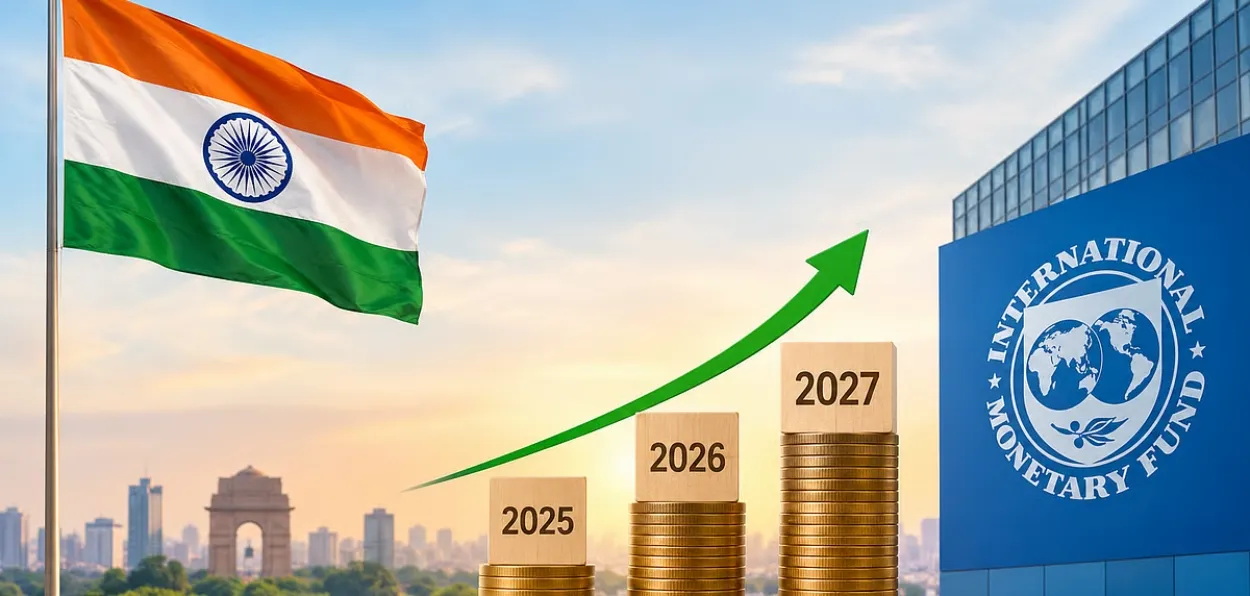
Seven per cent growth is not a number to shrug off. The International Monetary Fund (IMF) has raised its forecast for India’s growth in 2026-27 to 7 per cent, from 6.4 per cent earlier. In a world of uneasy markets and uncertain trade, this is a welcome vote of confidence in the economy’s momentum.
The upgrade reflects resilient demand and strong services activity. India has advantages that many economies would envy—a large home market, entrepreneurial energy, expanding infrastructure and a services sector with global reach. But a forecast is not a trophy, and one good year does not guarantee the next.
In the past, the IMF has flagged room for improvement in the quality, availability, and timeliness of India’s economic statistics. That is not the same as declaring the growth story unreliable. Its recent assessment of the revised GDP methodology is encouraging. Reliable data matter because investors, policymakers and citizens need to know not just how fast the economy is growing, but what is driving that growth.
The message is: take the compliment, keep the receipts and get back to work.
The World Outside
The world is not making the job easier. Trade is increasingly used as a weapon, energy has become a geopolitical bargaining chip, and the rules appear to change depending on who is writing them. Take US President Donald Trump, who has threatened or imposed punitive measures on countries buying Russian oil, with India among those caught in Washington’s crosshairs.
Yet, the United States itself has continued to rely on Russian-origin nuclear fuel and other energy links, while exemptions and strategic arrangements complicate its own sanctions posture. Japan, too, has maintained energy arrangements with Russia. The details differ, but the larger question remains: how persuasive is a universal lecture when the exceptions are shaped by national convenience?
This does not mean India’s choices carry no consequences, or that every country’s energy purchases are identical. It is, however, a reminder that moral certainty in global politics often comes with fine print. For India, the concern is less the theatre of tariff announcements than the economic exposure beneath it.
India imports most of the crude oil it consumes. A price spike can swell the import bill, pressure the rupee, complicate inflation management and squeeze household budgets. Trade disruptions can hurt exporters just as they are trying to win new markets. India cannot control Washington’s next move or the next conflict. It can, however, make itself less vulnerable by diversifying energy supplies, expanding domestic capacity, deepening trade links and helping local firms compete on quality, cost and reliability.
Jobs, Not Numbers
The true test of growth is not a forecast printed in Washington. It is whether a young Indian can find productive work, a small business can expand, and a family can see its living standards improve. India needs employment on a scale that matches both its population and its ambitions.
Services have been a powerful engine, but manufacturing must create a larger share of jobs and exports. Small firms need access to credit, dependable infrastructure and rules that do not turn expansion into an endurance test. Skills training must connect more closely with actual jobs. As artificial intelligence reshapes work, the goal should be to equip people to use new tools, not merely applaud the technology while leaving workers to adjust on their own.
Growth also depends on less glamorous foundations: reliable power, efficient ports and railways, good schools, accessible healthcare and faster dispute resolution. These are not add-ons to economic policy. They raise productivity, attract investment and allow more people to participate in the economy.
The Next Ascent
Prime Minister Narendra Modi has acknowledged that India’s march towards its ambitions is fraught with challenges. That matters because economic transformation is not one dramatic reform followed by a victory lap. It is a long sequence of decisions, implementation and course correction.
Private investment needs predictability. Regulation should be efficient without weakening accountability. And courts and dispute mechanisms must move faster, while public spending must support infrastructure and human development, keeping debt and borrowing costs manageable. Above all, reform needs to be judged by what changes on the ground, not by the announcement that launched them.
Some obstacles will yield to policy; others will demand years of persistence. India needs to improve not just the ease of doing business, but also the ease of getting a good job, learning a useful skill and building a viable enterprise. These are connected goals, not competing slogans.
Strengthen the Roots
The ambition to become a developed economy is within the realm of possibility, but it is not guaranteed by being the fastest-growing major economy. Sustained growth must translate into higher productivity, better jobs, rising incomes and opportunities that reach beyond successful sectors and cities. The outside world will remain volatile. Protectionism, energy shocks, rivalries and technological disruption are unlikely to disappear on schedule. India’s answer cannot be to wait for calm weather. It must strengthen the foundations that help it withstand storms.
The IMF’s upgrade is welcome because it recognises real momentum. The challenge now is to make that momentum durable: invest in people, make businesses more competitive, improve public institutions and measure progress honestly.
Nobody has ever reached the summit of Mount Everest by celebrating the view from its base camp. The climb demands preparation, stamina and the willingness to tackle one difficult stretch after another. India has reason to feel encouraged. It also has a long way to go.
The next ascent begins now.
The writer is a veteran journalist and communications specialist







.jpg "Gujarat’s women entrepreneurs bring their craftsmanship to life during Navratri")










_(2).webp)
.webp)