




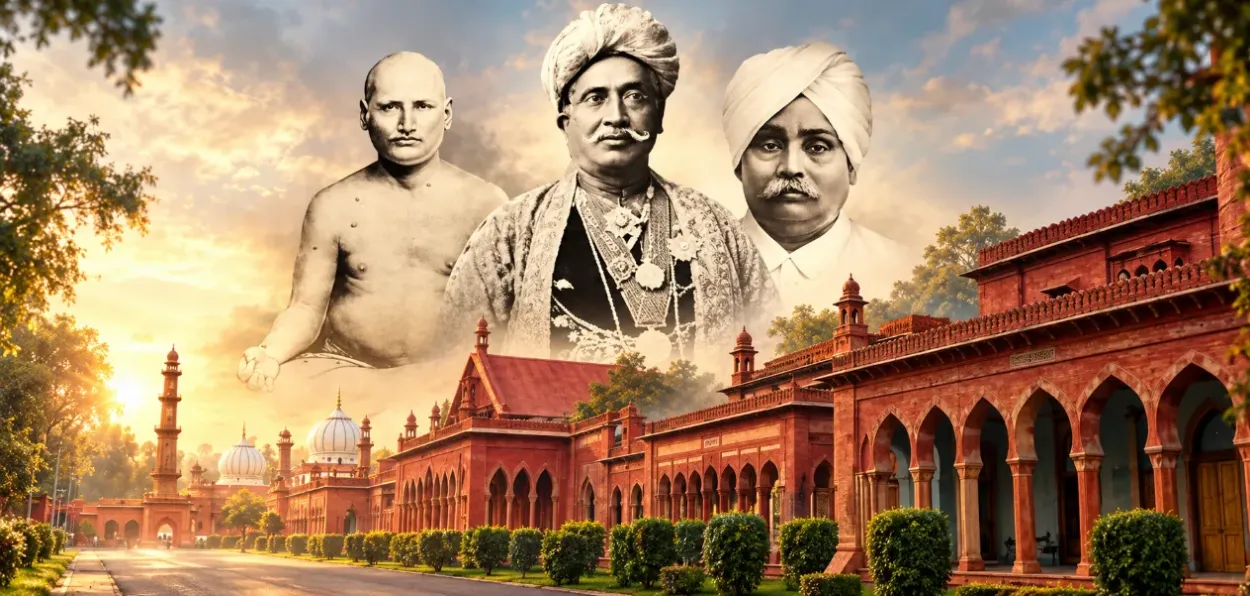
Sir Syed Ahmad Khan’s years in Banaras were an important phase in his intellectual journey and social reform efforts. He arrived at Banaras from Aligarh on 6 August 1867 to serve as a judge of the Court of Small Causes. In his later postings, he held different positions, including Sadr-us-Sudur, and spent seven years and six months in the ancient city.
Sir Syed regarded Banaras as educationally much more advanced than many other cities. Later, when he founded the Scientific Society, a majority of its members were from Banaras. They included Hindus, Muslims and Englishmen. During the later years of his service, he became actively involved in charitable and welfare initiatives and forged close relationships with the locals. It was also in Banaras that he laid the foundations for the movement to establish the Muhammadan Anglo-Oriental (MAO) College in Aligarh.
He established a homoeopathic hospital, delivered lectures on education at the Banaras Institute and played a key role in founding the Prince of Wales Hospital in the city.
Several prominent non-Muslim personalities of Banaras supported Sir Syed's intellectual, educational and welfare initiatives. Their contributions reflected the cooperation across religious and social boundaries that helped advance his vision of modern education and social progress.
Here are ten key non-Muslim personalities who were close to Sir Syed Ahmed and influenced his decisions:
Maharaja Ishri Prasad Narayan Singh
Maharaja Ishri Prasad Narayan Singh shared a close relationship with Sir Syed. He was among the earliest members of the Scientific Society, joining it on 9 January 1864. The Maharaja took an active interest, alongside Sir Syed and J. B. Ironside, in establishing a homoeopathic dispensary in Banaras. When the movement to establish the Muhammadan Anglo-Oriental College began, he donated Rs 2,000 towards the institution. Following his death, Sir Syed published a condolence note in the Aligarh Institute Gazette.
Swami Dayanand Saraswati
Swami Dayanand Saraswati, founder of the Arya Samaj, was a distinguished Vedic scholar and religious and social reformer. A proponent of monotheism, he opposed idol worship, a position that frequently brought him into debates with traditional Hindus.
He first met Sir Syed in Banaras, where the latter acted as a mediator between the Maharaja of Banaras and Swami Dayanand. In December 1873, when Swami Dayanand visited Aligarh and stayed at the residence of Raja Jai Kishan Das, Sir Syed went to meet him. They discussed scientific and religious approaches to purifying the air, including the practice of havan. Out of respect for Swami Dayanand, Sir Syed sat on the ground and remarked that he felt honoured to sit in the company of a saint.
In the Aligarh Institute Gazette, Sir Syed openly praised Swami Dayanand's belief in monotheism, reformist spirit and commitment to speaking the truth. He also published reports on Swami Dayanand's lectures delivered in different parts of the country. In 1877, during the tenure of Viceroy Lord Lytton, Swami Dayanand organised what was described as the first All-Religions United Conference. Sir Syed participated in the conference alongside Babu Keshab Chandra Sen and Harish Chandra.

Following Swami Dayanand's death in Ajmer on 30 October 1883, Sir Syed published a condolence article in the Aligarh Institute Gazette titled The Death of Swami Dayanand Saraswati. In it, he paid tribute to the reformer's intellectual contributions and social reform work.
Alexander Shakespeare
Alexander Shakespeare, Commissioner of Banaras Municipality, and Sir Syed developed a deep friendship during the latter’s posting in Bijnor. At Shakespeare's suggestion, Sir Syed wrote a history of Bijnor. On Shakespeare’s recommendation, the government granted Sir Syed a monthly political pension of Rs 200.
When Syed Mahmood returned from England in 1871, Sir Syed organised a reception for him in Banaras, presided over by Shakespeare. Later, when efforts were under way to establish the Madrasatul Uloom in Aligarh, Shakespeare donated Rs 100 towards the construction of its buildings.
Dr E. J. Lazarus
J. B. Ironside, Judge of Banaras
J. B. Ironside served as a judge and sessions judge in Banaras. In 1867, when Sir Syed launched an initiative to establish a homoeopathic hospital in the city, the Maharaja of Banaras was appointed its president and Ironside its co-president. At the hospital's inauguration, Ironside delivered a lecture on homoeopathic treatment. The lecture was subsequently published in an English journal and the Aligarh Institute Gazette.
Ironside also provided financial assistance to the Scientific Society and contributed towards the construction of the MAO College building.
Raja Deo Narayan Singh
Raja Deo Narayan Singh belonged to a Bhumihar Brahmin family and was awarded the title of 'Sir' in 1866. He served as president of the Banaras Institute and was among the early members of the Scientific Society. When Sir Syed established an English-medium school in Ghazipur, known as the Victoria School, he invited Raja Deo Narayan Singh to lay its foundation stone. After the Raja's death, his son, Raja Shambhu Narayan Singh, donated Rs 1,500 towards the construction of a permanent boarding house at the MAO College in his father's memory.
Raja Shambhu Narayan Singh
Raja Shambhu Narayan Singh, son of Raja Deo Narayan Singh, developed close relations with Sir Syed during the latter's service in Banaras. At Sir Syed's farewell ceremony on 13 July 1872, Raja Shambhu Narayan Singh read the farewell address in English.
He later attended the foundation-laying ceremony of the MAO College in Aligarh on 8 January 1877 and made a substantial financial contribution towards a boarding house established in memory of his father. He was also a member of the United Indian Patriotic Association, founded by Sir Syed.
Raja Shiv Prasad
Raja Shiv Prasad, popularly known as Raja Shiv Prasad 'Sitara-e-Hind', was an important figure in the Hindi movement and was associated with the education department. In 1872, he offered to donate Rs 1,000 towards the proposed college on the condition that it be established in Allahabad. Sir Syed did not accept the condition. As the project progressed, however, Raja Shiv Prasad donated the amount to the college. Following his death, Sir Syed published a condolence note in the Aligarh Institute Gazette.
Babu Fateh Narayan Singh
Babu Fateh Narayan Singh was a prominent landowner of Banaras and a relative of the Maharaja of Banaras. He played an important role in promoting the activities of the Banaras Institute, serving as its vice-president for a long period before becoming its president.
One of Sir Syed's close associates in Banaras, Babu Fateh Narayan Singh hosted Sir Syed's first lecture, titled The Progress and Education of the People of India, at his residence.
Bharatendu Harish Chandra
Bharatendu Harish Chandra, a pioneer of modern Hindi prose and drama, was regarded as one of Sir Syed's opponents on the question of Urdu. Despite their differences, however, the two maintained intellectual connections. Harish Chandra was a member of the Scientific Society. Sir Syed praised Harish Chandra's school and published his articles in the Aligarh Institute Gazette. A letter written by Harish Chandra concerning the inclusion of Sanskrit in the curriculum of the Madrasatul Uloom is preserved in the Sir Syed Academy.
Dr William Roy Hooper
Dr William Roy Hooper served as the civil surgeon of Banaras and was associated with the city's medical services. When the Banaras Municipal Committee was established in 1867, he became one of its members and played an important role in improving public health.
In 1876, construction of the Prince of Wales Hospital began under his supervision. The project received financial assistance from the Maharaja of Banaras and Sir Syed Ahmad Khan. At the hospital's inauguration in 1881, Sir Syed specifically acknowledged Dr Hooper's services and enthusiasm.
Walter Smith
Walter Smith was a merchant in Banaras and a close associate of Sir Syed. He joined the Scientific Society in January 1868, contributing cash as well as valuable glass instruments to the organisation. He also served on the committee of the homoeopathic hospital. On 1 April 1867, Smith saw Sir Syed off at the Banaras railway station as he set out on his journey to London. He also presented a gold watch to Syed Mahmood. Smith subsequently donated towards the construction of the college.
Maharaja Bahadur of Vizianagram
The Maharaja of Vizianagram was the ruler of the princely state of Vizianagram, in present-day Andhra Pradesh. He was a generous supporter of educational and welfare initiatives across India. His philanthropy extended to Aligarh, where he instituted a permanent annual scholarship at the Madrasatul Uloom for meritorious students. Following his death, Sir Syed expressed deep sorrow and offered his condolences in the Aligarh Institute Gazette.
Rai Narain Das
Rai Narain Das was one of the wealthiest bankers in Banaras and was involved in banking and moneylending. He joined the Scientific Society in August 1867 and contributed to welfare initiatives, including the homoeopathic hospital. Following his death on 18 December 1879, Sir Syed expressed his grief in the Aligarh Institute Gazette, paying tribute to his respectability and social standing.
Bapu Deva Shastri
Bapu Deva Shastri, a native of Maharashtra, was a distinguished scholar of Sanskrit and astronomy. He was appointed a teacher of mathematics and astronomy at the Sanskrit College in Banaras.
ALSO READ: APJ Abdul Kalam's identity is beyond religious labels
He attended meetings of the Banaras Institute, where he met Sir Syed. Sir Syed recognised his scholarly abilities and gave considerable prominence to his writings in the Aligarh Institute Gazette.
Dr Asad Faisal Farooqui is Assistant Professor of Mass Communication at Mangalayatan University, Aligarh.


.jpg "Gujarat’s women entrepreneurs bring their craftsmanship to life during Navratri")









_(2).webp)
.webp)