Bhakti Chalak/Pune
On a dark night in a deserted, zero-network area of Bopdev Ghat in Maharashtra, a gang-rape was reported. The case shook the nation, and all attention turned to its investigation. It was a blind case, with the criminal having left no clues whatsoever.
Rajas Shaikh, Assistant Sub-Inspector of Pune City Police, was given the responsibility of finding the rapist.
The location had no mobile network and no CCTV cameras. The culprit had switched his and the victim’s phones to flight mode. Not a single clue was left for the police to begin the investigation.
Rajas Shaikh worked day and night, checking CCTV footage. In a blurred image, he spotted the logo of a hotel on the suspect’s T-shirt. Beginning with this small clue, he immediately located the hotel and interrogated its owner.
The owner recognised his employee, and the police took the culprit into custody. He confessed and also revealed the names of his two accomplices.
Recalling the successful investigation, Rajas Shaikh says, "When this investigation was completed, a very senior IPS-rank officer hugged me tightly and congratulated me. Senior officers usually don't hug anyone, but that day I got the satisfaction that my work was truly valued."
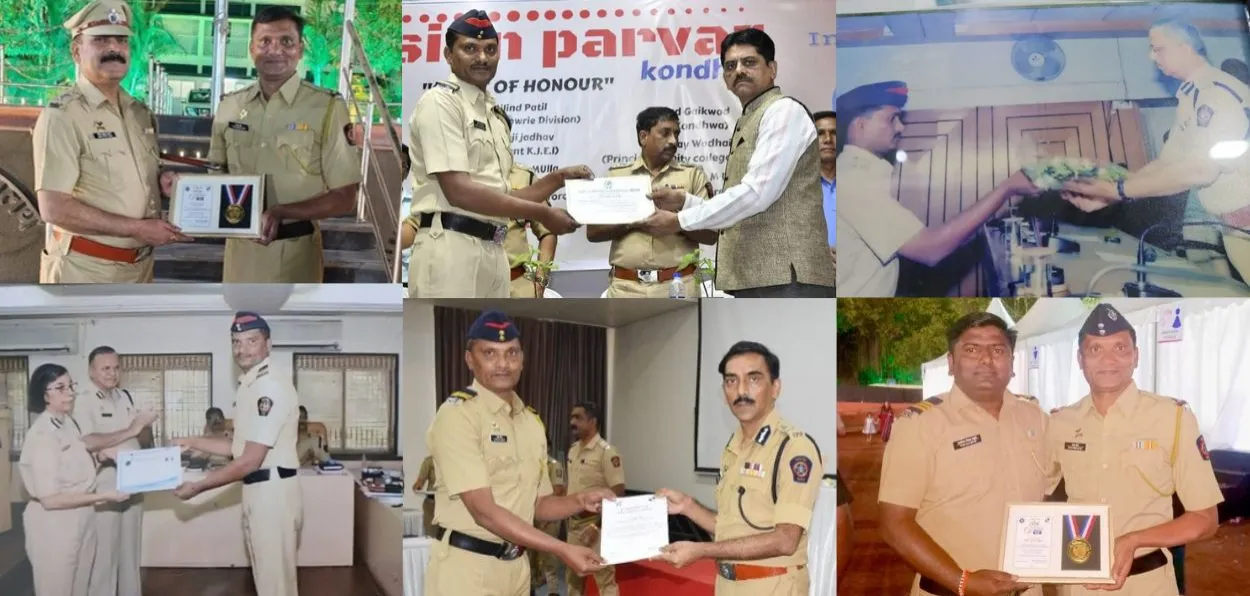
This complex case is among several such investigations that Rajas Shaikh has conducted during his 32 years of service. In recognition of his services, the Union Home Ministry recently honoured him with the ‘Ati Utkrisht Seva Padak’ (Medal for Most Excellent Service).
Speaking to ‘Awaz-The-Voice’, Rajas Shaikh said, "The other day a friend called and gave me the news of receiving the Government of India's Ati Utkrisht Seva Padak. For two minutes, my heart was heavy and tears welled up in my eyes. The hard work and service I have put in all these years had finally borne fruit."
Rajas Shaikh joined the Pune City Police Force in 1995. A tremendous craze for the khaki uniform and a strong desire to do something impactful for society and the country while being in uniform drew him towards the police.
After completing his graduation, he received a call from the Employment Exchange and decided to go for police recruitment. He was selected in his very first attempt.
Rajas is an athlete. He is a national-level volleyball player and has participated in long jump, high jump and triple jump.
His sports background came in handy in clearing the police entrance tests.
Initially, he worked as a helper in the storeroom and the reserve armoury section at Police Headquarters. He maintained records and handled the supply of weapons, ammunition and police uniforms for Pune city.
In 2002, he was transferred to the Traffic Branch. He was given responsibility for handling the then recently introduced prepaid auto-rickshaw service.
He also handled administrative work at the DCP office.
It was during Rajas Shaikh’s tenure at Wanowrie Police Station that his career in crime detection began. He says he was lucky to have good superiors as mentors who helped him in his journey as an ace investigator.
While at Wanowrie Police Station, he nabbed culprits in various crimes, including murder, burglary and kidnapping.
The most famous and challenging case among these was the triple murder committed by a man named Masalkar. He had brutally murdered his own mother, wife and little daughter. The media’s entire focus was on this case.
Everyone thought this man could not possibly be the culprit. But Rajas Shaikh’s sharp eyes caught his suspicious demeanour.
Speaking about this case, Rajas Shaikh said, "Initially, my seniors said why was I interrogating a man who has just lost his mother, wife, and baby?'
But I had a strong suspicion inside. We interrogated him and it was revealed that he had hatched this conspiracy to marry his girlfriend, and the court later convicted him of crimes of murdering the three."
During his posting at Kondhwa Police Station, he was assigned a case involving the disappearance of a poor man’s child. According to the father’s statement, some individuals had stolen his baby. The notion that the police only work for rich people was proven wrong by Rajas Shaikh and his team.
Searching day and night, they tracked down the little baby in just two days. The baby had been taken to beg at the large fair of Mhaskoba in Veer village of Pune district. The police went there, safely took custody of the baby and handed it over to the mother.
Speaking about that moment, Rajas says, "The way that mother held her baby and started crying, it was the most satisfying moment of my life. That satisfaction was far greater than the one after solving other cases."
In December 2017, he started investigating two cases involving the theft of ATM machines from the same location.
His team tracked CCTV footage for nine days, from Pune to Kirloskarwadi in Sangli district. On the ninth day, they traced one suspect and arrested him in Osmanabad. After interrogation, they apprehended the other members of the gang from Belagavi on the Karnataka-Maharashtra border.
The gang had built a trolley, pulley and slider. They would extract the ATM machine with the pulley and slide it directly into the vehicle. The gang’s exposure led to the solving of 19 crimes in Satara, Sangli, Kolhapur and Osmanabad.
Later, after being transferred to the Crime Branch, while working in the Anti-Narcotics Cell, he busted MD drug and marijuana smugglers, exposing their massive network. He also put culprits involved in Nigerian frauds and ATM cloning behind bars.
Rajas Shaikh’s native village is Bhiwadi in Purandar taluka, famous for its rebellion against the British. Rajas Shaikh says, "There is a different kind of attitude in the soil of my Bhiwadi. Carrying that same attitude, I have fearlessly worked in the police department to date."
Because of this very working style, retired senior officers used to affectionately call him ‘The Amitabh Bachchan of the Poor’. Not tolerating injustice oneself and not letting injustice happen to anyone else is a principle he has followed throughout his service, and he says he will continue to follow it throughout his life.
He has a set working style when inspecting a crime scene. He says, "If one goes to the crime scene and observes closely, a clue is 100% guaranteed to be found. If you grab onto that one thread and work, success is definitely achieved; this is my experience."
Rajas Shaikh’s family was extremely poor. There were six brothers and sisters in the family. His parents worked as farm labourers but educated all their children. Today, all five of his brothers and sisters are graduates.
"My mother was illiterate, but she used to sit us down to study holding a stick. She used to say there is no salvation without education. The concept of parent-teacher meetings has come up now, but back then, whenever my mother came to the Saswad market every Monday, she would visit our school and ask the teachers about our progress."
Rajas Shaikh lives in a joint family with his siblings. His wife, Najma, is a graduate of Wadia College. His elder daughter has done her B.Tech from MIT, while the younger daughter is in the 12th standard and she too wishes to become a police officer.
Rajas Shaikh has received more than 280 awards, including the Director General of Police’s ‘Quality Service Medal’ and two certificates of honour from the Chief Minister of Maharashtra.
He has also received the ‘Excellent Service Medal’ given for 15 to 25 years of unblemished service, and the Central Government’s ‘Most Excellent Service Medal’ given for service above 25 years.
On his work style, he says, “If people's work is done according to the rules and with a smiling face, there is no stress at all. Everyone should always enjoy their work."
Since police working hours are not fixed, their lifestyle can be stressful. But while balancing his job and health, Rajas takes care of his mental and physical well-being by eating only home-cooked food every day. He exercises, practises pranayama and meditates for 40–45 minutes every morning.
ALSO READ: After NASA recognition, Aarian Zeeshan Ahmed sets eyes on sun
Giving valuable advice to the younger generation, Rajas concludes, "Set a goal and consistently keep trying towards it. Consistency and wholehearted efforts will definitely lead you to your goal."

.webp "Representational Image")