 Manjit Thakur
In Bengal, Durga Puja is not just a religious occasion; It’s a major festival of arts, crafts, food, drink, employment and social life. Potters start making idols months in advance; artists get busy decorating the pandals; artisans make ornaments for idols and small shopkeepers invest their capital in the hope of reaping a good harvest in the festival season.
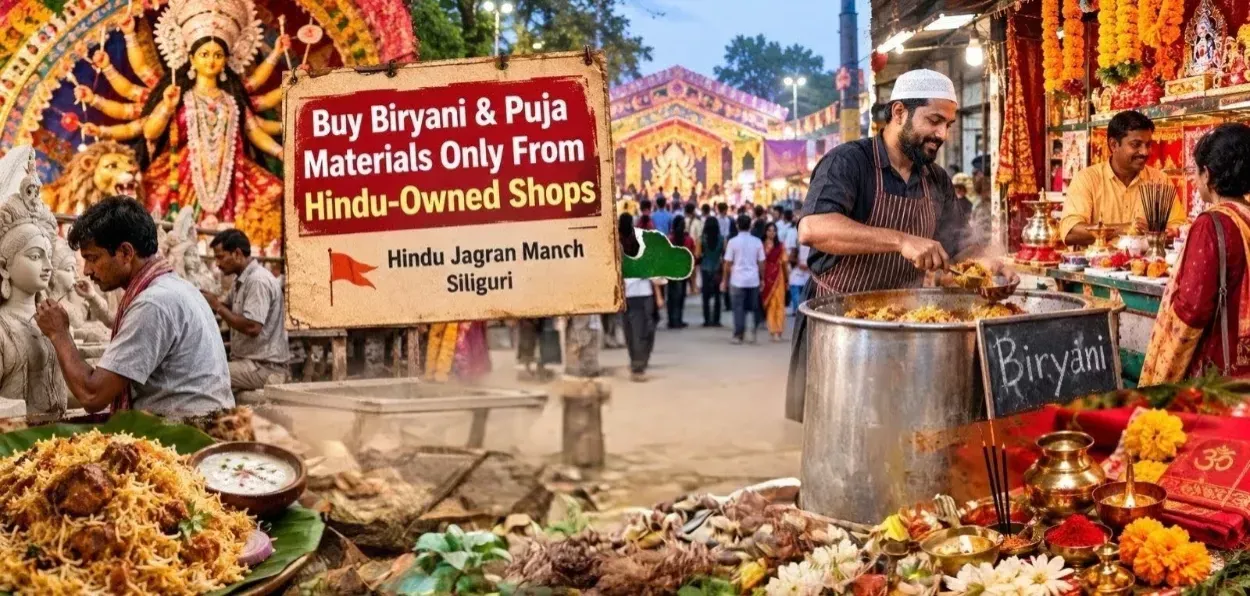
However, a news report from Siliguri, West Bengal, says that Hindu Jagran Manch posters have appeared in the hill town appealing to people (Read Hindus) celebrating Durga Puja to buy biryani and puja items from Hindu shops. It's an implied message to ensure Hindus don't buy stuff from Muslims. This raises questions about the role of religion in the marketplace. Should religion replace quality, price and trust in business? This manufactured conflict is also linked to the livelihoods of small traders, communal harmony and the shared cultural heritage.
Those behind the campaign say it was meant to support Hindu traders and not an 'order'. On the other hand, those objecting ti to it feared that it could divide the market along religious lines.
This controversy raises questions about financial behaviour in which religious identity replaces the trust between the customer and the shopkeeper, the balance of price, quality and service.
Every citizen has the right to buy goods from the shopkeeper of his choice. There is nothing wrong if someone wants to support a particular business, local products or small businesses. Efforts to promote economic cooperation within religious communities can also be a legitimate topic of discussion in a democratic society. But when the appeal is about asking buyers to choose shopkeepers’ religion over quality, its social meaning changes.
Such an appeal can also make the purchase a test of religious loyalty.
If such a message is repeated over and over again, traders belonging to other religions may fear losing customers. Customers may also be forced to think that buying goods from a particular shop will be made a question of loyalty to their own community.
At present, the evidence of how many traders have suffered real economic losses due to this campaign in Siliguri is not available. Therefore, it would not be appropriate to present the losses as a proven fact. However, the fear of economic boycott and the social pressure created in the market are serious questions in themselves.
The economy of festivals does not belong to any one community.
'Buy biryani from Hindu shops' poster campaign sparks row in Bengal's Siliguri ahead of Durga Puja. The posters were put up across the city by Hindu Jagaran Manch, an affiliate of the RSS. The organisation stated that messages like "Eat biryani at a Hindu shop" and "Buy puja articles from Hindu shops" are not a diktat.
— News Arena India (@NewsArenaIndia) October 13, 2026
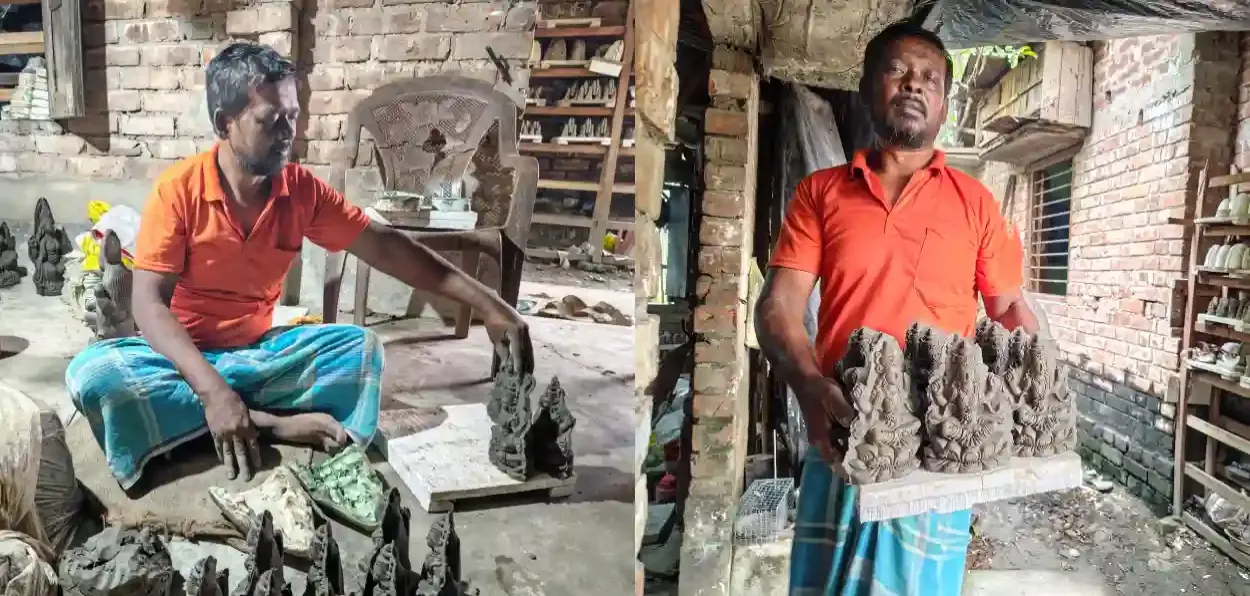
To understand the economy of Durga Puja, one must look beyond the lights in front of the pandal. It includes idol makers, bamboo and cloth traders, electricians, carpenters, painters, florists, tailors, food vendors, transport workers, and countless small businessmen.
They employ people from different religions and social backgrounds. Reports also mention that Muslims are among the artisans who make Durga Puja decorations and ornaments for the sholapith. This partnership is not an unusual social experiment. The economy of festivals in India has historically been based on this mutual cooperation of labour. The puja may be a matter of devotion for some, but the labour that goes into organising it is the source of livelihood for many.
So, the question is not why a Hindu businessman should get business. The question is: is the only way to help him by creating a chasm between him and a Muslim shopkeeper? Is it necessary to bring out religious identity to strengthen local businesses? Aren't there other avenues to help small shopkeepers, such as better markets, adequate credit, training, digital payments, and customer outreach?
If the goal is to strengthen the local economy, efforts should be based on the needs and economic circumstances of traders, rather than their religious identity.
The mention of biryani in this controversy has symbolic significance. Food is not just a means of satisfying hunger, but it is also a part of memories, tastes, culture and social interaction. Bengali food culture has been a part of different traditions and communities. Describing a dish as the permanent property of a single religion would be tantamount to limiting this cultural history.
It may be the customer's right to know whether the person making the biryani is Hindu or Muslim, but making it a mandatory condition for purchase is a completely different matter. Similarly, the religious identity of a shopkeeper selling puja items should be more important than whether he is providing quality goods at a reasonable price.
A basic principle of the market is that the customer makes a decision with his own understanding. When community pressure begins to dominate this decision, the market becomes not just a place for buying and selling goods but an arena for identity politics.
The Constitution of India protects the rights to religious freedom and equality. Article 15 prohibits the state from discriminating on certain grounds, including religion, while Article 19(1)(g) grants citizens the right to choose, practice and carry on business.
The scope of these provisions and their application to private individuals are separate questions. Therefore, it would not be right to declare every religious appeal unconstitutional. Nevertheless, the social significance of constitutional values is not limited to the interpretation of courts.
ALSO READ: APJ Abdul Kalam's identity is beyond religious labels
Equal citizenship means that a person’s livelihood and social respect should not be viewed with suspicion simply because of his religious identity. In a democracy, an organisation has the freedom to express its views. Similarly, citizens have the right to criticise this ideology. Restraint is also necessary while reacting to this controversy. It would be as wrong to associate the entire Hindu society with this campaign as it would be to view all traders of a religion in the same light.
The author is Editor, Audio-Visual, Awaz-the Voice

_(1).jpg "Visitors gather at the Santosh Mitra Square Durga Puja pandal, themed on the 150th anniversary of Vande Mataram and its historic role in India's freedom movement, ahead of the festival, in Kolkata")

.jpg "Gujarat’s women entrepreneurs bring their craftsmanship to life during Navratri")








.webp)