

 Rajeev Narayan
India has endured tariffs, visa restrictions and geopolitical pressure, but its market, manpower and industrial capabilities remain formidable. As Washington confronts a changed political landscape, New Delhi has an opportunity to pursue a fairer partnership that promotes growth and creates better opportunities for its citizens.
A good relationship is a partnership, never a one-way street. India and the United States have spent decades building ties founded on shared interests, democratic values and expanding economic cooperation. Yet recent months have reminded New Delhi that even close partners can have divergent priorities.
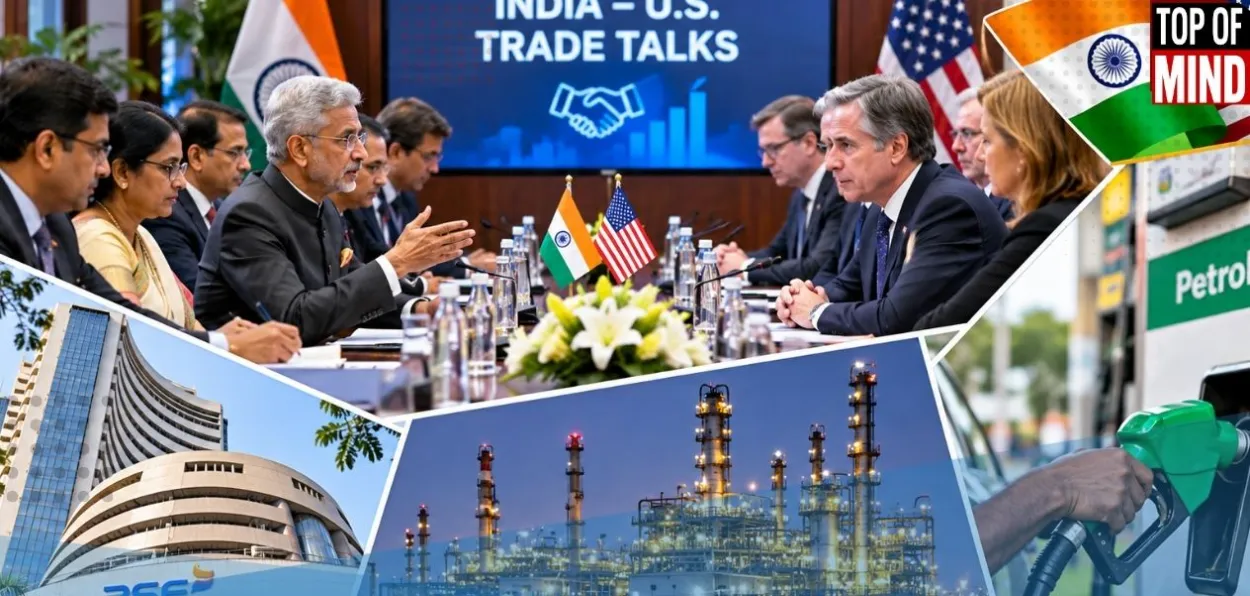
The trade deal first announced in February offered renewed momentum. Washington agreed to reduce its reciprocal tariff on Indian goods to 18 per cent, while India committed to opening its market further and increasing purchases of American energy and technology. But negotiations remain unfinished, with differences over market access and other issues.
For India, the question is not whether to engage America, but how to ensure that engagement delivers reciprocal benefits. A country of more than 1.4 billion people and a rapidly expanding consumer market need not negotiate as though it has little to offer. Economic cooperation must also respect legitimate national interests. The principle is simple: a durable partnership recognises the interests of both partners.
India is among the world’s largest oil importers, but it is also a major refining power. Reliance Industries’ Jamnagar complex is one of the world’s largest refining hubs, capable of processing various crude grades and serving international markets. That capability matters, especially amid volatile energy prices. US Secretary of State Marco Rubio’s recent visit to Mumbai and Jamnagar, including discussions with Indian officials and business leaders, underscored Washington’s interest in energy cooperation.
India’s refining expertise, infrastructure and access to diverse crude supplies, including Venezuelan grades, are strategic assets. They strengthen domestic energy security while making India an important partner in global supply chains. These should translate into practical gains: predictable energy trade, flexibility in sourcing oil and arrangements that respect India’s economic and energy requirements.
The same logic applies beyond petroleum. India’s engineering capabilities, pharmaceutical industry, manufacturing ambitions and skilled workforce offer substantial value to American businesses. The relationship should reflect that value, not reduce India to a market for US exports.
Indian Talent Is Needed
Few sectors illustrate mutual dependence more clearly than information technology. Indian companies help maintain the digital infrastructure on which US businesses depend. Indian professionals contribute to research, innovation and entrepreneurship, while US companies benefit from India’s talent pool. Yet tighter H-1B visa rules and costs have created uncertainty. Eligible registrations for the US financial year 2027 fell 38.5 per cent to 211,600, from 343,981 the previous year. Indian IT companies have responded by expanding overseas hiring and shifting more work to delivery centres in India and elsewhere.
PIYUSH GOYAL - "US trade deal will protect all sensitive Indian interests. Once details are out, the people of India will celebrate that not a single sensitive interest of our commerce or any stakeholder has been compromised" https://t.co/hb0VVx6fs3
— News Algebra (@NewsAlgebraIND) October 29, 2026
This resilience should not obscure the opportunity. Greater visa mobility benefits Indian professionals and American employers alike. India should seek a more predictable visa regime, alongside collaboration in advanced computing, semiconductors and artificial intelligence. Technology transfer and joint research should also be pursued wherever mutually beneficial.
The global expansion of data centres presents another opportunity. As artificial intelligence and cloud computing drive demand, countries are competing for investment. In the United States, concerns over electricity, water, land use and community costs have intensified debate on where these facilities should be built. India offers a large digital economy, skilled engineers, growing connectivity and growing demand for computing services. Global investment can create jobs, support innovation and strengthen domestic infrastructure.
But growth must be responsible. Data centres consume enormous quantities of electricity and water. New capacity must not come at the expense of communities, agriculture or environmental sustainability. India should attract investment that delivers lasting value through local employment, renewable energy, efficient cooling and technology partnerships, while serving Indian businesses and citizens as well as global clients.
The US midterm elections have altered Washington’s political landscape. Democrats have won control of both chambers of Congress, ending unified Republican control and creating a divided government. The implications for trade and foreign policy remain uncertain. President Donald Trump retains considerable authority, and a softer approach towards India cannot be assumed. However, the results may encourage greater scrutiny of abrupt policy shifts and create room for more measured economic relations.
The stock markets have responded positively. India’s stock indices have advanced, helped by falling crude prices and renewed foreign investor buying. The rally reflects how India’s prospects are closely tied to global stability, though it does not mean that uncertainty has disappeared altogether. But it does offer a timely reason for cautious optimism.
What India Deserves
India need not approach Washington with hostility or triumphalism. It should approach Washington with confidence. A fairer trade agreement, greater flexibility in energy sourcing, improved mobility for skilled professionals and deeper technology cooperation are reasonable objectives for a country that contributes substantially to the global economy. These are outcomes to pursue through negotiation and by demonstrating the value of a balanced partnership.
India’s rise also depends on engaging major powers without becoming dependent on any one of them, protecting strategic autonomy while expanding trade and converting its strengths into better lives for its people. For millions of Indians, growth must mean better jobs, higher incomes and stronger public services. The moment calls for neither bravado nor hesitation, but smart diplomacy, sound economic judgment and confidence in India’s capabilities.
ALSO READ: Five money-spending sprees Muslims can divert to community welfare
As the country celebrates Diwali, the festival of light offers an apt metaphor. India has weathered difficult years and considerable headwinds. The path ahead remains uncertain, but the country has reason to look forward—and to insist that its partnerships reflect the aspirations of its people.
The writer is a veteran journalist and communications specialist