

 Rajeev Narayan
From defence and advanced technology to trade and investment, India and Israel have built a strong partnership. But amid Israel’s political uncertainty and continuing regional tensions, India must balance strategic opportunity with its ties to the Arab world and the quest for Palestinian statehood.
A farmer battling a failing monsoon, a city running short of water, a business racing to outsmart cybercriminals and a defence planner preparing for tomorrow’s threats may appear to have little in common. Yet all four could have a stake in one of India’s most consequential global relationships—its growing ties with Israel. That partnership assumes added significance as Israel confronts an inconclusive election, leaving the political shape of its next government uncertain.
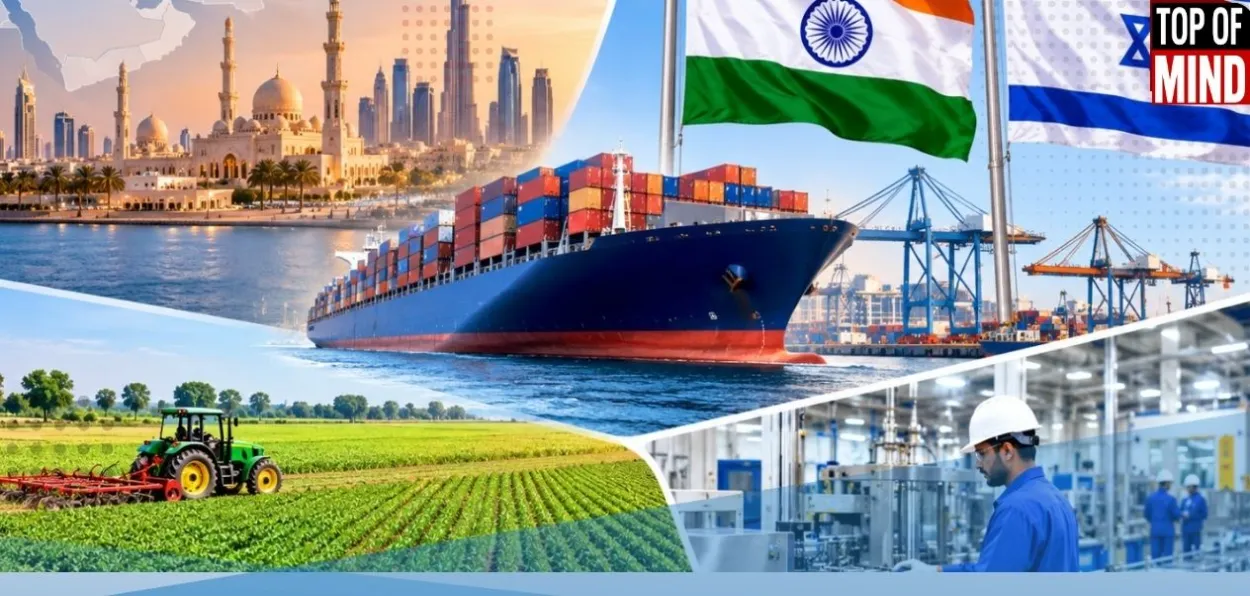
For decades, the relationship was viewed through the prism of defence and security. That remains an important pillar, but it no longer tells the whole story. Over the last three decades, India and Israel have expanded their engagement into agriculture, water management, cybersecurity, scientific research and advanced technology.
Prime Minister Narendra Modi’s February 2026 visit to Israel gave this relationship a fresh boost by elevating it to a Special Strategic Partnership for Peace, Innovation and Prosperity. They aim to move beyond buying technology to developing it together, adapting it to Indian needs and creating capabilities that can deliver economic and social dividends.
The opportunity, then, is not simply to acquire Israeli expertise. It is to turn that expertise into Indian capacity—better farming, more efficient use of resources, stronger technological capabilities and new avenues for enterprise. That is what could make this partnership matter beyond the corridors of power.
The Business of Friendship
Trade and investment will answer how far this relationship can expand beyond government agreements and diplomatic declarations. Bilateral trade reached US$3.93 billion in 2025-26. The two nations have also been negotiating a proposed free-trade agreement, with the second round of negotiations concluded in July. These offer a platform for wider commercial engagement, although the eventual benefits will depend on the terms agreed and the opportunities businesses can actually access.
For Indian companies, Israel offers expertise in technology, medical equipment, agricultural innovation, water management and manufacturing. For Israeli firms, India has a large consumer market, a growing digital economy, industrial capacity and a proven pool of scientific and engineering talent. The challenge is to turn these complementarities into diversified commerce. Trade dominated by a narrow range of products cannot capture the full potential of two economies with complementary strengths.
The proposed trade agreement could prove important. But an agreement is a means, not an achievement in itself. Its value will be measured by whether it makes business easier, encourages investment and generates benefits for people in both countries.
No Ignoring the Neighbourhood
There is also a strategic calculation that India cannot afford to overlook. Israel is important, but it is in only one part of a region central to India’s economic and diplomatic interests. The Gulf provides energy, investment, trade and employment opportunities to India. Disruption in West Asia can affect oil prices, shipping routes and supply chains. India’s expanding relationships with the United Arab Emirates, Saudi Arabia, Qatar and other states are, therefore, not peripheral to its foreign policy; they are integral to it.
This is why connectivity initiatives, including the proposed India-Middle East-Europe Economic Corridor, depend on stability and cooperation across political divides. Strategic projects cannot flourish in a climate of conflict. The Palestinian standoff remains central—India has supported a two-state solution, with a sovereign, independent and viable Palestinian state living alongside Israel in peace and security.
Supporting this does not require India to abandon its partnership with Israel. Equally, the partnership does not need India to remain silent about humanitarian suffering or dilute its support for a settlement. The security of Israelis and the rights of Palestinians need not be mutually exclusive concerns.
Politics Behind the Partnership
It is against this larger backdrop that the elections in Israel become relevant. The inconclusive result has left Benjamin Netanyahu’s Likud as the largest party, but neither bloc secured the 61 seats needed for a majority in the 120-member Knesset. Coalition negotiations are expected to determine the next government’s composition and priorities.
The outcome matters, but it should not obscure the foundations of India’s relationship with Israel. Bilateral cooperation rests on security interests, economic opportunities and institutional engagement. These are unlikely to disappear just because the composition of the Israeli government changes.
The election has also highlighted the growing political significance of Israel’s Arab citizens. Arab-led parties have secured a record 19 seats, giving their representatives a potentially consequential role in coalition negotiations. Whether this electoral weight translates into greater representation, improved public services or substantive policy gains remains to be seen.
Friendship with Perspective
India’s imperative is not to choose between a strategic partnership and its wider responsibilities in West Asia. It is to manage both. That requires defence and technology cooperation, stronger commercial links, research partnerships and collaboration in areas such as agriculture and water security. It also requires continued engagement with Arab countries, protection of Indian citizens across the region and consistent support for a peaceful resolution of the Israeli-Palestinian conflict.
Israel’s political uncertainty may influence the pace and direction of cooperation in the months ahead. Thus, India’s strategic horizon needs to be longer than any election cycle or prime ministerial tenure. The test is whether the friendship can produce benefits for both nations without narrowing India’s diplomatic choices elsewhere. For India, strategic autonomy is not a reason to keep partners at a distance.
ALSO READ: Can India continue to be the thought leader of the Islamic World?
The strength of the India-Israel relationship will be measured not by the warmth of rhetoric, but by what it delivers—and by India’s ability to sustain it without losing sight of the larger West Asian picture.
The writer is a veteran journalist and communications specialist