New Delhi
A day after Diwali celebrations, environmentalists have termed Delhi's deteriorating air quality a "public health emergency", warning that firecracker emissions have further aggravated an already severe pollution situation, with unfavourable meteorological conditions likely to keep pollutants trapped over the national capital for the next few days.
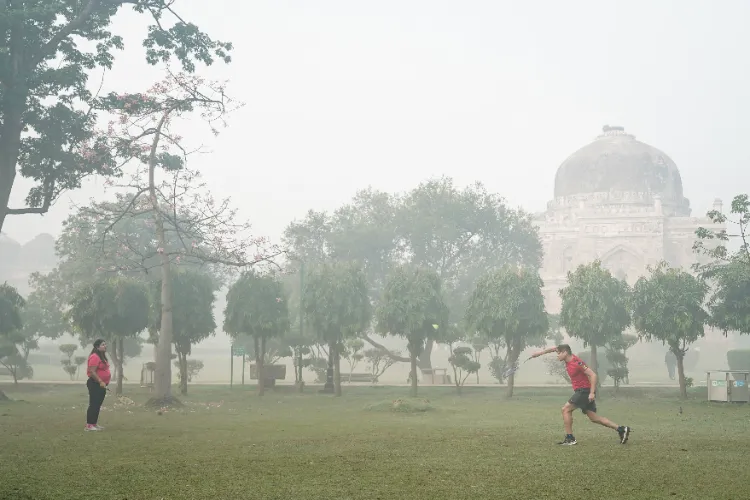
Residents of the national capital woke up to a thick blanket of smog, as air quality deteriorated to the 'severe' category at several monitoring stations, with the Air Quality Index (AQI) crossing 400 in multiple areas and visibility remaining poor during the early morning hours.
According to CPCB classification, an AQI between 0 and 50 is considered 'good', 51-100 'satisfactory', 101-200 'moderate', 201-300 'poor', 301-400 'very poor' and 401-500 'severe'.
Speaking to ANI, Environmentalist Bhavreen Kandhari said Delhi was already struggling with toxic air before Diwali and that the bursting of firecrackers had added another massive burden of particulate pollution, posing serious challenges for people suffering from respiratory problems and other disorders.
"Delhi's air has again become a public health emergency. The celebrations may be over, but the pollutants continue to stay and that has become quite a challenge for people who have problems with breathing and various disorders," Kandhari said.
Highlighting the limitations of the official Air Quality Index (AQI) scale, she said the scale goes up to 500, with readings above 400 falling in the 'Severe' category, as it does not measure pollution beyond that level.
"The official AQI scale has gone up to 500; anything above 400 is classified as 'Severe' because it doesn't measure anything beyond. But the numbers which people and citizens have been showing through social media are horrific. Even PM 2.5 yesterday went from 300 in the morning to about 1000 at night," she said.
Kandhari further said the situation had become more alarming because Delhi's air quality was already poor before Diwali, and the additional emissions from firecrackers had worsened the crisis.
"What makes this even more alarming is that Delhi was already struggling with toxic air before Diwali, which we were repeatedly saying, and now firecrackers have added another massive burden of particulate pollution. So, with the meteorological conditions right now, it is unable to disperse. They are going to stay with us," she said.
Pointing to the early warning system's forecast of severe air quality for the next few days, Kandhari said the deterioration was not unexpected, as authorities were aware of unfavourable weather conditions and inadequate enforcement.
"The early warning system has forecast severe air quality for the next few days. This is not unexpected; we knew the meteorological conditions were unfavourable. We knew enforcement was inadequate. Yet, once again, this was permitted and it is strange that while Government takes such strict measures for reducing emissions, it permits actually adding these very unnecessary horrific emissions that end up being like this every year," she added.
Meanwhile, environmentalist Vimlendu Jha also criticised the failure to enforce restrictions on firecrackers, saying that despite the Supreme Court's directions, crackers were burst in several parts of Delhi on Diwali night. "Despite the restrictions of the Supreme Court, we saw last night that firecrackers were lit in different areas of Delhi. And the AQI index, almost 500, the government figures had exceeded 500," Jha said.
He said private air quality monitoring devices recorded significantly higher pollution levels during the night and on Sunday morning, with readings ranging between 1,000 and 1,500.
"So, it is a very unfortunate situation that, despite the instructions of the Supreme Court, it was not made available. And the situation that was already very serious, which means we say that we were already in a severe condition, in a hazardous condition, that situation has worsened even more the next morning, which is today," he said.
Explaining the contribution of firecrackers to the pollution spike, Jha said that while AQI levels were around 400 before the celebrations, readings on private monitors rose to between 1,200 and 1,500 after approximately three hours of firecracker bursting. "This means that the concentrations of PM2.5 have increased by at least 4 times. So, the firecrackers had a very big contribution," he said.
He acknowledged that the impact of firecrackers might last for one to three days but stressed that the immediate spike in particulate matter could be substantial.
"There are many studies in which it has been said that it has increased by 20-30 times; that is, PM2.5 was more than that. If you look at the WHO experts, then PM2.5 is 100 times higher in different parts of Delhi on Diwali night," Jha said.
He added that firecrackers had compounded the pollution caused by Delhi's perennial sources of emissions.
"There is a lot of responsibility for firecrackers in this; there is a lot of contribution in this. And along with that, we have also added gold to Delhi's perennial sources, which are pollutants throughout the year. We have lit firecrackers and made the situation worse," he said.
Jha emphasised that air pollution was not confined to Delhi or determined by political boundaries, but affected the entire region and the Indo-Gangetic Plain.
"I repeatedly say that this is not just a problem of Delhi, because air pollution does not follow a political boundary. So, this is not just a problem of Delhi; it is a problem of the entire region. In fact, it is a problem of the entire Indo-Gangetic Plane," he said.