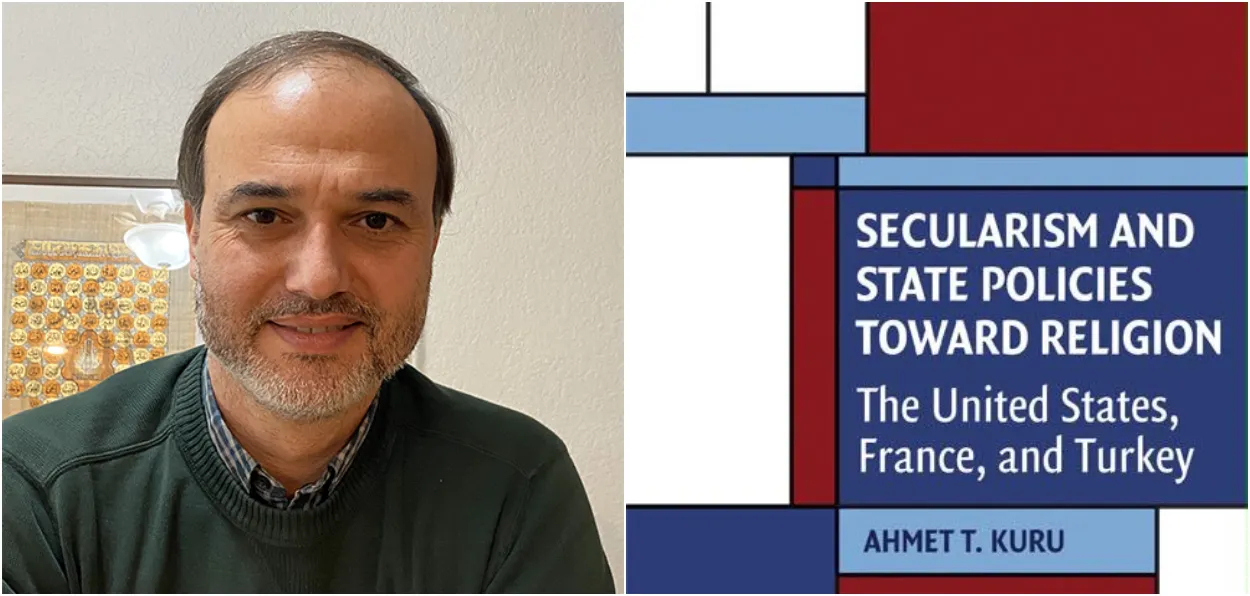
Ahmet T. Kuru
In France, Marine Le Pen, the leading contender in the upcoming presidential election, is promising to ban Muslim women’s headscarves in public spaces, including on the streets. If elected, she plans to put the proposal to a referendum.
Meanwhile, in the United States, the Democratic Party has nominated Abdul El-Sayed for Michigan’s U.S. Senate seat. El-Sayed’s wife, Sarah Jukaku, wears a headscarf. If Le Pen becomes president and succeeds in implementing her proposed ban, Jukaku will not be able to walk through the streets of France wearing her headscarf.
This contrast illustrates a crucial difference between the two countries and their approaches to religion. In my 2009 book, Secularism and State Policies toward Religion: The United States, France, and Turkey, I explained this distinction in terms of “passive secularism” in the United States and “assertive secularism” in France.
Passive secularism requires the state to remain neutral toward religious and nonreligious expressions in the public sphere. Assertive secularism, by contrast, seeks to restrict the public visibility of religion through more interventionist state policies.
The ban on headscarves in public high schools and the facecover ban on streets are examples of assertive secularism. These restrictions are unthinkable under the passive secularist model in the United States.
The constitutional foundations of the two systems also differ. The First Amendment to the U.S. Constitution states: “Congress shall make no law respecting an establishment of religion, or prohibiting the free exercise thereof.” These two principles—the prohibition of religious establishment and the protection of free exercise—have placed important limits on the government’s ability to promote religion or suppress it. The French Constitution, by comparison, declares France to be a secular republic but does not clearly delineate the boundaries of state power over religion.
What explains the development of passive secularism in the United States and assertive secularism in France? Much of the answer lies in history.
In French history, the alliance between the Catholic clergy and the monarchy helped produce a powerful anticlerical republican movement. During the long struggle between these two forces, from the French Revolution through the early twentieth century, assertive secularism became an important component of republican identity. In recent debates on Islam in France, assertive secularism has been combined with anti-Muslim prejudice and racialised politics. Together, these forces have intensified restrictions on Muslim symbols.
The United States followed a different historical trajectory. Several American colonies had established churches, but there was no single national church allied with a monarchy comparable to the ancient French régime. Consequently, the separation of religion and state developed less as a struggle against a powerful clergy and more as a mechanism of protecting religious diversity. This historical difference helps explain why public religious visibility has generally been more compatible with secularism in the United States.
This does not mean that the United States has been free of religious discrimination in general or Islamophobia in particular. Nonetheless, passive secularism describes a dominant understanding of the ideal relationship between state and religion in America.
The French experience demonstrates how assertive secularism can emerge as a reaction against an earlier alliance between religious and political authority. But assertive secularism can itself generate a political reaction.
Turkey provides a particularly important example. For decades, assertive secularists—especially military officers, judges, and university administrators—supported the ban on Muslim headscarves in universities and various public institutions. This and other assertive secularist policies created grievances among religious conservatives that have provided an important basis of Tayyip Erdogan’s populist Islamist rule.
In short, a clergy-state alliance may produce assertive secularism, while assertive secularism can produce a religious backlash. The solution is to seek a middle ground: passive secularism, which separates religion and the state while also protecting individual religious freedom. This can help avoid the extremes of religious authoritarianism and secular authoritarianism.
Such secularism should prevent the state from imposing religion while also preventing it from suppressing religion. It should protect the right to wear a headscarf as firmly as the right not to wear one.
Ahmet T. Kuru is an author and teaches at San Diego State University. This article is author's summary of his latest book "Secularism and State Policies Towards religion: The United States, France and Turkey"