

Ehsan Fazili/Srinagar
As a child, Sadiq Ali Mir’s fascination for skies led his home in Labertal village in Soibugh area of Budgam district, Kashmir, to aerospace research and entrepreneur. At 24, he is the founder of Zephyra Dynammics that develops autonomous electric vertical takeoff and landing (eVTOL) aircraft and urban air traffic systems for Indian cities.
Sadiq Ali Mir, 24, was recently enlisted in the inaugural National Space Society (NSS) 30 Under 30 Class of 2026. rThe list ecognize 30 emerging professionals advancing space exploration, development, and and settlement.
It may be mentioned that NSS is an international NGO, nonpartisan educational and advocacy organization dedicated to expanding human civilization beyond Earth and settling space.
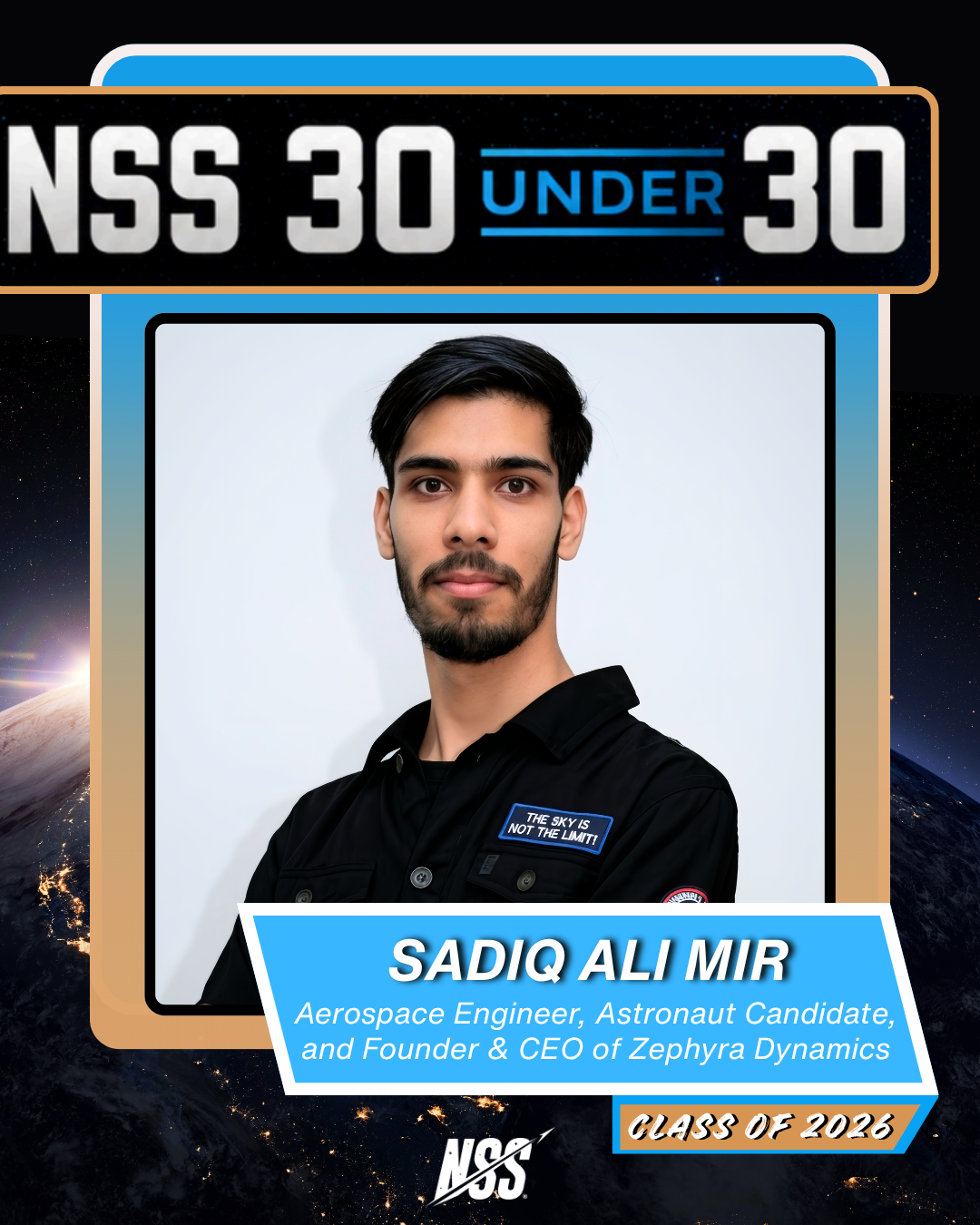 NSS poster of Sadiq Ali Mir's name on the list
“Being selected for the inaugural National Space Society (NSS) 30 Under 30 Class of 2026 is a deeply meaningful milestone in my journey. The NSS is an internationally recognised organisation that advocates for space exploration, development, and humanity’s future as a space-faring civilisation," Sadiq Ali told Awaz-The Voice.
“This is both an honour and a responsibility, and I am proud to represent Jammu and Kashmir and India in this inaugural class”, he said. “Beginnings do not have to define your boundaries. You do not need to come from a major city or have access to every opportunity from the start to pursue an ambitious dream”.
He hoped that a young student in Kashmir or anywhere in India would see this and believe that they, too, can contribute to science, engineering, and humanity’s future in space.
 Sadiq Ali Mir with Astro team
Sadiq Ali said that his journey began at school in Standard 7, “when I saw the International Space Station moving across the winter sky in Kashmir. By Class 10, I had decided to pursue aerospace engineering. At Rashtreeya Vidyalaya (RV) College of Engineering, Bengaluru, I co-founded Team AeroAstro with my amazing friends Suhana Arsh, Rishika Bandyopadhyay, Tushar Mongia, and Vaibhavi Mokashi.
“Together we worked on eVTOL aircraft concepts and space-related projects, and had the opportunity to present one of our aircraft projects to Boeing”, he said.
Later, he joined an international space workforce development programme involving Milo Space Science Institute, NASA, and the Australian Space Agency, serving as Lead Systems Engineer on the ICEFOX lunar rover development programme.
“After graduation, I continued building my engineering experience through research projects at IIT Roorkee, including unmanned aerial vehicle development, and began Phase 1 of astronaut-candidate training with Titans Space Industries for its planned 2030 mission. I also co-founded Zephyra Dynamics alongside my mentors”, he said.
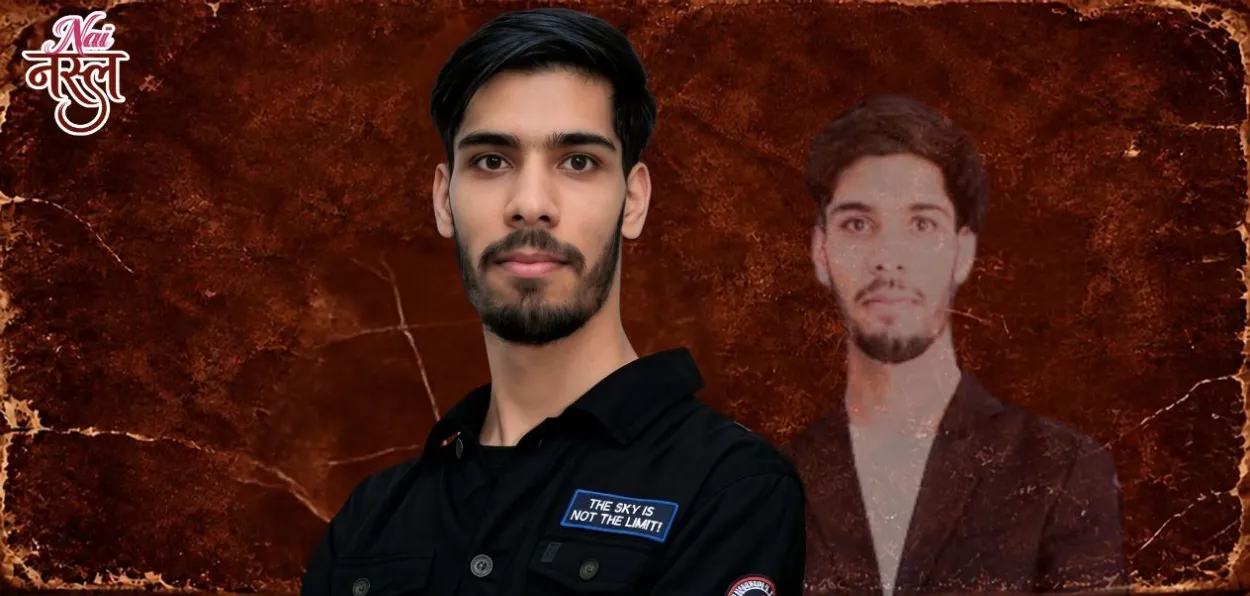
 Sadiq Ali Mir in College
“I believe this combination of technical work, research, leadership, and entrepreneurship shaped the journey behind this recognition”, Sadiq Ali Mir said.
Space technology, he said, brings together aerospace engineering, robotics, propulsion, electronics, software, and systems engineering to enable exploration beyond Earth. “It is not just about rockets and astronauts; it also includes satellites, lunar rovers, navigation, communications, and the technologies that support life and work in space”, he said.
“I chose this field because that childhood moment of discovering a human-made laboratory orbiting Earth made me curious about how such extraordinary systems are designed, built, and operated. During my undergraduate studies, that curiosity turned into hands-on work in aircraft design, reusable launch vehicle concepts, and lunar rover development”, Sadiq Ali said.
Mir said that his “primary motivation was curiosity”, which gradually became a “desire to build things that make a difference”. He was drawn to the challenge of bringing aerodynamics, structures, propulsion, control systems, and software together to “create complex machines that operate in demanding environments”, he said.
 Sadiq Ali Mir in a classroom
Working on ICEFOX, he said, taught him how many disciplines must come together to achieve a single mission. “Coming from Labertal (village) in Budgam also gave me a strong desire to create opportunities for others”, he said.
After graduating, he received several offers for Master's programmes in the United States as well as job offers. “I chose to continue with Zephyra Dynamics and help shape urban air mobility in India”, he told Awaz The Voice. “We are developing Kestrel X2, an autonomous eVTOL aircraft, and LAMINAR, an urban air traffic management platform. My larger motivation is to turn ambitious ideas into useful, reliable technology built in India”, he added.
My professional journey has taught me that ambition must be supported by discipline, technical rigour, and continuous learning. Research at IIT Roorkee has given me exposure to practical engineering challenges and reinforced the importance of testing, validation, and systems-level thinking. Astronaut candidate training is shaping me personally and professionally, teaching me to value preparation, consistency, teamwork, and responsibility.
Mir credits his parents, Mohammad Jaffer Mir and Zareena, as his best guides and motivators.
ALSO READ: Maharashtra’s ‘Moin Humanist’ Is reviving reading culture in villages
After Class XII, he joined RV College of Engineering, Bengaluru, in 2021 to study Aerospace Engineering. He graduated in 2025 as the Best Outgoing Student of the Department and batch, a moment he shares “with family, teachers, and everyone who supported me along the way”.