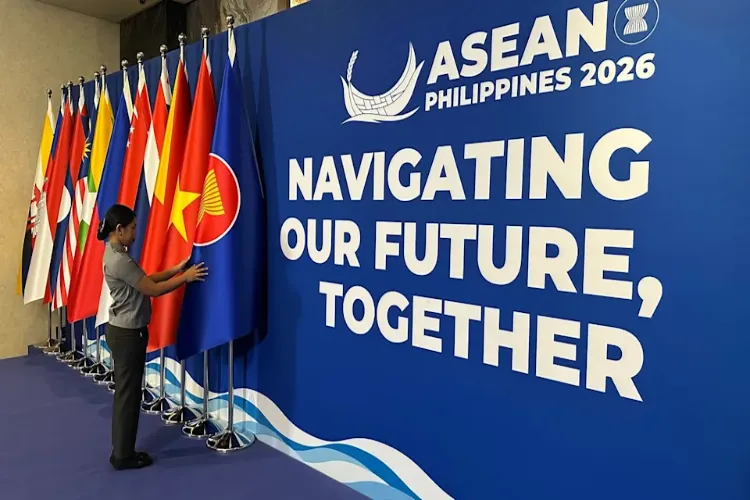
Cebu
Southeast Asia’s top diplomats met in the Philippine city of Cebu on Wednesday under mounting pressure to revive a stalled peace plan for Myanmar’s civil war and to meet a self-imposed deadline to conclude negotiations with China on a nonaggression pact in the South China Sea.
The meeting of foreign ministers from the Association of Southeast Asian Nations (ASEAN) comes at a time when the 11-member bloc continues to struggle with internal divisions and questions about its relevance. The grouping faced a major setback last year when deadly clashes erupted between Thailand and Cambodia over a long-standing border dispute. Although a ceasefire was later brokered by Malaysia, with pressure from US President Donald Trump, sustaining that fragile truce remains a priority at the Cebu talks.
The Philippines is chairing ASEAN this year, taking over what would have been Myanmar’s turn. Myanmar was stripped of its right to chair the bloc after the military ousted the democratically elected government of Aung San Suu Kyi in a 2021 coup.
ASEAN struggles to advance Myanmar peace plan
ASEAN does not recognise Myanmar’s military government, and its top leaders remain barred from attending regional summits, though lower-level diplomats have been allowed to participate. The civil war that followed the coup has killed tens of thousands of people and displaced millions, becoming one of ASEAN’s most serious challenges and a source of international criticism.
Western governments have repeatedly urged the bloc to take stronger action. Last week, Malaysian Foreign Minister Mohamad Hasan said ASEAN leaders had agreed at their October summit not to send observers to Myanmar’s recent elections, citing the absence of conditions for credible polls. Some member states, including Cambodia and Vietnam, nevertheless sent representatives independently.
ASEAN’s five-point peace plan, adopted in 2021 and calling for an immediate end to violence and dialogue among all parties, has failed to stem the fighting or bring about meaningful negotiations.
Advancing the peace plan is a key item on the Cebu agenda, according to documents reviewed by the Associated Press. Philippine Foreign Secretary Theresa Lazaro, ASEAN’s special envoy to Myanmar, is expected to brief her counterparts on her recent visit to the country, during which she met ruling generals and other officials.
Lazaro will also report on the outcome of a conference she recently convened in the Philippines involving political and ethnic groups opposed to the military government. The meeting explored ways to enforce the peace plan, promote de-escalation, facilitate humanitarian assistance, tackle transnational crime and encourage inclusive political dialogue, the Philippine Department of Foreign Affairs said.
Pressure builds over South China Sea code of conduct
ASEAN foreign ministers are also facing pressure to conclude long-running negotiations with China on a “code of conduct” aimed at managing disputes in the South China Sea, where Beijing’s sweeping territorial claims overlap with those of four ASEAN members.
The bloc hopes the agreement will prevent tensions in the strategically vital waterway—long seen as a potential flashpoint—from escalating into open conflict that could draw in the United States.
Although Washington has no territorial claims in the region, it has warned China that it is obligated to defend the Philippines, a treaty ally, if Filipino forces are attacked in the disputed waters.
Talks on the proposed code of conduct have dragged on for more than two decades without major progress, particularly on whether the agreement should be legally binding. While ASEAN has committed to concluding negotiations by the end of 2026, analysts remain sceptical.
ALSO READ: India’s-EU landmark FTA to spur growth, jobs, increase New Delhi's relevance
“Even with strong political will, concluding it will remain challenging,” said Australia-based analyst Lupita Wijaya, who researches South China Sea disputes. “The main obstacle is not the pace of negotiations but fundamental differences between China and ASEAN claimant states over international law and whether the code should be legally binding.”















.webp)




.webp)