Hyderabad
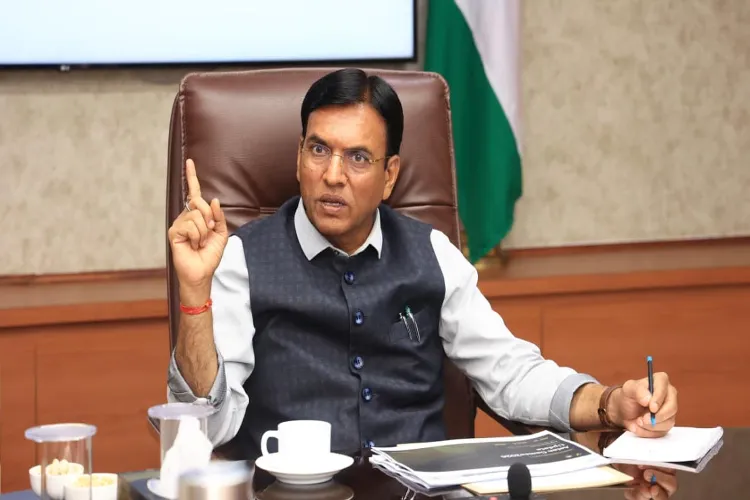
Union Labour Minister Mansukh Mandaviya on Tuesday said there is immense potential for cooperation among BRICS countries in areas such as social security, skills, AI and decent work.
Speaking after inaugurating the three-day BRICS Trade Union Forum Summit-2026 here, he said the BRICS countries together represent nearly half of humanity and one of the world's largest labour forces.
"As our economies continue to evolve, there is immense potential for deeper cooperation in areas such as social security, skills, AI governance, labour mobility and decent work," he said.
The forthcoming BRICS labour and employment ministers meeting in Hyderabad on July 15 provides an excellent opportunity to translate the recommendations emerging from the Summit into concrete policy cooperation and practical outcomes, he said.
Together, BRICS can shape a future of work that is innovative, inclusive and human-centric, he said.
Observing that employment generation remains at the heart of India's growth strategy, he said over the last decade, nearly 170 million employment opportunities have been created.
"The unemployment rate has declined from six per cent in 2017 to 3.1 per cent in 2025, while the female employment rate has increased significantly from 22 per cent to 38.8 per cent" during the same period, he claimed.
To sustain this momentum, the Centre has launched the Pradhan Mantri Viksit Bharat Rozgar Yojana, an employment-linked incentive scheme that aims to create 35 million formal sector jobs over the next two years, he said.
Talking about the reforms and achievements in labour-related issues, Mandaviya said that the EPFO, with over 80 million active members and eight million pensioners, is among the world's largest social security organisations providing provident fund and pension benefits.
ESIC covers over 150 million insured persons and their dependants, making it one of the world's most extensive workplace-linked health insurance and social security systems, he added.
Recognising the needs of the country's growing workforce, ESIC and EPFO also underwent significant reforms aimed at expanding social security coverage, simplifying processes, and enhancing service delivery for beneficiaries and employers, he said.
These efforts have contributed to India's remarkable progress towards universal social protection. India's social protection coverage has expanded from 19 per cent in 2015 to 64.3 per cent in 2025, covering nearly 940 million people.
Preliminary estimates for 2026 show that coverage has crossed one billion citizens, he said.
The Union Labour Minister also said India is investing heavily in skilling, reskilling and "lifelong learning" through initiatives such as the Skill India Mission, as the government recognises that the future of work will be shaped by rapid technological change.
The Central government's objective is to transform India's demographic dividend into a global talent pool equipped with skills in emerging sectors such as AI, robotics, advanced manufacturing and green technologies, he said.
India advocates ethical AI, responsible innovation, continuous reskilling, digital literacy and robust social dialogue to ensure a just transition for workers. Technological advancement must always be accompanied by social inclusion and worker protection, he said.
READ MORE: Shakiba Mohammad brings Middle East flavours to Guwahati
Noting that India's labour governance framework is built upon a strong tradition of tripartite social dialogue among the Government, employers and trade unions, he said EPFO and ESIC are governed through tripartite structures.
Similarly, the institutions established under the new Labour Codes, including the National Social Security Board, the Central Advisory Board, and the Occupational Safety, Health and Working Conditions Advisory Board, are also constituted on a tripartite basis, he added.











.webp "Representational Image")
.webp "Ram Mandir, Ayodhya")
.webp)
_(1)_(1).webp)