Saquib Salim
The First War of National Independence in 1857 is celebrated as a first major uprising against British colonial rule, but its blueprint had been drawn half a century prior at Vellore (now in Tamil Nadu) in 1806. On July 10, 1806, this mutiny by the Indian sepoys of the English East India Company was surely a dress rehearsal for the great revolt of 1857.
A Slice Of History
Colonial narratives often minimise the mutiny as a spontaneous, localised reaction to offensive military dress regulations, but in reality it was an organised political conspiracy with a highly coordinated insurrection engineered by the sons of Tipu Sultan in captivity and sustained by an extensive underground network of revolutionary Fakirs.
After killing Tipu Sultan in 1799, the English East India Company moved his children to Vellore Fort. But the resistance of Tipu’s blood was far from over with his death.
The Commander-in-Chief of the English army ordered several innovations in early 1806, including the removal of beards, tilaks, and earrings, and forcing them to wear new headgear. This caused discontent among sepoys, which was actively weaponised by Tipu’s sons for a revolt against the British.
F. W. Blunt, the wife of an English officer stationed at Vellore, wrote about the role of the princes in the mutiny, "Nine of the ringleaders, as they were called, were brought down to Madras and here passed publicly through the streets in irons, destined to receive the most dreadful military punishment…… The nine men in irons awaiting a most severe punishment was made use of by the sons of Tippoo, who have been kept prisoners in the Palace at Vellore since the taking of Seringapatam, and served to ripen a design that had been long formed. A conspiracy was formed by the Sepoys to murder all the Europeans and take possession of that Fort."
When the sepoys went for a massacre of English troops on the night of July 10, 1806, Tipu’s sons led them. Colonel Alfred Keene recorded the scene inside the fort, “The Christian drummers were seized, taken to the palace where Tippu's sons were confined, and made to beat the "general" ; lights flashed in the palace, refreshments were brought out; a mob of sepoys called on the princes to place themselves at their head; Tippu's own flag, green stripes on a red field, was nailed to the flagstaff. Prince Muizuddin (son of Tipu Sultan) ordered his horse to be saddled, and told off a party of sepoys to go and seize the principal hill fort; when that was captured and the dead body of Colonel Marriott, paymaster of stipends, brought before him, he promised he would mount his horse and ride through the native town proclaiming the restoration of the Mahommedan power.”
Keene further pointed out, “In the mutinies of Vellore and the greater one of 1857, two points of similarity stand out prominently. In each is the unreasoning fear of an attack on the institutions of religion and of caste; for the greased cartridges in the latter mutiny had as much to do with the outbreak as had the new head-dress in 1806, and the presence of the remnants of the Moghul Dynasty at Delhi acted in 1857 precisely as had the presence of Tippu's family at Vellore in 1806.”
The sepoys were fighting to restore the old order led by the royal blood of Tipu. Lt. Col. W. J. Wilson noted that the sepoys shouted, "Come out, Nawab, come out, Nawab, there is no fear," a call specifically "supposed to be addressed to Futteh Hyder, the eldest of the four Mysore Princes". By replacing the English flag with Tipu Sultan's personal standard, handed over by Prince Moizuddin, the rebels solidified the central political authority of the Vellore mutiny.
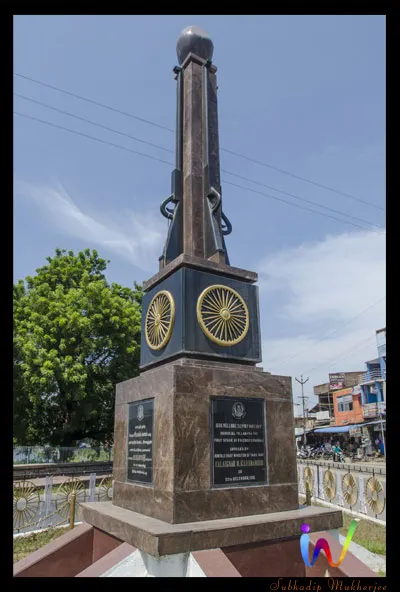
Vellore Memorial Pillar, Vellore City
Tipu’s sons provided the political leadership; Fakirs planned and executed this revolt. Fakirs ensured the spread of the 1806 revolt beyond Vellore by carrying revolutionary messages and inciting anti-English sentiments across different cantonments. Thousands of Fakirs executed a sophisticated campaign:
Fakirs had reached English cantonment cities including Bangalore, Vellore, Bellary, Nandi Hills, and Chennai in large numbers. They organised puppet shows near military lines depicting British defeats by the French, sang songs detailing Tipu’s historic valour, and spread warnings that the English planned to convert Hindus and Muslims to Christianity.
Leaders like Abdullah Khan and Peerzada managed operations in Bangalore and Vellore, while Rustam Ali incited sepoys locally. Nabi Shah, a spiritual guide to Tipu, utilised Muharram gatherings to sing praises of the late Sultan and denounce those aiding the English.
At the outset of the mutiny, a Fakir named Shaikh Adam distinguished himself as a primary leader of the Vellore revolutionaries. After the initial uprising was suppressed at Vellore, Fakirs like Aleem Ali Shah and Noor Khalil Shah continued planning uprisings in Bellary, Hyderabad, and the Nandi Hills, telling the people that Tipu’s loyalists, Marathas, and Polygars would soon rise. Historian Perumal Chinnian noted: “The Southern conspiracy was supported by Fakirs and other religious mendicants. In fact, the conspiracy was established in all the army stations by them.”
Charles Macfarlane, detailing how the luxury granted to Tipu's sons attracted anti-British elements, wrote "...in connection with these desperadoes were some few Frenchmen, disguised as fakirs or dervishes, who went about the country inveighing everywhere against the English as robbers and tyrants. It is also stated that placards were fixed up within the mosques and Hindu temples, where Europeans never entered, to excite a general spirit of revolt among the whole native population of Madras."
The British internal investigations confirmed that the dress regulations were merely a tactical spark utilised by the sons of Tipu and Fakirs. While an official enquiry commission under Major General Pater pointed evenly to the dress innovations and the residence of Tipu's family, top military officials differed. Sir J. F. Cradock, the Commander-in-Chief, argued that the headgear issue was a mere pretext, and that the true objective was the restoration of Tipu Sultan’s dynasty. The Court of Directors ultimately agreed, declaring that the captive sons of Tipu and their abettors took deliberate advantage of the sepoys' dissatisfaction "to instigate them to insurrection and revolt, with the view of effecting their own liberation, and the restoration of the Mahomedan power".
The revolutionaries killed 128 English soldiers and 15 officers, including Colonel Fancourt and Lieutenant-Colonel McKerras. The British regained control when Colonel Gillispie arrived from Arcot at around 7 am. They killed over 500 Indians inside the fort; 6 were blown from cannons, 5 were shot by firing squads, 8 were hanged, and several were transported for life. Tipu’s sons were removed to Kolkata under stricter vigilance, and their retainers faced execution and imprisonment. Governor Lord William Bentinck and Commander-in-Chief Sir J. F. Cradock were both removed from their offices.
READ MORE: Kafeel Painter infuses life and emotions in Bollywood posters
The Vellore Mutiny was more than an isolated, reactionary mutiny over a headgear. Led by Tipu Sultan’s sons and fueled by the Fakirs, it was a pre-planned war of independence that established a blueprint successfully implemented nationwide in 1857.

.jpg "Gujarat’s women entrepreneurs bring their craftsmanship to life during Navratri")