New Delhi
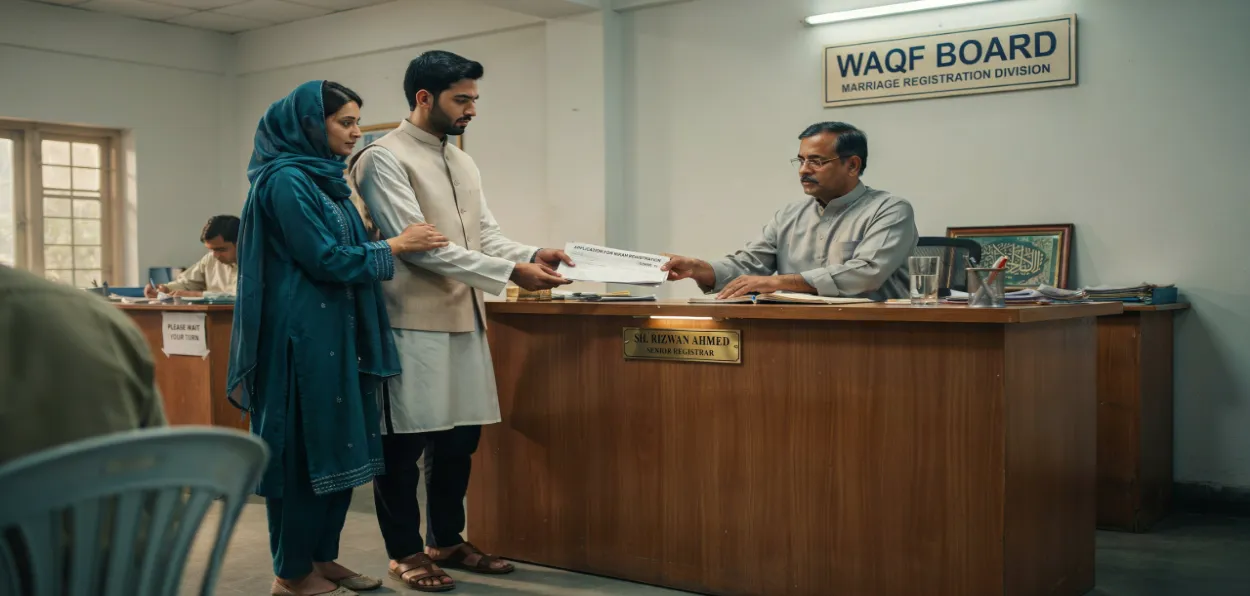
The Chhattisgarh Waqf Board has introduced sweeping changes to the Nikah (Islamic marriage) process, including a mandate that the nikahnama (marriage contract) must be bilingual (Hindi and English alongside Urdu). Additionally, for inter-religion marriages, prior written permission and a registered court marriage are now required.
The Chhattisgarh Waqf Board headed by Dr Saleem Raj, a senior BJP leader, has announced that Muslims marrying a person of another faith would mandatorily require its permission.
So, the Chhattisgarh State Waqf Board would function virtually as a marriage licensing authority, with effect from August 2026, when the proposed regulation comes into force.
Many Muslims have protested against this, saying the Waqf Board has no jurisdiction on supervising who marries whom.
Under the Central Waqf Act of 1995, the primary, legally defined mandate of any state Waqf Board is strictly confined to the management, maintenance, protection, and financial auditing of Waqf properties, which include mosques, shrines, cemeteries, and religious lands.
As such, Chhattisgarh already has a stringent anti-conversion law which states that any religious conversion done solely for marriage, or any marriage performed for conversion, will be treated as legally null and void (invalid) unless the strict 60-day prior legal procedure and official declarations are followed.
#WATCH | Raipur, Chhattisgarh: On the new trilingual Nikahnama format and directives to Maulanas regarding inter-religion marriages by the Waqf Board, Chairman of the Chhattisgarh State Waqf Board, Dr Salim Raj says, “The proposed amendment entails retaining the existing format… pic.twitter.com/mvRyhil6N0
— ANI (@ANI) July 7, 2026
The Waqf Board has made it mandatory for all Islamic scholars and clerics who solemnise marriages to register themselves directly with the state authority. This move has drawn sharp criticism from legal scholars, civil rights activists, and the Muslim community, who view it as an aggressive intrusion into purely personal lives.
According to the proposed guidelines, which are slated to come into absolute effect from August 2026, any interfaith marriage involving a Muslim man or woman will strictly require the prior and explicit written permission of the Waqf Board.
At the surface level, the proposal requires that before any interfaith Nikah can be solemnised, the prospective bride and groom must submit an application to the Waqf Board.
The board will then conduct an extensive scrutiny process, checking the mutual consent of both parties, verifying identity documents, and investigating legal paperwork related to religious conversion if it is deemed necessary for the marriage.
The duration of this process is not mentioned, so the marriage can be delayed for as long as the Board and its political bosses want.
Defending this sweeping overhaul, Dr Saleem Raj argued that these changes are necessary to keep up with evolving times. He stated, “Changes are necessary with changing times. Steps are being taken across the country towards a Uniform Civil Code (UCC) where marriage registration will become mandatory. Since Urdu is not easily understood in government offices, the trilingual format will actively help people in obtaining Aadhaar cards, passports, and official marriage certificates.”
Dr Raj claimed that individuals from other states frequently enter Chhattisgarh, hide their true religious identities, and contract marriages. According to his perspective, this practice regularly leads to immense social friction and severe law-and-order situations, often categorised under political narratives like “Love Jihad.”
He insisted that “Interfaith marriages cause social disputes and law and order problems,” and asserted that the newly proposed rules will put a complete stop to such controversies because clerics will no longer possess the independent authority to solemnise these marriages without state clearance.
ALSO READ: Sajida Khan: India's first woman audio engineer
Legal experts assert that the Waqf Board’s new directive amounts to a direct violation of the fundamental rights guaranteed to Indian citizens under the Constitution. The Supreme Court of India, in its landmark judgment in the Shafin Jahan v. Asokan K.M. case, has repeatedly and unequivocally affirmed that the right to marry a person of one’s own choice is an integral, non-negotiable facet of Article 21, which guarantees the right to life and personal liberty.

.jpg "Gujarat’s women entrepreneurs bring their craftsmanship to life during Navratri")