Eman Sakina
For centuries, Muslims have looked at the heavens as signs of Allah’s power and wisdom. The Qur’an repeatedly invites believers to reflect on the stars, the moon, the alternation of night and day, and the vast order of creation. Today, humanity has gone beyond observation and entered space itself. This raises fresh questions for Muslim astronauts: How do they pray in zero gravity? How do they fast during Ramazan when the sun rises and sets many times a day? How do they find the Qibla while orbiting the Earth?
Friday Musings
These questions show that Islam is not limited by place. Rather, it is a faith that accompanies the believer, whether on land, at sea, in the air, or in space.
The Qur’an encourages Muslims to study the universe with wonder and humility. Allah says: “Indeed, in the creation of the heavens and the earth and the alternation of the night and the day are signs for those of understanding.” (Qur’an 3:190)
This verse reflects a deep Islamic spirit of inquiry. Muslim scholars throughout history studied astronomy not only for scientific curiosity, but also to determine prayer times, the Islamic calendar, and the direction of the Ka‘bah. In that sense, modern Muslim astronauts continue a long tradition of combining faith and knowledge.
Islam is universal. It is not confined to one country, climate, or even one planet. Allah says: “To Allah belongs the east and the west. Wherever you turn, there is the Face of Allah.” (Qur’an 2:115)
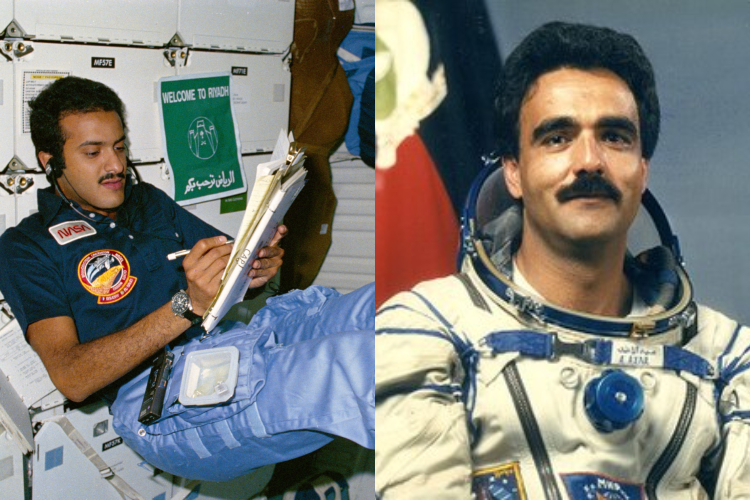 Prince Sultan bin Salman Al Saud of Saudi Arabia, the first Muslim astronaut (Left ), and Afghan national Abdul Ahad Momand, who was the first cosmonaut to carry the Quran into space
This does not remove the obligation of facing the Qibla in prayer, but it reminds believers that Allah’s mercy and knowledge are not restricted by physical direction. Islamic law also recognises hardship and necessity. A sick person may pray sitting, a traveller may shorten prayers, and someone unable to use water may perform ‘tayammum’. These principles become especially important in space.
How Muslim Astronauts Pray
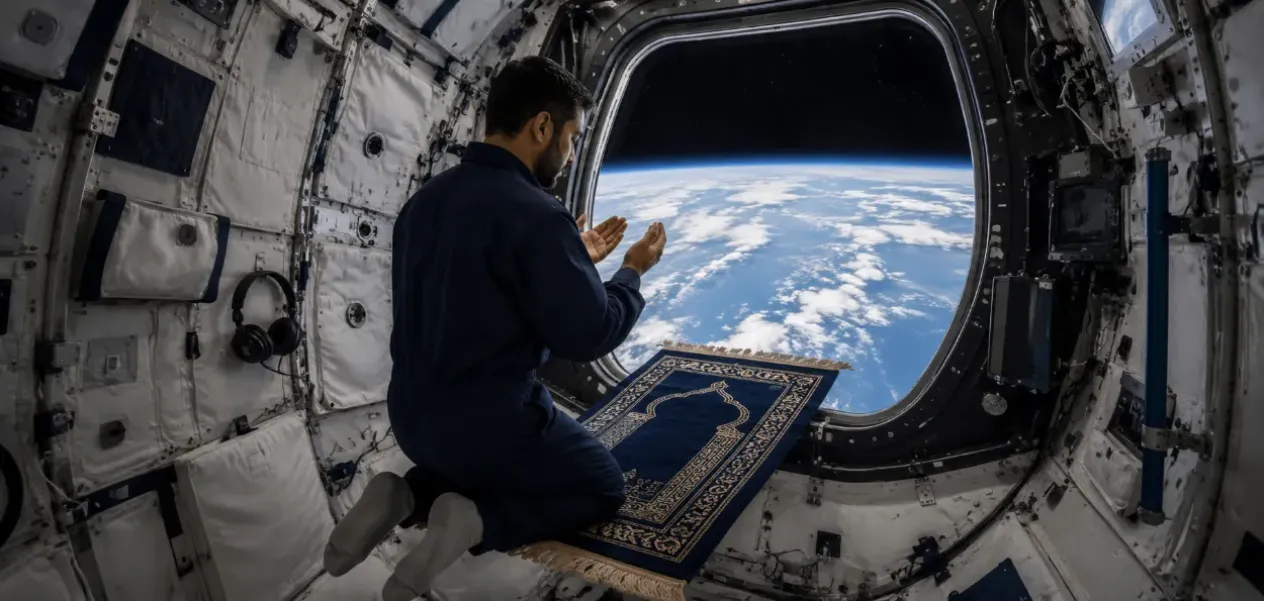
Prayer remains obligatory, but it is performed according to ability. In space, standing, bowing, and prostrating may be difficult because of microgravity. Astronauts may pray while strapped in place or use gestures when full movement is impossible. The goal is sincerity and remembrance of Allah, not hardship beyond human capacity.
Wudu (ablution) also requires adjustment. Because water is limited and floating droplets can damage equipment, astronauts use water carefully. If water cannot be used safely, Islamic law allows alternatives such as tayammum.
Finding the Qibla
The Qibla is one of the most interesting challenges in space. On Earth, Muslims face the Ka‘bah in Makkah. In orbit, however, the spacecraft moves constantly around the planet. Scholars generally advise astronauts to face the Qibla as best as they can at the start of prayer. If that becomes impossible, they may continue with their best effort, and the prayer remains valid.
Fasting is also adapted with wisdom. On the International Space Station, astronauts may see many sunrises and sunsets in one day. Because following each one would be impractical, scholars often recommend using the timetable of the place of launch, Makkah, or another fixed Earth-based schedule. If fasting would seriously harm health or mission safety, Islam allows postponing the fast.
Allah says: “Allah intends for you ease and does not intend for you hardship.” (Qur’an 2:185)
Faith among the Stars
Space exploration does not weaken faith; for many Muslims, it strengthens it. Looking at Earth from orbit reveals how small human divisions are and how vast Allah’s creation is. The universe becomes a reminder that science and worship are not enemies. They are both ways of recognising the greatness of the Creator.
READ MORE: Kafeel Painter infuses life and emotions in Bollywood posters
Whether on Earth or in space, the Muslim remains connected to Allah through prayer, fasting, gratitude, and remembrance.

_(1)_(1).webp "Khanqah Emadia Qalandaria, Patna, Bihar")





.webp "People offering Eid prayers at the Hazratbal shrine, Srinagar")