




 Baladas Ghoshal
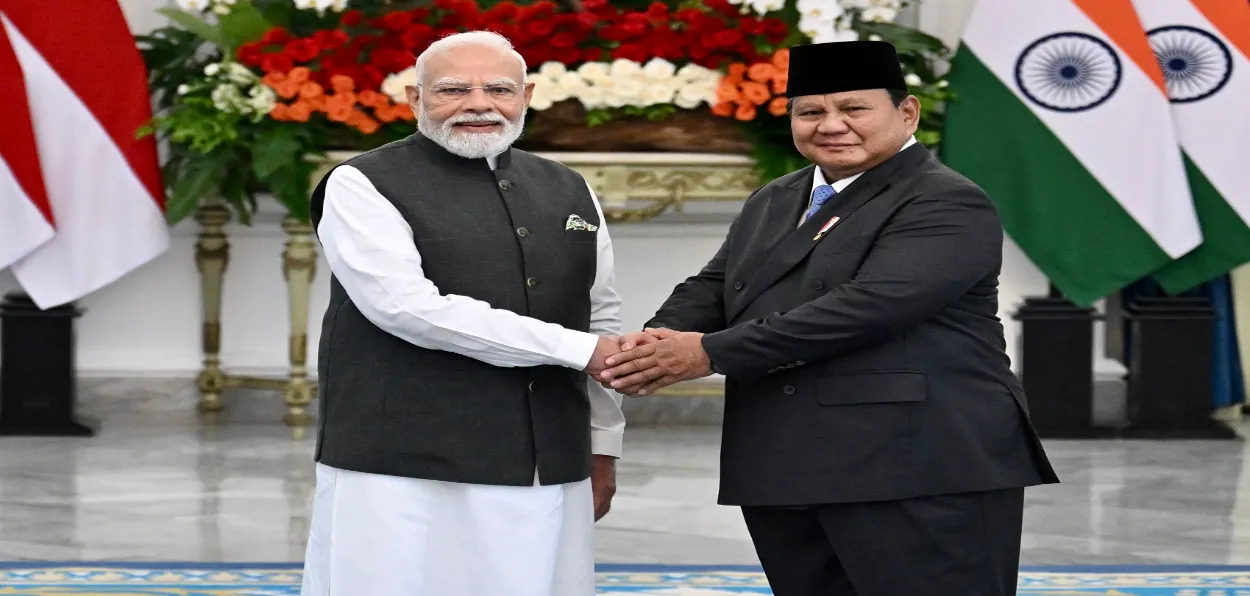
Prime Minister Narendra Modi’s recent visit to Indonesia has opened new avenues for cooperation in foreign policy, defence, trade, digital connectivity, maritime security and civilisational exchanges. But converting these opportunities into tangible outcomes will require political will, innovative thinking and, above all, timely implementation. This has become even more important in a rapidly evolving geopolitical and geoeconomic landscape across the Indo-Pacific.
The timing of the visit was particularly significant. India and Indonesia occupy strategic positions at opposite ends of the Indian Ocean and share a common interest in preserving a stable, inclusive and rules-based regional order. At the same time, both countries face mounting challenges arising from intensifying great-power rivalry, maritime security concerns and the need for resilient supply chains.
As an Indonesian scholar based in Australia has observed, these developments are reshaping strategic priorities across the Indo-Pacific. Australia, the final destination on Prime Minister Modi's three-nation tour, is itself a key partner in strengthening regional strategic, economic and maritime cooperation.
The visit also built upon the momentum generated by Indonesian President Prabowo Subianto's visit to India as Chief Guest at the 2026 Republic Day celebrations. Much of the groundwork for the latest agreements had already been laid during that visit. The task now is to convert those understandings into practical initiatives in areas such as maritime security, food security, critical minerals and electric vehicle supply chains.
The importance of the visit lies not merely in the 20 bilateral outcomes announced but in the breadth of cooperation they represent. These span defence, critical minerals, technology, education, healthcare, agriculture, maritime security and cultural exchanges.
Prime Minister Narendra Modi has shared this clip of his visit to Prabnaban Temple in Indonesia on X;
इंडोनेशिया के प्रम्बानन मंदिर में ॐ नमः शिवाय! pic.twitter.com/AuHupT2vSO
— Narendra Modi (@narendramodi) July 8, 2026
Foremost among them was the landmark defence agreement under which Indonesia will acquire the BrahMos missile, a long-standing priority for Jakarta. The two countries also agreed on air-to-air cooperation to strengthen defence collaboration, promoting indigenous manufacturing and expanding India's growing defence exports.
Equally significant was the extension of the Memorandum of Understanding on maritime safety and security to promote freedom of navigation and strengthen cooperation between the two countries' Coast Guards. The agreement assumes added importance against the backdrop of China's increasingly assertive posture in the South China Sea.
This year marks the tenth anniversary of the Permanent Court of Arbitration's landmark ruling rejecting China's expansive maritime claims based on so-called historical rights. Despite the judgment, Beijing has steadily expanded its presence in waters falling within the Exclusive Economic Zones of neighbouring states under the United Nations Convention on the Law of the Sea (UNCLOS), to which China is a signatory. Although Indonesia is not formally a claimant in the South China Sea disputes, its Natuna Islands overlap with China's so-called Nine-Dash Line, resulting in periodic confrontations between Indonesian and Chinese maritime agencies.
Another major outcome was renewed cooperation on developing the strategically located Sabang Port near the Strait of Malacca. The project has the potential to enhance both maritime security and economic connectivity while complementing India's ambitious Great Nicobar development project.
Discussions on Sabang have continued for years. Indonesian universities and government agencies had earlier sponsored feasibility studies, while scholars visited India to examine the proposal. Yet despite the initial enthusiasm, the project gradually lost momentum. The Jakarta Post once argued that Indonesia should view Sabang not merely through a geopolitical prism but as an economic opportunity that could benefit from its proximity to Great Nicobar.
With the project receiving fresh political backing, New Delhi and Jakarta should now move swiftly to remove the bureaucratic, technical and regulatory hurdles that have delayed its implementation. If executed effectively, Sabang could emerge as one of the most visible symbols of India-Indonesia strategic cooperation.
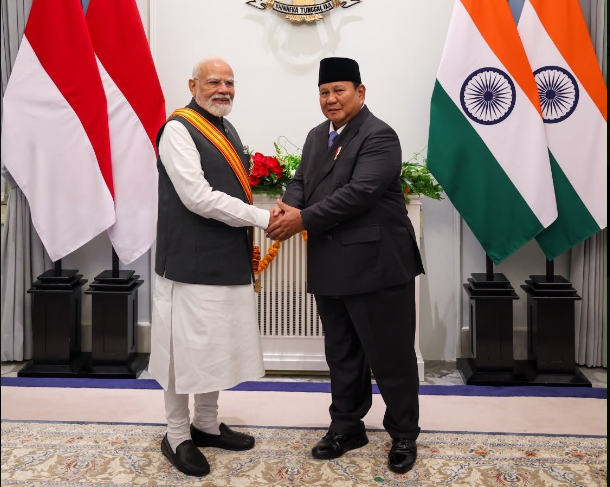 Indonesian President Prabowo Subianto conferring the country's highest civilian award on PM Narendra Modi in Jakarta
The visit also produced several important agreements aimed at strengthening economic and technological integration. India and Indonesia agreed to integrate elements of their digital public infrastructure, including the Unified Payments Interface (UPI) and the Open Network for Digital Commerce (ONDC), facilitating cross-border trade and financial transactions. Beyond bilateral commerce, the agreement positions India's digital public infrastructure as a potential model for wider ASEAN cooperation.
Another agreement focused on critical minerals and steel supply chains to secure reliable access to rare earth elements while encouraging joint investment in mining and processing. Such cooperation is essential for industries ranging from electric vehicles and renewable energy to defence manufacturing and advanced technology, thereby enhancing both economic resilience and technological security.
Indonesia also expressed interest in collaborating with India on Electronic Voting Machine (EVM) technology for its large-scale democratic elections. Should Indonesia eventually adopt the system, it would represent a significant endorsement of India's democratic and technological capabilities.
Education emerged as another promising area of cooperation. Plans to establish a campus of the Indian Institute of Management (IIM) Bengaluru in Indonesia could substantially strengthen India's educational presence in ASEAN and serve as a template for future initiatives across the region.
Yet educational diplomacy remains an underutilised pillar of India's engagement with Southeast Asia. One estimate suggests that more Indonesian students pursue higher education in China than in all Western countries combined. As these graduates move into positions of influence in government, academia, business and the media, they inevitably shape Indonesia's long-term strategic outlook.
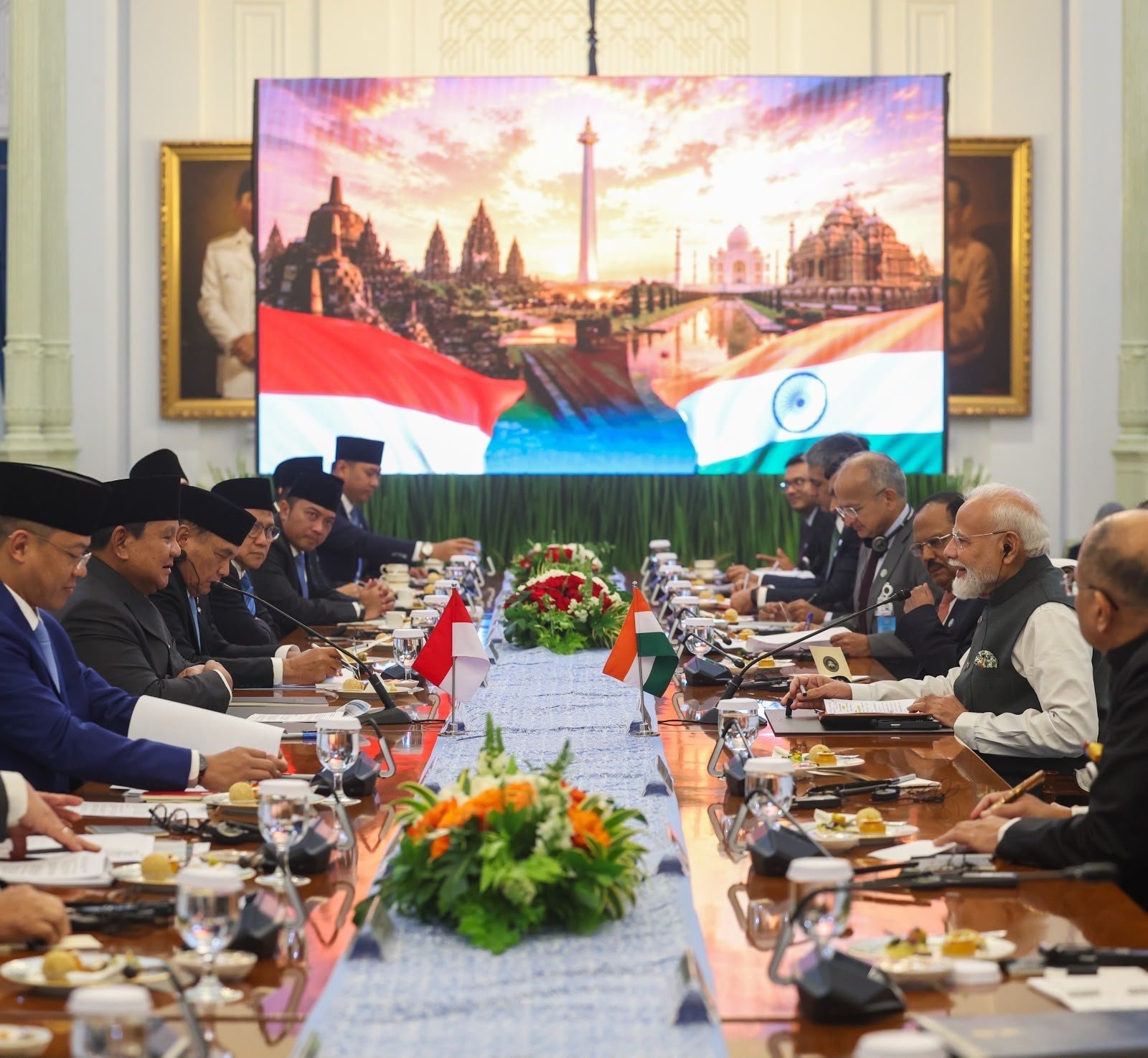 Delegation-level talks between India and Indonesia during PM Modi's visit
India has made valuable contributions through scholarship programmes and the Indian Technical and Economic Cooperation (ITEC) initiative, which has successfully trained officials from across Southeast Asia. However, its scholarship programmes have yet to attract the region's brightest students in significant numbers.
India must therefore do more to showcase the strengths of its universities, faculty and alumni. Many Indian graduates today occupy distinguished positions in global academia, multinational corporations and international institutions, yet these achievements remain insufficiently projected abroad.
Successful diplomacy ultimately depends on building constituencies within partner countries that naturally support closer bilateral ties. Such constituencies often emerge among scholars, journalists, business leaders and policy experts who develop sustained professional and intellectual engagement. With the notable exception of Singapore, India has yet to cultivate such networks across much of Southeast Asia.
Having spent more than six decades teaching, researching and engaging professionally with Southeast Asia, I remain convinced that enduring partnerships are built not only through government-to-government relations but also through sustained interaction among academics, journalists, entrepreneurs and opinion-makers. While official ties have strengthened considerably, these broader societal connections have lagged. Addressing this imbalance is a priority for India.
Civilisational ties also featured prominently during the visit. Accompanied by President Prabowo Subianto, Prime Minister Modi visited the Prambanan Temple in Yogyakarta, reaffirming the centuries-old cultural links.
PM Modi also paid tribute to the late Biju Patnaik, whose extraordinary role in supporting Indonesia's struggle for independence remains one of the defining chapters in bilateral relations. Patnaik assisted Indonesian nationalist leaders during their freedom movement and played a pioneering role in developing the country's Air Force, for which he was honoured by Indonesia. During the visit, President Subianto conferred the Bintang Adipurna, Indonesia's highest civilian honour, on Prime Minister Modi, underscoring the warmth and maturity of the bilateral relationship.
Taken together, the agreements reached during the visit mark an important milestone in India-Indonesia relations. They provide a comprehensive framework for expanding strategic, economic, technological and cultural cooperation.
The challenge now lies not in announcing new initiatives but in implementing those already agreed upon. Too often, promising projects have been slowed by bureaucratic delays and procedural inertia. Equally important will be sustained investment in educational, intellectual and people-to-people exchanges that give strategic partnerships their long-term resilience.
ALSO READ: Sajida Khan: India's first woman audio engineer
If the political commitment demonstrated by Prime Minister Modi and President Prabowo Subianto is matched by effective implementation, the visit could prove to be a turning point in India-Indonesia relations while contributing to a more stable, prosperous and rules-based Indo-Pacific. In that sense, Prime Minister Modi's call to "perform and transform" now applies as much to implementation as it does to vision.
Professor Baladas Ghoshal is Secretary General, Society for Indian Ocean Studies and the Former Chair in South and Southeast Asian Studies, JNU

_(1)_(1).webp "Khanqah Emadia Qalandaria, Patna, Bihar")








.webp)



.webp)