 Shankar Kumar
Pakistan has been basking in the self-belief that its mediatory role in bringing Iran and the US to the negotiating table over the Middle East war, has been recognised by the international community. Does this artificially cultivated narrative of Pakistan align with the turmoil unfolding within its own territories? Not at all. Yet, what shocks and surprises many is Islamabad’s resistance to learning from its past mistakes as well as Dhaka’s attempt to overlook its homegrown Islamic outfits which are maintaining discreet relations with Islamist and radical elements linked to Pakistan and West Asia.
For Pakistan, there seems to be no escape from the wave of turbulence that is going on in its various regions. While unrest has hit Pakistan-occupied Jammu and Kashmir, (POJK) Balochistan too has been experience discontent fueled by longstanding political, economic, and human rights grievances.
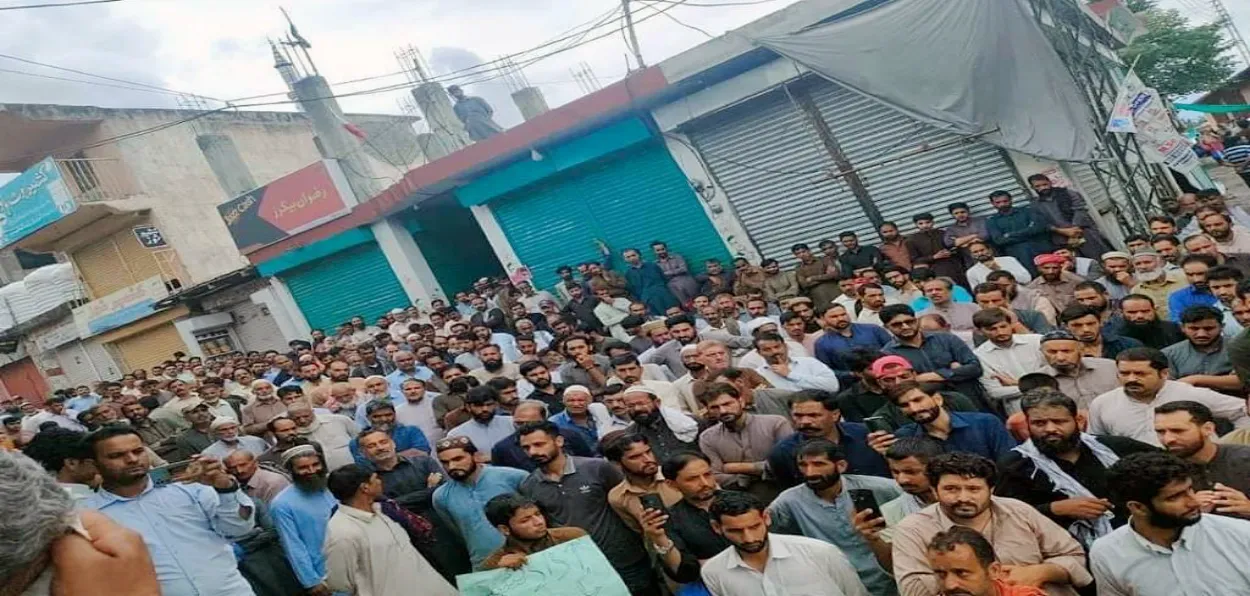
Videos circulating on social media show people in POJK raising slogans against Pakistan and declaring that the region is not part of the country. Going by media reports, more than 600 people have been arrested, dozens of people killed, and hundreds injured in the Pakistani army’s crackdown against protestors.
However, civil society groups claim the toll in the violence is at least 400 as military action continues unabated in POJK, where a fresh agitation has been going on since June 9 over non-fulfilment of long-pending demands of the public. The demands include abolition of 12 reserved seats in the POJK Legislative Assembly, greater administrative and financial autonomy, protection of civil liberties, and judicial and governance reforms.
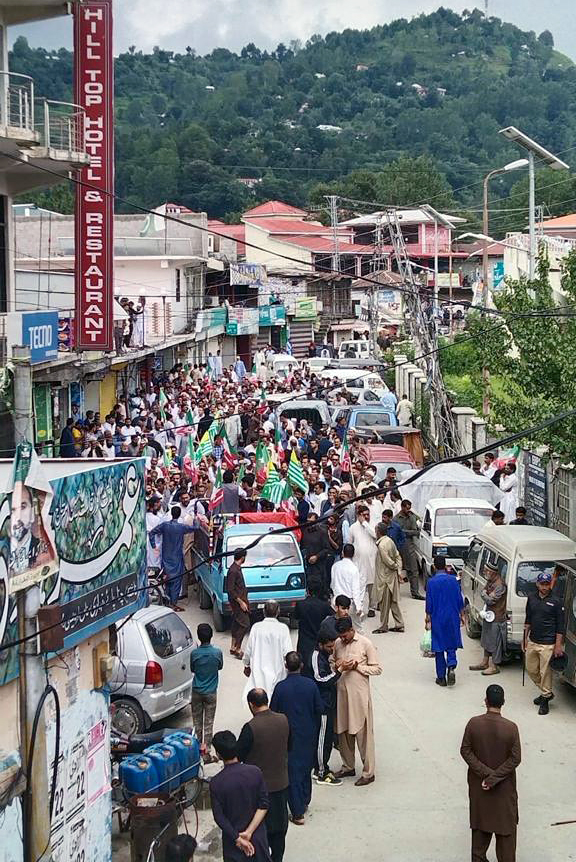 A scene of protests in Kotli, POJK
Along with human rights abuses and political and economic marginalisation for years, POJK residents are also fighting against a food and economic blockade that Pakistan has imposed to suppress the dissent—a situation reminiscent of East Pakistan before the 1971 Indo-Pak war. Islamabad had imposed economic and food blockades on its eastern flank before the Bangladesh liberation war in 1971.
Uncertainty looms large over the POJK, but right now people there are facing brute atrocities, including power cuts, an imbroglio on the movement of food and drinking water supply, a freeze in internet, mobile and landline services.
Pakistan is already under the lens of the international community for its atrocities in Balochistan and against religious minorities; years of unmitigated discriminatory approach against POJK residents have exposed Pakistan and its institutions, which are filled with religious zealots.
Farahnaz Ispahani, the former member of Pakistani parliament, in her write-up for Hudson Institute said, “The Pakistani government’s policies and institutions have become deeply sectarianized. Things have become worse in the past few decades due to a combination of factors. These include years of radicalisation of Pakistani society…in the name of Islam.”
Despite this, if Pakistan's institutions, including its military, have become increasingly radicalised in the name of Islam, why are the people of POJK—99% of whom follow Islam- still denied equal rights, dignity, and justice?
Pakistani decision-makers in Islamabad and Rawalpindi have deliberately kept POJK outside the formal constitutional framework in the name of a future plebiscite, all the while exercising extensive control over the region.
The result is that POJK residents find themselves in a prolonged political and economic crisis; they feel denied their rights for a meaningful participation in decision-making on issues affecting their political future, governance, and natural resources. This has raised fundamental questions about the gap between Pakistan’s commitment to Islamic solidarity and the realities on the ground in POJK.
Experts attribute Pakistan’s growing internal instability to the Punjabi-dominated state apparatus.
They argue that concentration of power in Islamabad (political) and Rawalpindi (Deep State), coupled with ongoing political and economic discrimination of people in POJK, Balochistan and other parts of Pakistan, is the reason behind the current turbulence in the country.
The deteriorating security situation in Balochistan points to the deeper crisis. In the latest attack, on July 3, the Baloch Liberation Army (BLA), a banned separatist group, claimed responsibility for killing more than 30 Pakistan Coast Guard personnel in Jiwani in Gwadar district of Balochistan.
Data compiled by the US-based NGO, the Armed Conflict Location & Event Data Project, shows a sharp increase in Baloch insurgents’-led violence over the past five years, with a 60% rise in fatalities in 2025, considered to be the deadliest year.
These incidents are an outburst of the deep-seated grievances that remain unaddressed. Balochis have over the years complained about enforced disappearances, extra-judicial killings, state repression, political marginalisation and the exploitation of the province’s abundant natural resources by Islamabad.
Experts say as long as Punjabis' dominance continues and regional aspirations are ignored and dealt with through repression, insurgency will never end in Balochistan.
The Bangladesh scene
Even as Pakistan grapples with a self-made crisis, Bangladesh, since the removal of Prime Minister Sheikh Hasina, is yet to take decisive action against growing footprints of radical Islamic groups.
Last month, as per Dhaka Tribune, black and white flags bearing the Kalma (the Islamic declaration of faith) sprang up across Mirpur, Chattogram, Cox’s Bazar and Faridpur. Visuals from rallies and motorcycle processions across other parts of Bangladesh also showed participants carrying similar flags bearing Arabic inscriptions. Such flags have been associated with terror groups like al-Qaida and the Islamic State.
#WATCH | Dhaka, Bangladesh: A reported bomb explosion occurred in Savar, near Dhaka, during a rally organised by the newly formed National Citizen Party (NCP), injuring at least three people.
— ANI (@ANI) July 6, 2026
The march marks the second anniversary of the student protests against former… pic.twitter.com/XbrsqDErE9
It has not so far been ascertained whether the Hizb-ut Tahrir, which held a ‘March for Khilafat’ in front of Dhaka’s main mosque last year, was behind the sudden emergence of Kalema bearing black and white flags in Bangladesh or some other outfits.
With its wings spread in several parts of the world, including Pakistan, Hizb-ut Tahrir, a radical Islamic outfit, undertakes a covert approach to disseminate its ideology and agenda. In 2009, the Sheikh Hasina government had banned this outfit.
But ironically, all radical Islamic groups outlawed before the Muhammad Yunus-led interim administration gained operational space in Bangladesh soon after the ouster of the Sheikh Hasina government in August 2024.
The interim regime lifted the ban on the hardcore Islamist group, Jamaat-e-Islami Bangladesh (JIB) and allowed it as a political outfit. The Sheikh Hasina government had banned the JIB for its links with Pakistan’s Islamist groups and the Inter-Services Intelligence.
The outfit, which had openly backed Pakistan during the 1971 war, despite the torture and mass killings of local Bengalis by the Pakistani Army personnel in East Pakistan, has long been accused of spreading radical ideologies and fanning sentiments against India within Bangladesh.
ALSO READ: MEA comes to rescue of Nazneen stuck at Doha airport
Overall, the trajectories of Pakistan and Bangladesh present a striking contrast. While Pakistan is finding it hard to contain the consequences of decades of political and economic discrimination and radicalisation, Bangladesh stands at a crossroads where the choices made today will determine whether it consolidates its gains or repeats mistakes that have caused instability in Pakistan.

.jpg "Gujarat’s women entrepreneurs bring their craftsmanship to life during Navratri")