




 Atir Khan
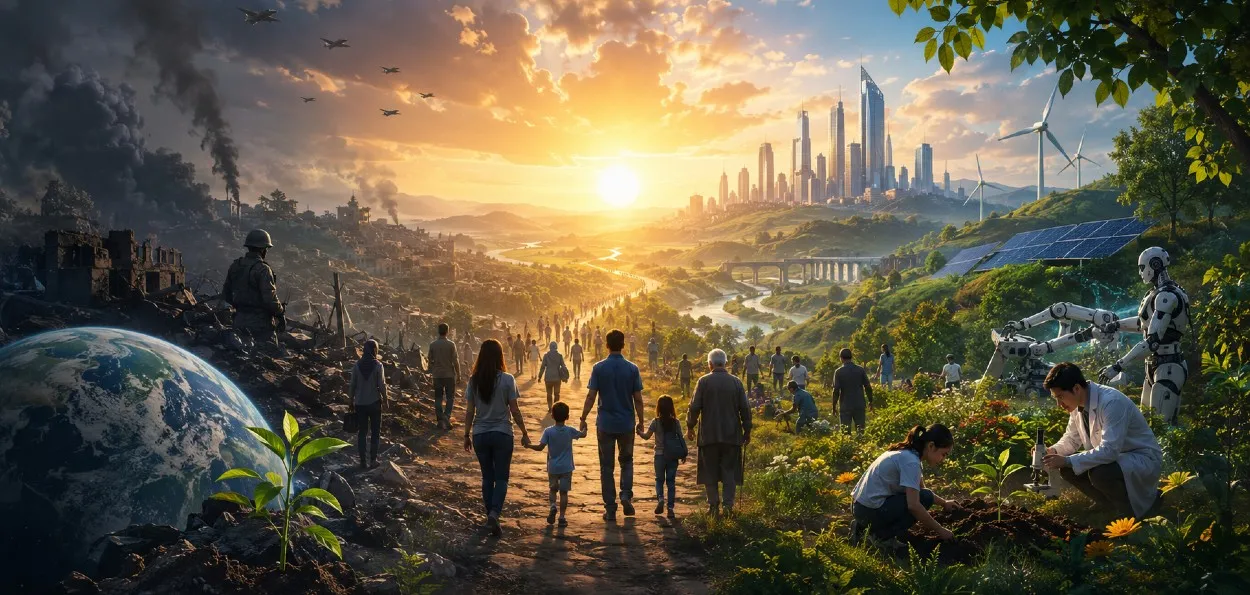
Our daily news feeds are crowded with predictions of impending catastrophe. Wars, religious polarisation, climate change, energy shortages, environmental degradation, artificial intelligence replacing humans, food insecurity and economic uncertainty dominate public discourse.
It is easy to believe that humanity stands on the edge of an irreversible crisis. Yet history tells a different story.
Every generation believed it was living through unprecedented times and that civilisation was approaching its end. Time and again, those predictions have failed. This does not mean humanity has escaped adversity. Rather, it has repeatedly demonstrated an extraordinary ability to adapt, innovate and recover.
For decades, two competing schools of thought have shaped our understanding of the future. Catastrophists warn that civilisation is headed towards collapse, while techno-optimists insist that innovation will solve every problem. Interestingly, both camps have often overestimated their ability to predict what lies ahead.
Take population growth. During the 1960s, many experts warned that the world's rapidly expanding population would inevitably trigger mass starvation and social collapse. Prestigious scientific journals projected relentless population growth and severe food shortages.
Reality unfolded very differently.
 Minister Sumitra Mahajan at the birth of India's one billionth baby, Aastha Arora, in 2000
Global population growth peaked at around 2.1 per cent annually in the late 1960s and has steadily declined ever since. Fertility rates are now falling across much of the world, and many countries are grappling not with population explosions but with ageing societies and shrinking workforces.
These demographic trends also challenge another persistent myth—that one religion or community will eventually overwhelm others through unchecked population growth.
Such fears have circulated for generations, yet they are rooted more in political rhetoric than demographic reality.
As fertility declines across regions and communities, simplistic narratives of demographic domination lose much of their credibility.
The same pattern is evident in food security. Not long ago, feeding eight billion people seemed an impossible task. Today, humanity produces enough food to nourish the global population.
Hunger has not disappeared, but it is increasingly a consequence of conflict, poverty and distribution failures, rather than an inability to produce enough food.
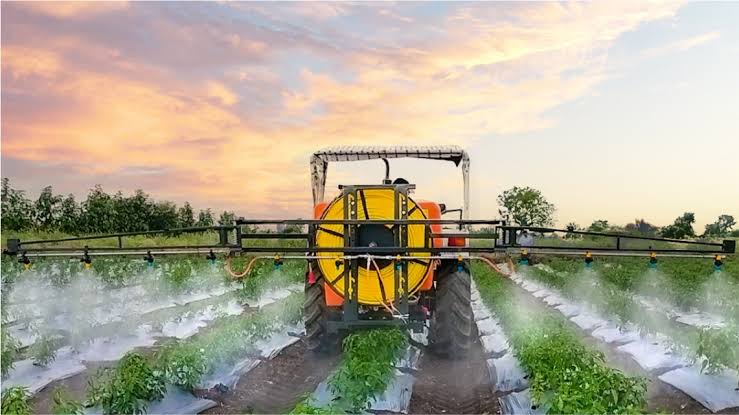
Human ingenuity has repeatedly expanded agricultural productivity beyond what earlier generations thought possible.
This broader story of progress is reflected across almost every major indicator. Despite two world wars, pandemics, financial crises and regional conflicts, people today are, on average, healthier, wealthier and better educated than at any other time in history.
Extreme poverty has declined dramatically over recent decades. Life expectancy has increased across much of the developing world, while millions have gained access to healthcare, education and modern infrastructure that previous generations could scarcely imagine. Recognising this progress does not require us to ignore genuine challenges such as climate change or environmental degradation. These are serious problems demanding sustained scientific, political and social responses. But history suggests that panic is rarely an effective strategy.
Human societies have consistently demonstrated an ability to confront difficult problems through innovation, adaptation and collective action. Artificial intelligence, the latest source of both excitement and anxiety, deserves the same balanced perspective.AI will undoubtedly transform professions, industries and the way we work, communicate and create.
 Asia's largest solar park in Gujarat
Yet the foundations of modern civilisation remain firmly rooted in the physical world. Steel, cement, ammonia and plastics continue to underpin our buildings, transportation systems, agriculture and manufacturing. No algorithm or chatbot can replace these essential materials or eliminate humanity's responsibility to produce them sustainably.
History also reminds us that technological optimism can be just as misleading as technological pessimism. During the Cold War, scientists explored ambitious ideas such as nuclear-powered aircraft and using underground nuclear explosions to extract natural gas.
One such experiment, Project Gasbuggy in New Mexico in 1967, detonated a 29-kiloton nuclear device—more than twice as powerful as the Hiroshima bomb—deep underground in the hope of boosting gas production. The experiment failed, joining a long list of grand technological visions that never fulfilled their promise.
The story of nuclear energy illustrates how difficult it is to predict technological futures. Around 70 per cent of France's electricity is generated by nuclear power, while Germany chose a very different path.
India, too, witnessed intense political opposition when nuclear power expansion was proposed. Different societies, faced with similar technologies, often make very different choices.
More recent forecasts have proved equally unreliable. Predictions about the pace of electric vehicle adoption, renewable energy, cryptocurrencies and countless other innovations have repeatedly missed the mark—not because these technologies lack potential, but because human behaviour, economics, public policy and markets are extraordinarily difficult to forecast.
The lesson is both simple and reassuring. The future has never unfolded exactly as experts imagined. Some fears have proved exaggerated. Some breakthroughs have exceeded expectations. More often, reality has emerged from an unpredictable combination of scientific discovery, human resilience, sound policy and sheer chance.
Thinkers such as Yuval Noah Harari have rightly raised important questions about the transformative potential of artificial intelligence. AI is undoubtedly a revolutionary technology, but it is unlikely to replace every other technology that sustains modern life.
Just as billions of landline telephones were replaced by mobile phones within a generation, some digital technologies can spread with astonishing speed.

Physical infrastructure, however, evolves differently. It will not be possible to replace terawatts of electricity generated by steam and gas turbines with photovoltaic cells or wind turbines within a similarly short period. Technological transitions are rarely instantaneous.
The warnings deserve thoughtful consideration. But predictions should inform public debate, not imprison our imagination. The future is never written in advance.
Human civilisation has endured wars, pandemics, economic collapses, technological revolutions and profound social transformations. Through every upheaval, humanity has adapted, learned and moved forward.
That should inspire confidence—not complacency. We should prepare wisely for tomorrow without surrendering today's peace of mind. Concern for the future is necessary; constant fear is not.
Many of the rewards of the choices we make today will not be ours to enjoy. We may never fully witness the benefits of restoring forests, reducing pollution or protecting the environment. Those rewards may belong to our children and grandchildren.
But that has always been the story of civilisation. Every generation inherits the sacrifices of those who came before and leaves behind a better foundation for those yet to come.
ALSO READ: Farkhanda Khan Fida's artistic journey is inspired by M F Husain
The greatest strength of the human species has never been its ability to predict the future with precision, but its remarkable capacity to shape that future through resilience, creativity and hope.
Perhaps that is the most reassuring story of all!.













_(1)_(1).webp)



_(1).webp)