 Pallab Bhattacharyya
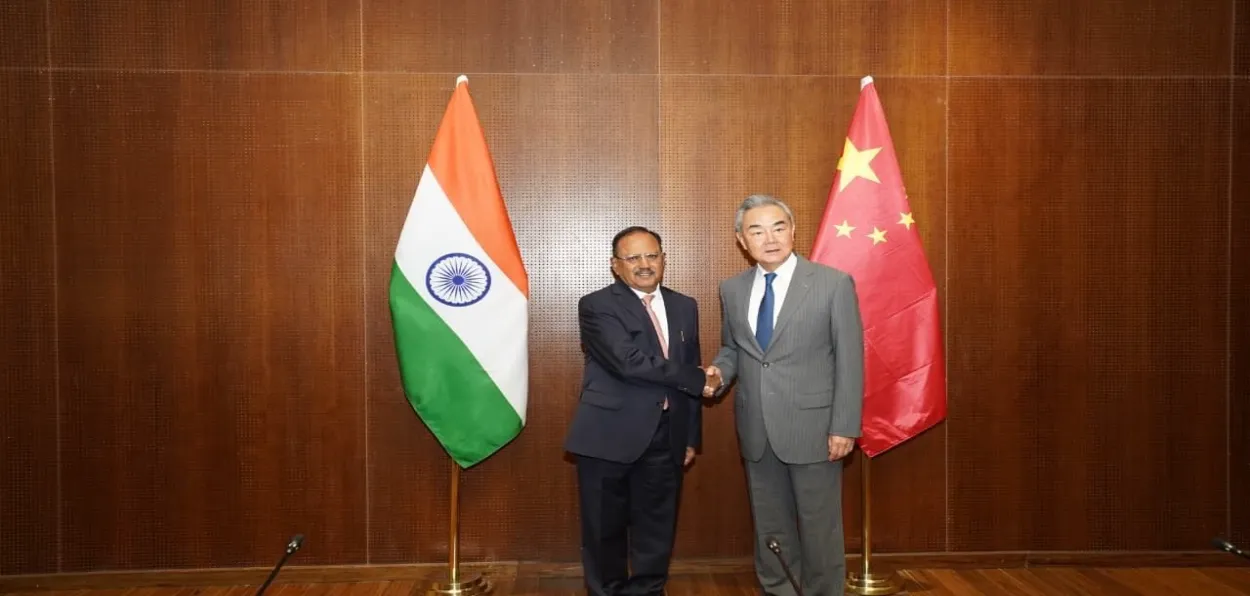
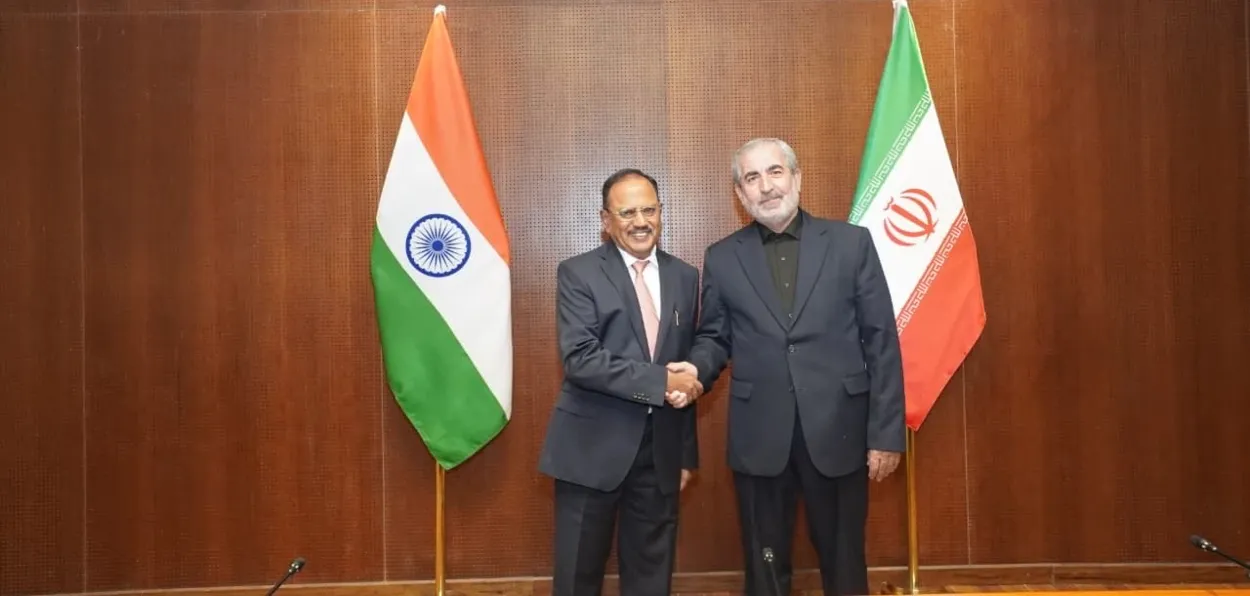
On June 22, on the sidelines of the 16th BRICS National Security Advisers' Meeting in New Delhi, National Security Advisor Ajit Doval held a significant bilateral meeting with Ghadir Nezamipour, the Deputy Secretary for Defence Affairs at Iran's Supreme National Security Council. The two-day summit saw senior security officials from China, Brazil, Ethiopia, and other member nations together and it provided a diplomatically charged backdrop for this important exchange.
Both sides reviewed the evolving situation in West Asia, deliberated on bilateral ties, and explored cooperation within the BRICS framework. That the meeting came barely days after the signing of a landmark 14-point Memorandum of Understanding between the United States and Iran — formally ending over 110 days of military conflict — made it all the more consequential. Doval's engagement with Nezamipour signalled India's careful attempt to recalibrate its relationships in a region now tentatively stepping back from the abyss.
The US-Iran conflict erupted on February 28 when coordinated American and Israeli strikes targeted Iranian infrastructure. Iran's retaliatory closure of the Strait of Hormuz — through which approximately 20 per cent of the world's oil and 20 per cent of global LNG trade transits — constituted the most severe energy supply shock in modern history. Hundreds of tankers were stranded in the Persian Gulf, insurance premiums skyrocketed, and commodity prices entered prolonged volatility.
For India, the implications were immediate. As the world's third-largest energy consumer, India depends on the Strait of Hormuz for roughly 40 per cent of its crude imports, while nearly 90 per cent of its LPG imports move through that single corridor. The blockade sent India's import bill soaring and stoked inflationary pressures, threatening to derail an economy navigating US tariff turbulence and sluggish global demand.
The 14-point MOU signed between President Donald Trump and Iranian counterpart Masoud Pezeshkian — formalised in Versailles and confirmed on June 19, 2026 — offers a fragile but welcome reprieve. Under its terms, all military operations on every front, including in Lebanon, were to cease immediately and permanently.
The United States committed to lifting its naval blockade of Iranian ports within 30 days, restoring maritime traffic to pre-war volumes. Iran pledged toll-free passage through the Strait of Hormuz for at least 60 days and confirmed it would neither acquire nor develop nuclear weapons, agreeing to address its enriched uranium stockpile under IAEA supervision.At the BRICS National Security Advisers' Meeting, NSA Ajit Doval says, "𝐈𝐧𝐝𝐢𝐚 𝐰𝐞𝐥𝐜𝐨𝐦𝐞𝐬 𝐭𝐡𝐞 𝐌𝐎𝐔 𝐫𝐞𝐚𝐜𝐡𝐞𝐝 𝐛𝐞𝐭𝐰𝐞𝐞𝐧 𝐭𝐡𝐞 𝐔𝐒 𝐚𝐧𝐝 𝐈𝐫𝐚𝐧...The opening of the Strait of Hormuz is a very welcome development. It will remove supply chain bottlenecks… pic.twitter.com/kx6FEsXU4D
— All India Radio News (@airnewsalerts) June 23, 2026
Washington further committed to issuing waivers covering Iranian crude oil, petroleum products, and related banking and transportation services, while also unfreezing billions in Iranian assets. A $300 billion reconstruction fund for Iran is envisioned, financed by the US and regional partners. Both sides have a 60-day window to negotiate a comprehensive final agreement, extendable by mutual consent and ultimately to be endorsed through a UN Security Council resolution.
For India, the geopolitical and economic significance of this MOU can scarcely be overstated. The most immediate gain is the restoration of reliable energy supply lines. Brent crude slipped below $80 a barrel in the days following the signing, easing fears of a sustained inflationary spiral. India, which spent approximately $123 billion on oil imports in FY26, stands to benefit from lower crude prices, a strengthened rupee, a narrowed current account deficit, and reduced pressure on sectors ranging from aviation and petrochemicals to fertilisers and logistics.
The World Bank had already raised India's FY27 growth forecast to 6.6 percent before the MOU was finalised; a durable peace framework could add further momentum to that trajectory.
Beyond energy, the deal opens a window of extraordinary strategic opportunity through revival of the Chabahar Port and the International North-South Transport Corridor. India had invested over $120 million in developing the Shahid Beheshti terminal at Chabahar, offering a maritime gateway bypassing Pakistan and connecting directly to Afghanistan, Central Asia, Russia, and Europe.
US sanctions had progressively strangled this ambition: the 2026-27 Union Budget carried zero allocation for Chabahar, and the last American sanctions waiver expired on April 26, 2026. The MOU's seventh clause — committing the United States to terminating all forms of sanctions against Iran in an agreed schedule — holds out the prospect of a full Chabahar revival. With sanctions lifted, India could resume active port operations and accelerate the INSTC, the 7,200-kilometre multimodal freight corridor linking Mumbai to Moscow through Iran, potentially cutting shipping time to Russia and Europe by nearly half compared to the Suez Canal route.
The bilateral reset that the Doval-Nezamipour meeting embodied reflects a broader strategic logic New Delhi has long pursued: independent, multi-vector diplomacy that refuses permanent subordination to any single power. India had resumed crude and LPG imports from Iran in April 2026 after a seven-year break, a signal analysts described as marking the limits of New Delhi's tilt toward Washington.
The BRICS meeting itself was emblematic of this approach, bringing India together with China, Iran, Brazil, and Ethiopia in a parallel security architecture. Doval's meeting with Nezamipour reinforced that India's relationship with Iran is structurally significant — woven into India's vision of regional connectivity, energy security, and its aspirations as an independent pole in a multipolar world.
For global trade, the reopening of the Strait of Hormuz marks the beginning of a slow but crucial unwinding of one of the worst supply-chain crises of the decade. Shipping through the Strait had plunged by approximately 95 percent during the conflict's peak, and the backlog of stranded tankers means normalisation will take months.
ALSO READ: Bhiwandi mosque opened doors to NEET parents, showed way to brotherhood
The directional signal nevertheless matters: Asian equity markets touched record highs following the MOU signing, and Iranian oil returning to global markets in volume could ease energy costs across the developing world. The 60-day negotiating window is strewn with formidable challenges — Iran's nuclear stockpile, Israel's conspicuous absence from the MOU text despite its military presence in Lebanon, and competing interests from Saudi Arabia to Hezbollah. India's diplomacy in the weeks ahead, quietly advanced through channels opened at the BRICS NSA meeting, will be decisive in ensuring the fragile promise of June 2026 is not squandered.










_(1).webp)
.webp)