




 Rajeev Narayan
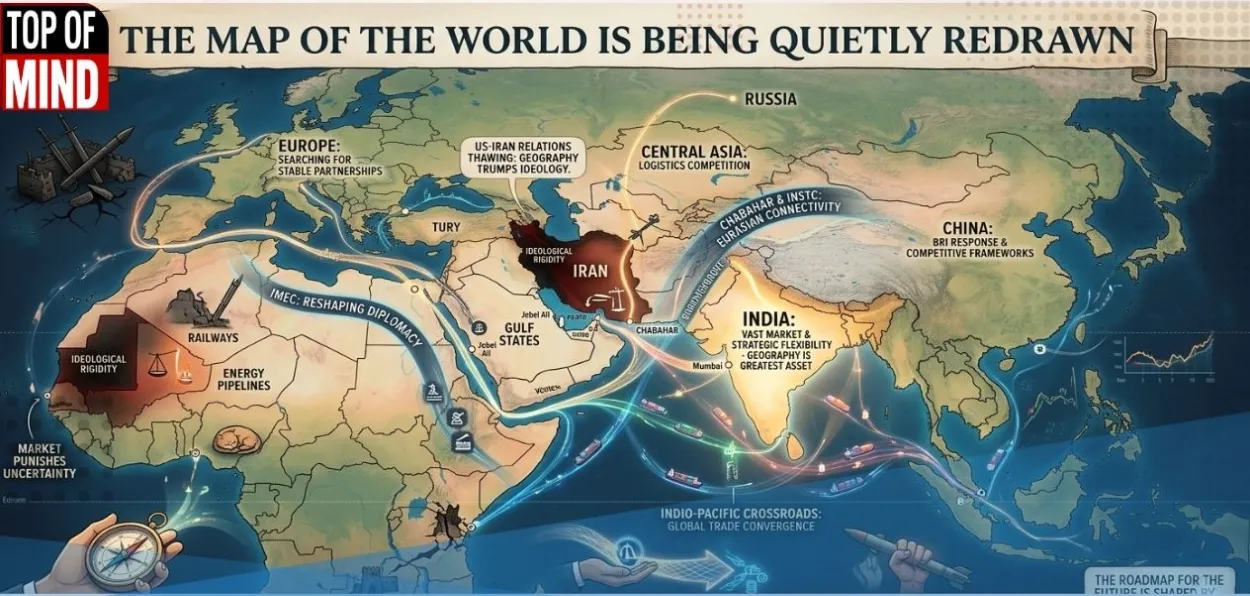
Quietly, the map of the world is being redrawn. It is not being done through conquest or wars. It is not even being done through ideology. It is being done through economics, trade, currencies, markets and ports. Across deserts, oceans and rail tracks in Europe, in the Gulf and in Central Asia, a contest is unfolding, one that may define the balance of power more than armies or missiles can. Nations are racing not to grab territory, but to control connectivity. Trade routes, logistics corridors, energy pipelines, ports and shipping lanes are the new instruments of influence, as consequential as military alliances once were.
Given this backdrop, the thaw between the US and Iran is more than a diplomatic accommodation. It signals the arrival of a geopolitical transition in which geography, commerce, logistics and connectivity become more consequential than ideological rigidity. Trade routes will matter more than battle lines. Ports will acquire strategic value once reserved for military bases. Economic corridors will reshape diplomacy faster than political rhetoric. And few countries stand to gain more from this shift than India.
This does not mean that India can afford complacency, battling a security environment tainted by friction with Pakistan and China. Defence preparedness, deterrence capability and modernisation, therefore, remain non-negotiable imperatives. But the ongoing global transformation offers India an extraordinary geopolitical opportunity, provided it leverages its core strengths of demographic scale, skilled manpower, market size and strategic flexibility. For perhaps the first time in decades, India’s location itself is one of its greatest assets.
Maps Being Redrawn
The US-Iran peace deal proves that economic concerns are outselling military action. For years, skirmishes in West Asia disrupted oil markets, shipping lanes and investor confidence. Yet, the economic costs of instability became impossible to ignore. Inflation surged, and freight costs jumped, leaving supply chains vulnerable. Even distant economies felt the aftershocks. And inevitably, economics entered the geopolitical equation.
Trump seems to think he signed the MOU with Iran last night. He signed in Wednesday in France. pic.twitter.com/IFCQRx2UsN
— MeidasTouch (@MeidasTouch) June 19, 2026
Today’s world is living with instability, and life is becoming financially untenable. Historically, markets have punished uncertainty faster than diplomacy can resolve it. For investors, reward predictability. Countries facing inflation and growth shifts realise that economic survival demands strategic restraint. This change is shifting the global order away from ideological confrontation and towards economic pragmatism.
India’s Geography
In this transition, India’s significance is rooted not merely in economic growth, but in geography itself. Positioned between the Indo-Pacific, the Gulf and Eurasia, India occupies a strategic location in the global economy. Trade routes connecting Europe, West Asia, Central Asia and East Asia intersect in the Indian Ocean region. Energy flows critical to global markets pass close to Indian shores. Connectivity projects linking continents place India at the centre of geopolitical permutations. For years, policymakers treated geography as a challenge. Today, that same geography is becoming an economic opportunity.
The Chabahar Port project once illustrated this evolution. Now, initiatives such as the India-Middle East-Europe Economic Corridor reflect a new reality – that global economic competition is being fought through infrastructure and logistics, not conventional military confrontation. The leaders of the 21st Century are building corridors as aggressively as previous generations-built alliances.
Post-Ideological World
In today’s volatile environment, India’s foreign policy instincts suddenly appear remarkably well thought-out. For years, New Delhi’s autonomy was criticised as ‘ambiguity’. India maintained relationships simultaneously with the US, Moscow, Tehran, the Gulf and Europe. And lately, the global order has been rewarding precisely such flexibility. The future clearly belongs less to rigid alliances and more to overlapping partnerships.
India understands something critical about geopolitics – that geography outlasts ideology. Political systems change. Governments rise and fall. Alliances shift. But trade routes, energy needs and geographic compulsions endure. This is why India’s diplomacy in West Asia matters. It affects energy security, inflation, remittances and growth. In a new world, strategic flexibility is less a diplomatic luxury and more an economic necessity.
Corridor Century
In the coming decades, geopolitical contests will revolve around connectivity. China recognised this early with the ‘Belt and Road’ project. With ports, railways and infrastructure financing, it converted economic connectivity into Chinese influence across continents. Other powers are responding with competing architectures of their own. This is not accidental.
Infrastructure is not only developmental, but it is geopolitical too. The map of the future will be defined not by ideological blocs but by economic corridors. For India, this creates both urgency and possibility. New Delhi cannot rely solely on demographic optimism or domestic markets, as India’s long-term rise will also depend on how effectively it integrates itself into regional and global economic architectures. The modern contest is not just about defending borders. It is also about securing corridors, supply chains and access points. Economic geography is the new hotbed of competition.
Changing Destiny
Hidden in the transformation is a cause for concern. Geography’s return does not mean the death of conflict. India’s security challenges are real and immediate. In a turbulent neighbourhood, military preparedness will continue to matter. Also, strategic deterrence cannot be sacrificed in pursuit of economic optimism. But the lesson of the emerging global order is clear as well – that nations that remain connected may prove more influential than nations that remain isolated within ideological rigidity.
The future may not belong to those who choose sides permanently. It will belong to countries capable of speaking across camps, managing complexity and building networks of commerce, energy and connectivity that outlast political turbulence. India possesses many of the ingredients needed to pull off such a role. Geography has placed it at the centre of emerging trade architectures. Demography provides scale. Manpower offers competitiveness. A vast market means economic gravity. Autonomy allows diplomatic flexibility. The challenge lies in converting those advantages into a durable influence.
READ MORE: Tasir Ali is a proud father of five sons in uniform
For centuries, geography has shaped the rise and fall of civilisations. Then ideology overshadowed it for a bit. Now, as trade routes regain importance, as connectivity overtakes confrontation and as economics begin disciplining geopolitics, geography may once again become destiny. In that returning geography, India could discover the true economic pull of its strategic centrality.
The writer is a veteran journalist and communications specialist.









_(1)_(1).webp)



.webp)
.webp)

_(1).webp)