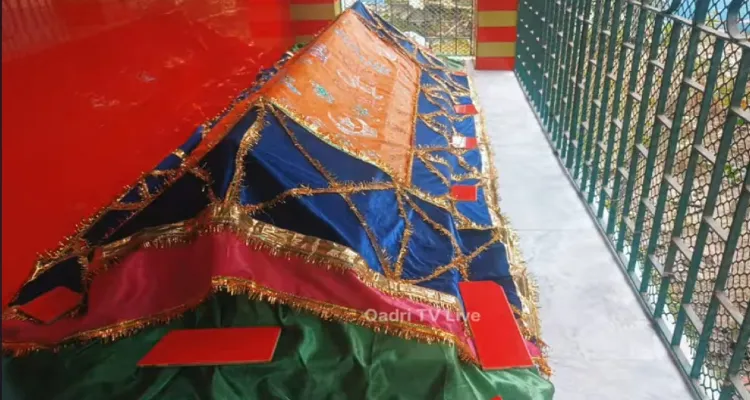
_(1).webp "tHE shrine of Hazrat Syed Shah Ehteram Al Qaderi")
Deb Kishore Chakraborty
As one moves away from the bustle of Arambagh town towards Miyapara, the atmosphere seems to change. Just behind Miyapara Jama Masjid lies a cemetery. Within this cemetery stands the sacred shrine of Hazrat Syed Shah Ehteram Al Qaderi. For residents, this place is not merely a grave. It is an important religious site associated with reverence, remembrance and spirituality.
Standing inside the cemetery, the first thing one notices is the surrounding silence. Amid rows of graves, the grave of Hazrat Ehteram Al Qaderi can be identified separately. Local people believe that this is where the Sufi saint rests. The shrine has therefore remained associated with religious devotion and respect for generations.
The location of the shrine also has a special significance. Since it is situated directly behind Miyapara Jama Masjid, the place is easily accessible to religious devotees. With the mosque, cemetery and shrine located close to one another, the entire area has developed a peaceful and religious atmosphere.
The title “Al Qaderi” associated with the name of Hazrat Syed Shah Ehteram Al Qaderi naturally brings to mind the Qadiri Sufi order. Qadiriyya is one of the oldest and most prominent Sufi traditions in Islam. Its heritage is associated with Hazrat Abdul Qadir Jilani. Over time, various branches of the Qadiri order spread across different parts of the Indian subcontinent.
This tradition of Sufi spirituality places particular emphasis on self-purification, remembrance of Allah, moral living, love for humanity and service to people. In different parts of Bengal, khanqahs, dargahs and shrines associated with this tradition have influenced not only religious life but also social life.
The association of the title Qaderi with the saint buried at the Arambagh shrine naturally raises questions about his connection with the Qadiri tradition. However, no reliable publicly available documentation provides detailed information about his spiritual guide, specific genealogy or silsila. Therefore, it is important to present his identity while respecting the beliefs and reverence of local people.
Speaking to residents at the shrine makes it clear that the history of a religious site does not remain confined to old documents. It also develops its own history through collective memory. The remembrance of a saint across generations, paying respect at his grave and considering the place sacred are all important parts of local religious culture.
The shrine of Hazrat Syed Shah Ehteram Al Qaderi carries this atmosphere of memory. Since it is situated inside a cemetery, there is no excessive grandeur at the site. Instead, its silence and peaceful surroundings are among its defining characteristics. Standing behind the mosque in the cemetery, the shrine creates a quiet space amid the town's busy life.

Standing at the shrine naturally raises several questions. Who was Hazrat Syed Shah Ehteram Al Qaderi? When was he born and when did he pass away? Where did he come from Arambagh? Who was his spiritual guide? How deep was his connection with the Qadiri silsila? Was there a khanqah functioning here during his lifetime?
The complete answers to these questions are still unclear. Yet the respect shown by local people towards his grave and the long-standing memories associated with it demonstrate that the saint holds a special place in the religious landscape of Arambagh.
Although present-day Arambagh is known as a busy subdivision town, its history is long. The Arambagh subdivision was established in 1819. At that time the area was known as “Jahanabad”. Later, on April 19, 1900, its name was changed to “Arambagh”.
Over this long history, various religious and social institutions developed in the region. The shrine at Miyapara is one local reminder of this diverse religious heritage.
Today, standing in front of the shrine, one can see the peaceful cemetery, the nearby Jama Masjid and a grave surrounded by reverence. It is not architectural grandeur that defines the place. Rather, the faith and memories of the people appear to be its most important identity.
On the map of Arambagh, this may be a small space. But for local people, the shrine of Hazrat Syed Shah Ehteram Al Qaderi represents much more. It is a place carrying the memory of a Sufi saint, a centre of religious devotion and a silent witness to the diverse cultural heritage of Arambagh.
ALSO READ: Sundarbans student Selima Molla to witness ID Parade from Invitees' Gallery
Behind Miyapara Jama Masjid, within the cemetery, the memory of a Sufi saint therefore continues to rest in silence. The town may have changed with time, but that memory continues to live on through the respect of the local people.



_(1).webp "Graves of Sufis at Triveni-Saptagram Khanqah")