 Shankar Kumar
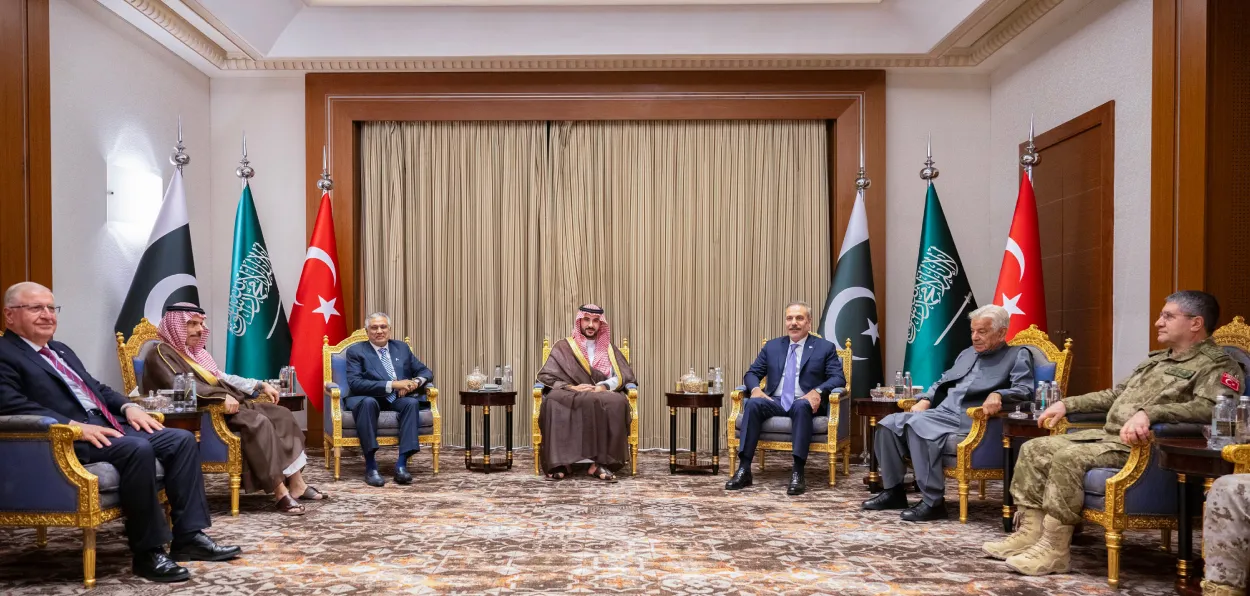
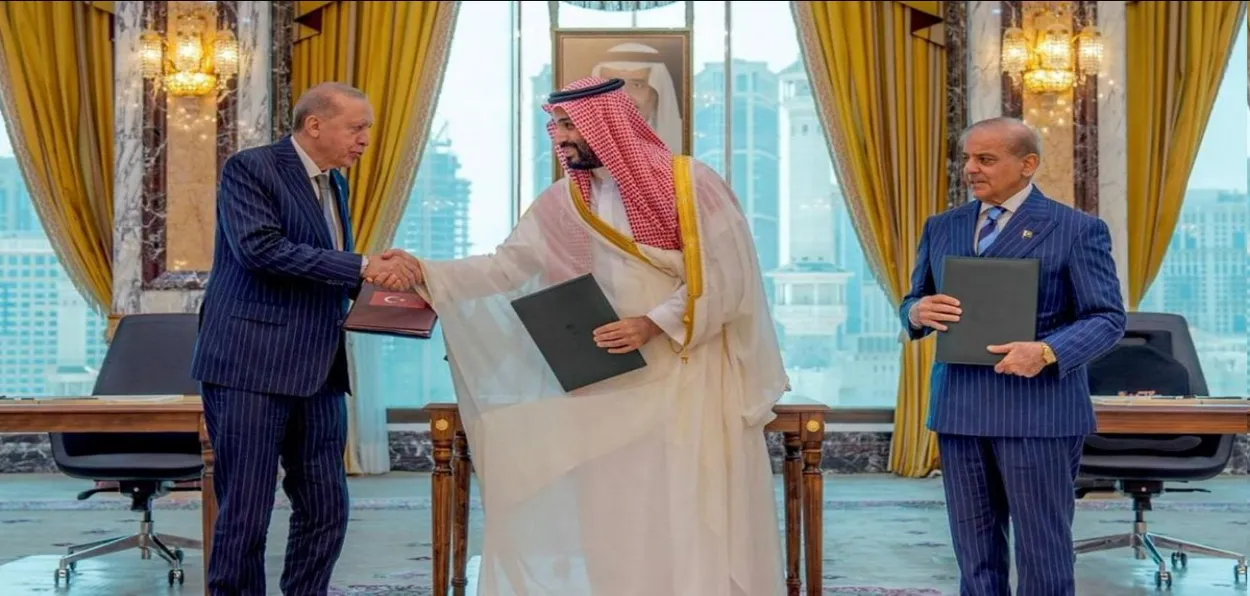
On August 7, amid a shifting geopolitical situation in West Asia, Saudi Arabia, Turkey and Pakistan signed a trilateral defence pact in the Saudi holy city of Mecca. The pact, which is intended to provide a combined deterrence against an act of aggression, as these three signatory countries said in their joint statement, is that an armed attack against any of the three is to be regarded as an attack on all.
The pact is viewed as a major development in the Islamic world as it comes at the time when joint US-Israel strikes against Iran have profoundly impacted the security situation in the West Asian region, with the Strait of Hormuz emerging as a major flashpoint between Tehran and Washington DC.
However, for India, as some strategic experts opine, the trilateral pact is not without its share of challenges. They argue that if New Delhi carries out punitive strikes, as it did last year under ‘Operation Sindoor,’ against terrorist hideouts in Pakistan, Islamabad would not think twice in portraying such Indian attacks as acts of war.
It would deliberately depict Indian military response as an act of war in an attempt to warrant invocation of the trilateral pact’s collective-defence provisions, and draw Turkey and Saudi Arabia into the conflict, argued these experts.
However, this view overlooks that the trilateral pact’s practical significance would depend on how the two other signatories interpret an incident. If India characterises its attack against Pakistan as a counter-terrorism operation, will Saudi Arabia and Turkey still go by Islamabad’s version? Moreover, Saudi Arabia’s military alignment against India is highly unlikely.
Under Vision 2030, Riyadh is pursuing economic transformation which requires strong partnerships with major economies. Saudi Arabia considers India as its long-term economic partner. Given this, Saudi Arabia undertaking any disruptive military action against India would be highly improbable.
Then the trilateral pact is riddled with vagueness. First of all, even if it lays emphasis on the principle of collective defence provisions, it does not spell out automatic military obligations as within NATO. Nor does it set out a NATO-like institutional structure, military command system or have any clause that could define a response mechanism. It is also silent on the common budget of the military alliance.
Additionally, strategic experts maintain that phrases like “an attack on one is an attack on all” do not necessarily mean an automatic declaration of war or automatic deployment of troops.
In this regard, Turkish Foreign Minister Hakan Fidan’s statement assumes high significance. In an interview with a Turkish news outlet, Anadolu Agency, he said that an attack on a member country will only be considered a common threat if that country formally requests assistance.
Besides, the pact does not specify what military obligations each member would assume if Pakistan or any other member of the pact comes under attack. Whether a member under attack would be provided with troops or an air defence system, weapons, logistical support, intelligence or diplomatic assistance--there is no clarity on military assistance and its nature, said strategic experts.
Amid this, it is a fact that neither Pakistan nor Saudi Arabia nor Turkey has a history of providing military support. In December 2015, Saudi Arabia announced the formation of the Islamic Military Counter Terrorism Coalition (IMCTC) with more than 40 Islamic countries, including Pakistan as its members. IMCTC’s headquarters was set up in Riyadh with former Pakistan Army Chief General Raheel Sharif as its head.
On September 15, 2018, Pakistan rejected Saudi Arabia’s call for support in its fight to halt the advance of Al Houthi rebels in Yemen. In fact, Pakistan’s parliament went ahead and voted against joining Riyadh-led military intervention in the West Asian country. This, however, was not an isolated incident of breach of commitment by Pakistan.
Last September, Islamabad and Riyadh signed the Strategic Mutual Defence Agreement, pledging that any aggression against one would be considered an attack against both. “If either Pakistan or Saudi Arabia is attacked from anywhere, it will be considered an attack on both nations, and we will respond together,” remarked Pakistan’s Defence Minister Khawaja Asif after Islamabad and Riyadh signed the Strategic Mutual Defence Agreement.
Yet, since the US and Israel launched combined attacks on Iran in February, Saudi Arabia has faced repeated attacks on its military and non-military assets by the Houthis and Iran. Pakistan has remained stoically silent; it has not responded militarily to attacks from Iran or the Houthis in Saudi Arabia even though it has expanded its military presence in the Gulf country by deploying thousands of troops, fighter aircraft and drones there.
In view of this, questions have been raised about whether the commitments made by Pakistan, Saudi Arabia and Turkey under the joint military pact would at all be honoured in the event of a crisis. The incident also casts doubt on the pact’s effectiveness and credibility.
ALSO READ: At 25, Capt Haneef laid down his life for his men and country
India’s Ministry of External Affairs has meanwhile limited its response to a brief and cryptic comment that New Delhi was closely monitoring the situation. “This is also a development that we are closely following, and we shall keep you updated,” MEA Spokesperson Randhir Jaiswal said. On the other hand, neither the US nor Israel has issued a formal statement on the trilateral military pact so far.

.jpg "Gujarat’s women entrepreneurs bring their craftsmanship to life during Navratri")