New Delhi
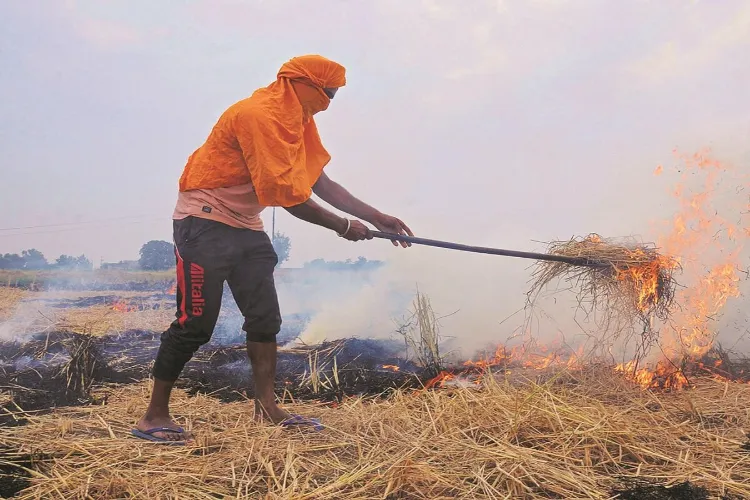
The Centre has taken several measures to curb crop residue burning in North India, a key contributor to deteriorating air quality in the Delhi-NCR region during winters.
In a written reply in the Lok Sabha, Kirti Vardhan Singh, Union Minister of State for Environment, Forest and Climate Change, said the government has been supporting farmers with financial assistance, machinery and policy interventions to promote alternative crop residue management practices.
Singh said that "active fire events due to crop residue burning are monitored using satellite remote sensing, following the 'Standard Protocol for Estimation of Crop Residue Burning Fire Events using Satellite Data' by the Consortium for Research on Agroecosystem Monitoring and Modeling from Space (CREAMS) Laboratory, Division of Agricultural Physics, ICAR-Indian Agricultural Research Institute, New Delhi."
He said farmers are being facilitated with alternatives such as in-situ crop residue management and ex-situ utilisation of paddy straw. "The in-situ crop residue management includes in-situ mulching or incorporation of the paddy residue in the field itself through efficient and affordable mechanised means or crop residue management machinery," Singh said.
To support the efforts of Punjab, Haryana, Uttar Pradesh and Delhi, the Ministry of Agriculture and Farmers Welfare launched a Central Sector Scheme on Crop Residue Management in 2018-19 to subsidise the machinery required for managing crop residue.
Under the scheme, 50% financial assistance is provided to farmers for purchasing crop residue management machinery, while 80% assistance is provided to rural entrepreneurs, farmer cooperatives, self-help groups, farmer producer organisations and panchayats for establishing Custom Hiring Centres.
The minister said financial support of 65%, up to Rs 1.50 crore, is also provided to paddy supply chain projects for machinery and equipment such as higher horsepower tractors, cutters, tedders, balers, rakers, loaders, grabbers and telehandlers.
"During the period from 2018-19 to 2025-26 (as on 10.03.2026), Rs 4,237.47 crores have been released. The States have distributed more than 3.53 lakh machines to the individual farmers and established more than 43,535 Custom Hiring Centres in the States," Singh said.
The minister added that the Commission for Air Quality Management in NCR and Adjoining Areas (CAQM), constituted under the CAQM Act, 2021, has issued several directions to address air pollution and crop residue burning in the region.
These include Direction 90 issued on May 9, 2025, which calls for a plan to ensure rent-free availability of crop residue management machines for small and marginal farmers, and Direction 92 issued on June 3, 2025, mandating the use of paddy straw-based biomass pellets or briquettes in brick kilns located in districts beyond the NCR in Punjab and Haryana.
The CAQM also issued Direction 95 on October 1, 2025, authorising district authorities to file complaints before jurisdictional judicial magistrates in cases of inaction by officials responsible for enforcing measures to eliminate stubble burning.
Singh said the commission has also directed coal-based thermal power plants located within a 300 km radius of Delhi to co-fire biomass-based pellets or briquettes with coal to promote the use of biomass.
The Ministry of Environment, Forest and Climate Change has also notified the Environment (Utilisation of Crop Residue by Thermal Power Plants) Rules, 2023, mandating a minimum five per cent blend of pellets or briquettes made from crop residue along with coal by thermal power plants in the NCR and adjoining areas.
Additionally, the Central Pollution Control Board has framed guidelines for one-time financial support from Environment Protection Charge funds for establishing pelletisation and torrefaction plants to promote the utilisation of paddy straw.
READ MORE: An officer can't afford to go wrong, says top cop Ajeetha Begum
To monitor compliance, 31 flying squads from the CPCB were deployed between October 1 and November 30, 2025, in identified hotspot districts of Punjab and Haryana to track actions and coordinate with district authorities and pollution control boards.
"With coordinated efforts, the States of Punjab and Haryana have collectively recorded more than 90% reduction in fire incidences during paddy harvesting season in the year 2025 in comparison to the same period in the year 2022," Singh said.










.webp "MEA Additional Secretary (USA & Canada) Nagaraj Naidu")