Gandhinagar (Gujarat)
With a steadfast commitment to empowering citizens through good governance, the state government has remained consistently proactive, launching multiple initiatives to ensure that development reaches even the remotest areas and to strengthen women's participation in India's growth journey.
Under the guidance of Prime Minister Narendra Modi, the Central Government launched the Lakhpati Didi Yojana in 2023 to economically empower three crore women by 2027.
In Gujarat, under the leadership of Chief Minister Bhupendra Patel, the scheme has been effectively implemented, resulting in 5.96 lakh women achieving annual incomes exceeding Rs 1 lakh by December 2025 and proudly emerging as Gujarat's Lakhpati Didis.
The Chief Minister stated that, guided by the Prime Minister's vision, Gujarat has adopted multiple successful initiatives to strengthen women's empowerment. He added that, with effective implementation of the Lakhpati Didi scheme, the state is well-positioned to enable 10 lakh women to become Lakhpati Didis in the near future.
Kankuben Garva from Kutch earns an annual income of over ₹10 lakh.
The state government has effectively implemented the Lakhpati Didi programme at the grassroots level, leading to a transformative impact on women's livelihoods. Kankuben Garva, a resident of Mankuwa village in Bhuj, Kutch, hails from a family traditionally engaged in handicrafts.
Through her participation in the Saras Mela, she gained a wider platform to showcase Kutch handicrafts, creating new market opportunities. With support from a Rs 1.5 lakh Community Investment Fund and a Rs 4 lakh cash credit loan, she established a shop in her village and expanded production by mobilising other women from her self-help group.
Today, her products are marketed beyond the state, and she continues to scale up her enterprise through sales on prominent online platforms such as Amazon. Earning an annual income of over Rs 10 lakh, Kankuben attributes her success largely to the sustained support from the state government under the Livelihood Mission.
Bhavanaben gains a new identity through the Namo Drone Didi Yojana
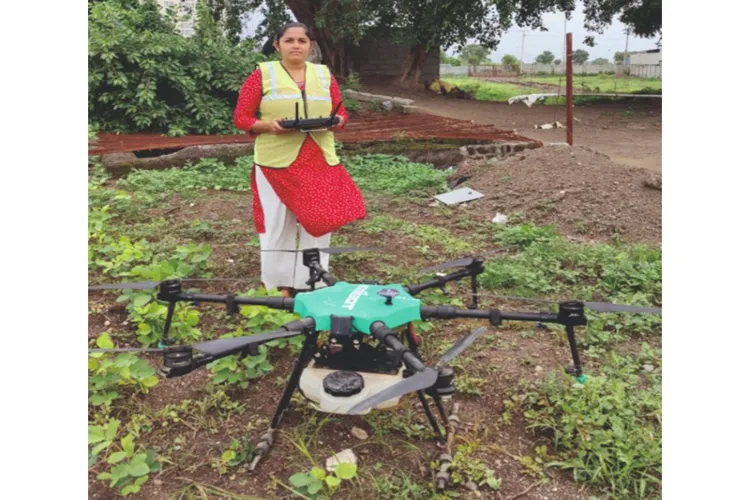
Bhavanaben Bharatkumar Chaudhary, a resident of Varsada village in Kankrej taluka of Banaskantha district, has earned a distinct identity in the region as a Drone Didi. Educated up to the bachelor's level, she is actively engaged in animal husbandry and agriculture.
Selected under the Namo Drone Didi Yojana, she received specialised training in pesticide spraying using drones and is now widely recognised as a Drone Didi across Kankrej taluka. While continuing to live and work in her village, she is realising her aspirations and motivating other women to become Aatmanirbhar. Under the Namo Drone Didi Yojana, women aged 18 to 60 years, with a minimum Class 10 qualification, are eligible to train and work as drone pilots.
Identification of over 10 lakh potential Lakhpati Didis in Gujarat
Currently, trained Community Resource Persons (CRPs) in the state have identified 10.74 lakh women with the potential to become Lakhpati Didis. To systematically capture details of their existing livelihood activities, available resources, expenditure, and income, the Ministry of Rural Development, Government of India,
has developed a Digital Livelihood Register. Based on data from the Digital Livelihood Register, the identified Lakhpati Didis are receiving need-based support, including training, assets, financial assistance, and marketing support.
How does the Lakhpati Didi scheme work?
The scheme supports rural women associated with self-help groups in starting income-generating activities to help them exceed an annual income of Rs 1 lakh. Women can start businesses in agriculture, animal husbandry, handicrafts, and other locally relevant sectors.
To facilitate this, various government schemes provide support through training, financial assistance, and market linkages, enabling sustained income growth.
As per the guidelines of the Central Government, income calculation for a Lakhpati Didi includes the following details:
* Total annual income from agriculture and allied activities.
* Income from non-farm activities such as manufacturing, trading, and services.
* Income of any family member who is salaried/employed.
* Income earned from farm and non-farm labour work.
* Financial Amounts received through the benefits of government schemes.
* Income earned through commissions and honorary salaries (stipends).
Training of over 10,000 Community Resource Persons by 248 Master Trainers.
READ MORE: Ashhar-Anil dosti: A bond that transcends religions
To ensure the successful implementation of the scheme, the Gujarat government has taken several important steps. At the taluka level, 248 Master Trainers have been appointed, who have trained more than 10,000 Community Resource Persons (CRPs) to date.
These CRPs will support women associated with self-help groups. Throughout this process, data is regularly updated in the Digital Livelihood Register, enabling effective monitoring and facilitating the provision of training, financial support, and market linkages to women entrepreneurs.
.png)