Lucknow (Uttar Pradesh)
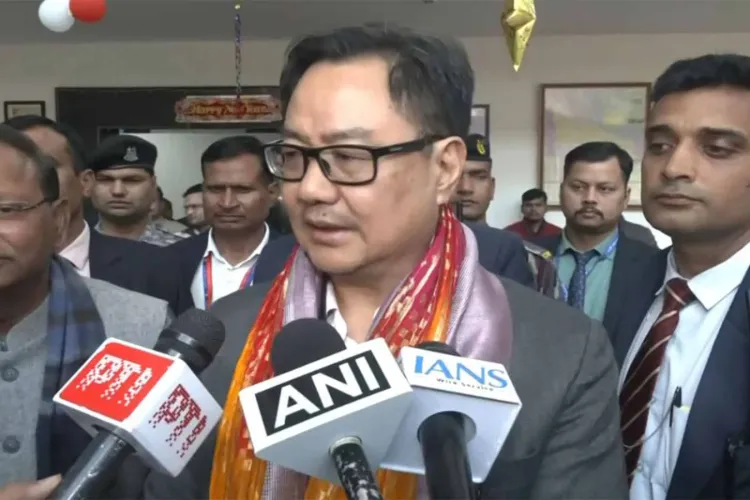
Union Parliamentary Affairs Minister Kiren Rijiju on Tuesday said the government aims to inform every village in Uttar Pradesh about the benefits of the Viksit Bharat G-RAM G act.
Speaking to the reporters in Lucknow, Rijiju said, "We have a meeting in which the senior leaders of the state. We will have discussions on the Viksit Bharat G-RAM G bill also. This is a historic bill, and we need to inform everyone in every village about the benefits of this new bill. UP is the largest state in India, and if VB G RAM G Bill becomes a success here, it will become successful in the entire country."
Rijiju is in Lucknow to participate in events related to the VB G RAM G act.
VB G RAM G act guarantees 125 days of wage employment per rural household, up from the existing 100 days, for adult members willing to undertake unskilled manual work.
As per Section 22 of the Act, the fund-sharing pattern between the Central Government and the State Governments will be 60:40, while for the North Eastern States, Himalayan States, and Union Territories (Uttarakhand, Himachal Pradesh, and Jammu and Kashmir), it will be 90:10.
The Congress party had announced a nationwide 'MGNREGA Bachao Sangram' from January 10 to February 25, opposing the VB G RAM G Act.
Earlier in the day, Congress MP KC Venugopal sharply criticised the VB G RAM G act, stating that the right to employment has been taken away through the new legislation.
ALSO READ: Yunus regime is supporting radicals in Bangladesh: Rokeya Prachi
Venugopal was addressing a gathering in Thiruvananthapuram, where he pointed out that under the old law, the Centre had to bear 100% of the wage component; however, under the new amendment, the Centre will bear only 60%, with the remaining 40% to be borne by the state.
"The employment guarantee scheme is the largest employment-providing programme the world has ever seen. Through the new amendment, the very right to employment has been taken away. Under the old law, the Centre had to bear 100% of the wage component. As per the new amendment, the Centre will bear only 60%, and the remaining 40% has to be borne by the state," Venugopal said.


.webp "Me Muslim Mavala Chatrapatincha activists handing over their letter to Satara District Collector")
.png)