Aditi Bhaduri
Rokeya Prachi is a well-known theatre, TV and film artist of Bangladesh. She is the recipient of many national awards. She has also been a trade union leader, an Awami League member, and the former cultural secretary of the party's Women’s Wing. She was making a movie on Bangabandhu when the August uprising broke out, and Sheikh Hasina’s government was overthrown. Prachi had to stop filming. She and other women with her were attacked as they went to pay respects to the Sheikh Mujibur Rehman, the country's founding father, on his martyrdom day on 15 August 2024. After a few more attacks, she went underground.
Speaking to Aditi Bhaduri from an undisclosed location, she describes the changes that have taken place in Bangladesh since August 2024. Excerpts from the interview:
How do you find events in "New Bangladesh", that is, since the Sheikh Hasina-led Awami League government was overthrown?
The Bangladesh that existed till August 2024 was a dynamically growing country, where Muslims, Hindus, Christians, Buddhists co-existed peacefully; where artists, cultural activists, and others could go about their work safely. After 5th August 2024, forget about the Awami League members, or women, even the graves of those connected to Muktijoddha (war of liberation) are not safe. Today, Bangladesh is being ruled by mobs, terrorists, and religious radicals, who, in turn, are led by Mohammed Yunus. He plans to install the Jamaat, Shibir, and Mullahs in power, so that he can become more powerful through them. That is why he has given indemnity to all those criminals from their ranks who had been in custody.
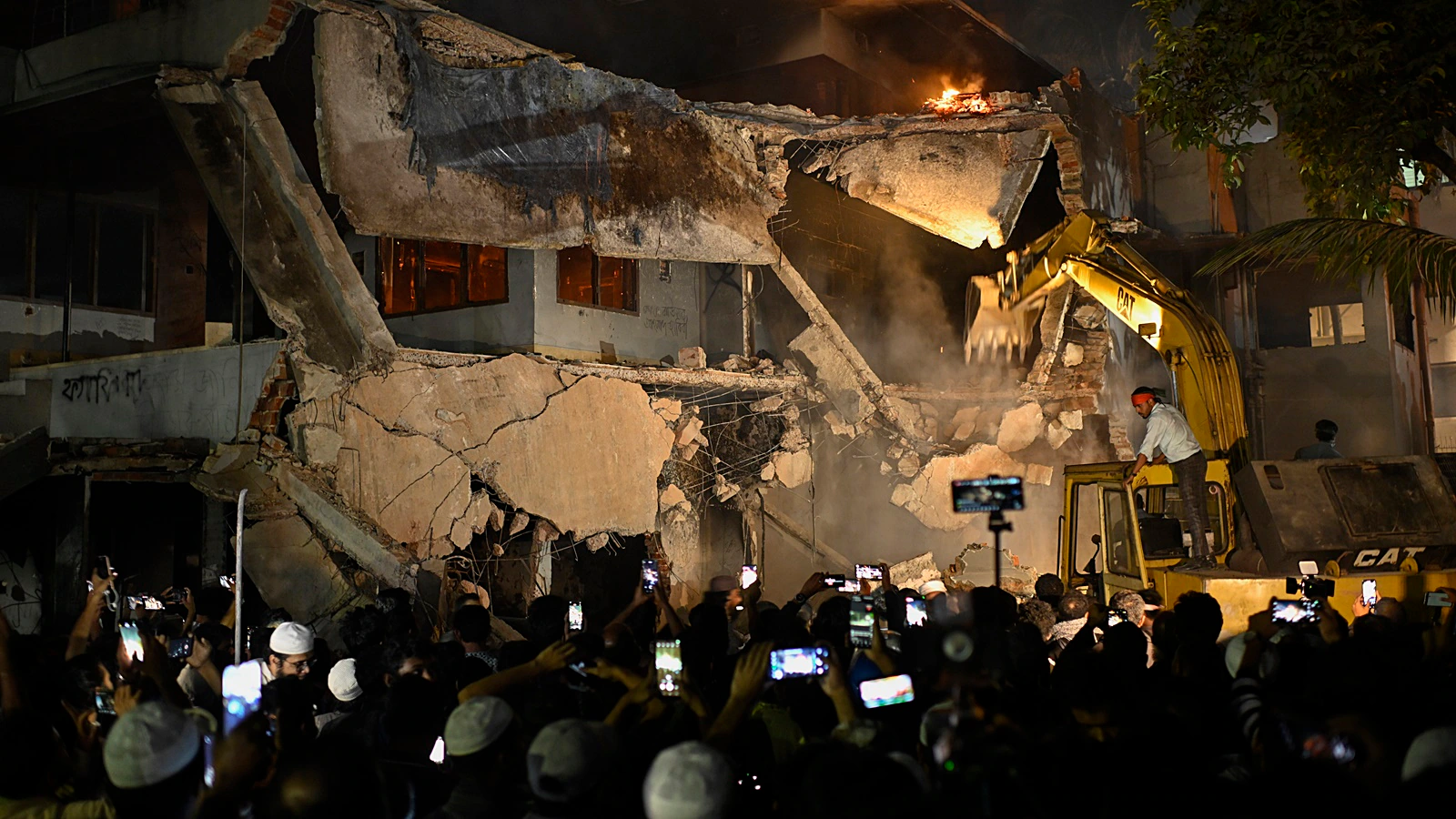 Mob razing the house of Sheikh Mujibur Rehman, founder of Bangladesh, in Dhaka
We had hoped at least the BNP would respect the memory of the liberation war and the spirit of 1971, but just as the BNP had earlier allied itself with the Jamaat, it continues to do so even now. They are negotiating seats for the elections, scheduled to be held in February 2026. So those forces who had been opposed to the 1971 war are now finding their way to power; they are the ones who are behind the attack on minorities in Bangladesh and fuelling anti-India sentiments. They are backed by Pakistan, Turkey, and the US deep state. Bangladesh has turned into a den of radicals, fundamentalists, and hardliner clerics, who have become extremely powerful now. We need to defend the country against them.
You are first and foremost an artist. What is the condition of artists and the arts in Bangladesh today?
Well, those artists who had aligned themselves with Pakistan and opposed the liberation movement in 1971 have once again aligned themselves with those very forces. However, a far greater number of artists are against these forces; artists who want to have good relations with India and who encourage and support India-Bangladesh friendship. However, they are silent, and many, like me, have gone underground out of fear of the mob violence. They will resurface when conditions change. In general, artists are under great duress now.
You have many identities. As a woman, tell us how women in Bangladesh are faring since August 2024? During the Awami League government, indices on women had been improving dynamically.
In August, there were many attacks on women connected with the Awami League (AL), followed by attacks on women who were connected to the liberation war. Then came attacks and restrictions imposed on women in general. There is, in particular, a group calling itself the Tawhidi Jamaat that turned into a moral police. They are imposing restrictions on women's clothes, dictating how women should be dressed, imposing restrictions on women’s work outside the house, etc.
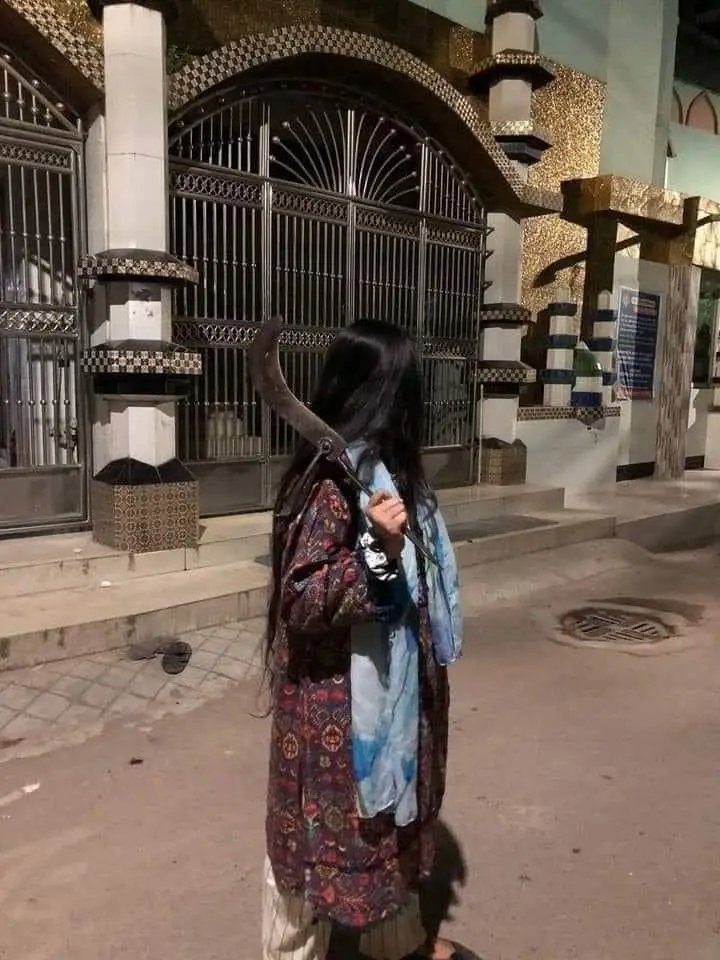 A Bangladeshi Hindu woman in Shankhari Market area of Dhaka
A new phenomenon that has become critical regarding the Awami League is that if a group or mob goes in search of a party member and can't find him at his home, they harass his wife, daughter, or sister. Such harassment even includes rape. This has become very common.
But the worst is that this violence against women, especially sexual violence, is being video recorded and uploaded on social media. You can imagine how this would destroy the woman in question in a society like Bangladesh.
What about non-Awami League women?
Ordinary, apolitical women have also been assaulted publicly for their clothes. Initially, there was so much violence against both men and women. Thereafter, a pattern emerged. Initially, if any woman was attacked, then she was alleged to be an AL supporter. As if this was okay! But the interim government and its Jamaat affiliates made this justification. This gradually changed from allegations of Bangabandhu supporter to Liberation War supporter. However, now the gendered nature of such violence has become visible.
In March, a female student at Dhaka University was harassed by a university employee for her "inappropriate" clothing. The employee was arrested, but a group calling itself the Towhidi Jamaat, another fundamentalist group, began protesting, and the culprit was immediately released.
In November, a university student was physically assaulted by a bus conductor after she protested his lewd comments about her attire. Then, a female journalist was raped. There is a lot of pressure on journalists now.
Another distinguishing aspect of the Yunus government is that these terror groups are even trying to put pressure on working women. They are questioning if it is halal for women to work outside the house, and the nature of the work, etc.
.jpeg) But, yes, this violence is not seen against women affiliated with the Jamaat or even with the Bangladesh National Party (BNP).
But, yes, this violence is not seen against women affiliated with the Jamaat or even with the Bangladesh National Party (BNP).
The uprising was a spontaneous and popular one against what has been termed the increasingly corrupt, authoritarian rule of the Sheikh Hasina-led Awami League government. In hindsight, what is your opinion of what the Awami League did wrong?
I absolutely reject these charges. This is a narrative that had been in the making for a long time, championed by Mohammed Yunus and his backers, and they struck at an opportune moment.
What is happening on the streets of Bangladesh today? No one can voice any alternative opinion. He will be attacked by a mob, and if it happens to be a woman, she will face sexual assault. There was hardly any mob violence during Sheikh Hasina's time.
Take the rights of women - we could dress up in whatever manner, do whatever work. Is that possible now? Moral policing is enforcing a dress code for women and beating her up if she is not following what they prescribe. Each day, different groups are issuing fatwas against working women.
The Yunus government is not just silent on these atrocities but is willingly partnering in this social engineering.
Take the quota stir, which began all this on 5th August 2024. The quotas were scrapped, and the protests should have stopped, but it didn't. That means there was a bigger plan that was activated. What is the result now?
The Yunus government has removed all job quotas for women. Even quotas for remote districts have been eliminated. His government has also removed all women’s quotas in elections, which had been there since the inception.
What about the violence against minorities? Did such violence happen under the Awami League government?
Arts, creativity, all this flourished under the Awami League. The streets were safer. Journalists are particularly targeted. We saw the torching of the offices of premier media houses like Prathom Alo. Have you ever seen the likes of this during the Awami League?
Bangladesh has today become a magnet for radicals and terrorists from different parts of the world, from Pakistan, from Myanmar, and other places.
ALSO READ: Syed Nawaz Miftahi illuminates the world of the blind
This is the most regressive governance that Bangladesh has ever seen in its history. And it is supported by Pakistan, Turkey and the US. Even Afghanistan, where the Taliban is now ruling, is better for women than Bangladesh, where a Nobel peace prize winner is in charge.
Aditi Bhaduri is an independent journalist and researcher specialising in Eurasian geopolitics. This intereview was conducted in Bengali and translated by the author

.webp "Union Home Minister Amit Shah")








.webp "Representational Image")