New Delhi
Riding high on the momentum of electoral victories in the crucial states of Assam and West Bengal, and after hosting the Foreign Ministers of BRICS nations — including Iranian Foreign Minister Seyed Abbas Araghchi — Prime Minister Narendra Modi is set to visit the United Arab Emirates to strengthen bilateral cooperation, particularly in the energy sector.
Abu Dhabi will be the first stop of PM Modi’s five-nation tour, which also includes the Netherlands, Sweden, Norway, and Italy.
Talks between India and the UAE are expected to focus heavily on energy security as rising tensions in West Asia continue to push up global oil prices and put pressure on India’s foreign exchange reserves.
The visit comes at a time of acute geopolitical uncertainty, with the fragile US-Iran ceasefire under strain and disruptions in the Strait of Hormuz threatening global energy supplies.
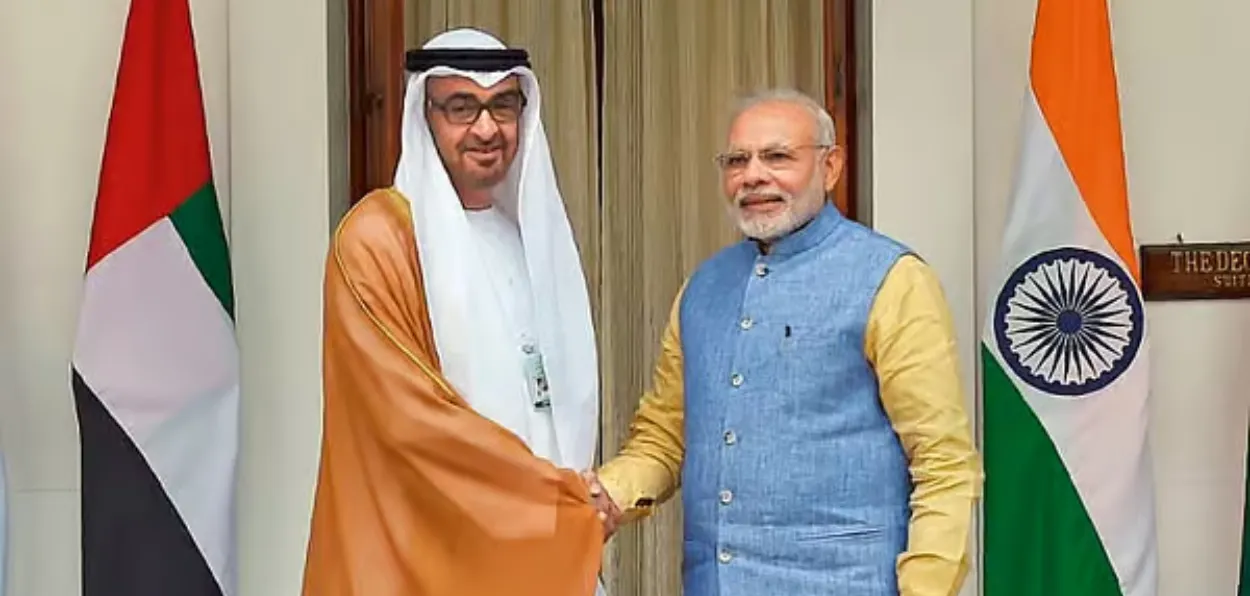
During the visit, PM Modi will meet UAE President Sheikh Mohamed bin Zayed Al Nahyan for their second face-to-face meeting in just five months.
The two leaders last met in January this year when the UAE President visited New Delhi for wide-ranging discussions on technology, artificial intelligence, trade, and food security. Several agreements and letters of intent were signed during that visit.
On the eve of PM Modi's visit, UAE Minister of State for International Cooperation, Reem Al Hashimy said, "We are anticipating, with great excitement, the visit of PM Modi tomorrow, May 15th 2026. He is a key figure of friendship, of a longstanding partnership, and a true treasure to the leadership and to the people of UAE. We are very much looking forward to having him come. Our President, His Highness Sheikh Mohammed bin Zayed was in India in January of this year, as our Crown Prince in February for the AI Summit. Since PM Modi has taken office, they have been regularly seeing each other a few times a year. So, his presence tomorrow will be part of that continued friendship and relationship and we are very keen and excited to have him come to the UAE."
Reem Al Hashimy said energy security would feature prominently in the discussions.“I think especially today, energy is compromised around the world because energy has also been weaponised, with the Strait of Hormuz effectively being taken hostage, which is something the international community is trying to address,” she said.
#WATCH | Abu Dhabi, UAE: Ahead of PM Modi's visit, UAE Minister of State for International Cooperation, Reem Al Hashimy says, "I think especially today, energy is compromised around the world because energy has also been weaponised by the Strait of Hormuz being taken hostage… pic.twitter.com/U3VMYfA7zU
— ANI (@ANI) May 14, 2026
“By doing so, many people around the world — including in India — are struggling with basic household needs. That issue will certainly feature in our conversations tomorrow. More importantly, it is important to highlight that the UAE has always been, and continues to be, a responsible global player in the energy space.”
She added that the UAE’s recent decision to exit OPEC was driven by its desire to produce at its full capacity amid global supply challenges and continue playing a responsible role in ensuring energy stability.
In New Delhi, Aseem Mahajan, Additional Secretary for Gulf Affairs in the Ministry of External Affairs, underlined the depth of India-UAE energy ties, describing the UAE as “an important partner in our energy security.”
He noted that the UAE was India’s fourth-largest source of crude oil last year, meeting nearly 11 percent of the country’s total requirement.
On liquefied natural gas (LNG), Mahajan said Indian companies and ADNOC Gas have entered into long-term supply agreements for a cumulative 4.5 million tonnes annually, making India “the biggest buyer of UAE LNG.”
He further pointed out that the UAE is also the largest supplier of LPG to India, meeting nearly 40 percent of the country’s requirement, while simultaneously being the second-largest destination for India’s petroleum exports.
Mahajan added that Indian companies have invested more than 1.2 billion US dollars in upstream energy assets in the UAE. He also highlighted Bharat PetroResources Limited’s oil discovery in Abu Dhabi’s Onshore Block 1 earlier this year — the first upstream oil discovery by an Indian company in the region.
The UAE, he said, is also the first country to partner with India on strategic petroleum reserves, storing over five million barrels of crude oil at ISPRL’s facility in Mangalore.
Meanwhile, the linking of India’s UPI payment platform with the UAE’s AANI system has significantly improved cross-border transactions for businesses and the Indian diaspora.
The UAE remains India’s third-largest trading partner and the seventh-largest cumulative source of foreign investment over the past 25 years.
ALSO READ: Dr. Benazeer Tamboli's work on empowering women is an inspirational story
As West Asia navigates one of its most turbulent phases in recent years, Friday’s meeting in Abu Dhabi is being viewed as a key pillar of stability and long-term strategic cooperation between the two nations.









_(4).webp)