




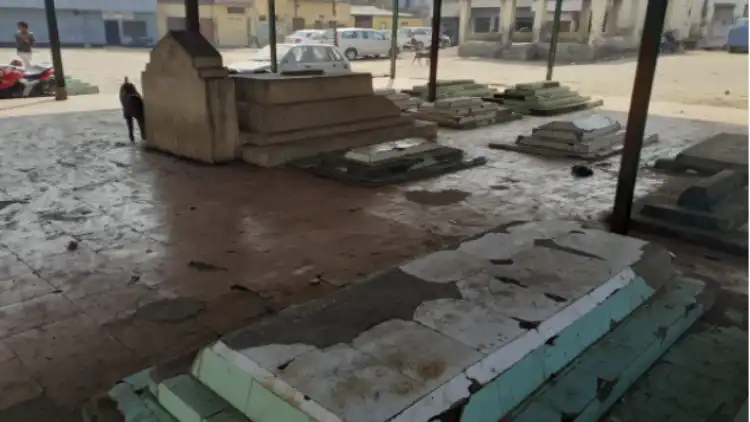
Faizan Khan/Agra
The grave of 18th century poet Nazir Akbarabadi, whose love for the city of Taj Mahaj is immortalized in his classic Urdu poems lies in disarray amidst a patch of wilderness and strays and sheep sent for grazing roaming around.
The tombstone has also fallen due to wear and tear of vagaries of nature and there is none to repair it. Located in Tajgunj area of Agra, the grave’s surroundings have been encroached..
Akbarabadi is considered as a pioneer of Urdunazm and poem and he is credited with having infused urdu with the common idiom to express himself. Born in Delhi, his family shifted to Delhi with his family and fell in love with the city.
He was an exponent of culture of Braj land and it reflected in his poetry. It’s sad, therefore the city, seems to have forgotten him.
Earlier during the Samajwadi party reign, the government would spruce up the tomb for the day; now, it seems, even the government has forgotten the soil of the soil.
It’s said that Mir Taki Mir, Mirza Ghalib and Nazir Akbarabadi introduced the land of Agra to the people of the world through their poetry. Nazir Akbarabadi used to write compositions in colloquial language as well.
Nazir was born in Delhi in 1735 AD as Wali Mohammed to Farukh and his wife. The latter hailed from Agraand was daughter of Sultan Khan, the Nawab of Agra fort. Nazir was the 13th child of his parents and the only one to survive.
It is said and Nazir survived because of the blessings of Sufis. As a child he was alwayd dressed as a girl by his parents who wanted to protect him from the evil.
Nazir was married to Tahbarunnisa Begum of Malco street near Taj Mahal. They had two children: son Gulzar Ali Asir and daughter Emami Begum.
Nazir Akbarabadi would write in Arabic and Persian Sanskrit, Urdu, Punjabi, Marwari, Hindi and its dialects.
After his marriage, Nazir started living in the Tajganj locality of Agra. After some time he shifted to Mathura to make a living. However, he could not stay away from his favourite city for too long and returned to be appointed as in charge of accounts in Agra. After this, he taught the children of Nawab Muhammad Ali Khan.
He was the first to write ghazals in urdu, a genre that is still popular among music and poetry lovers.









.webp)