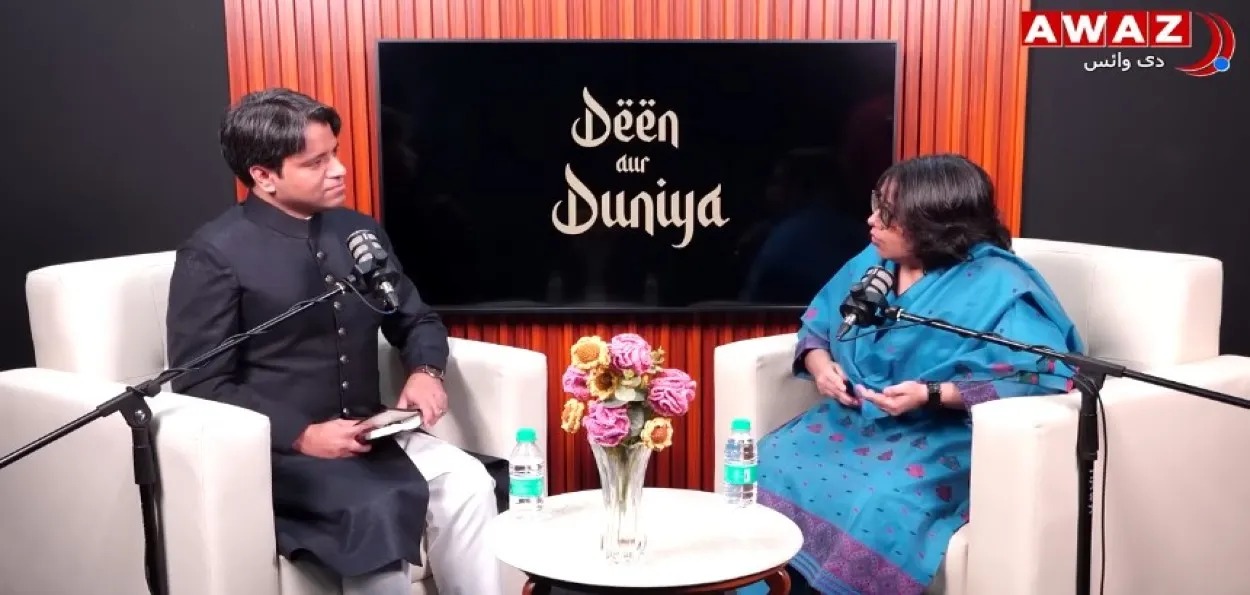
In Awaz-The Voice's special podcast Deen Aur Duniya (Religion and the World), Jamia Millia Islamia Professor Firdous Azmat, who is an expert in Women's Studies, expressed these views.
Host Saquib Salim discussed the prevailing concepts about Muslim women in his podcast. He pointed out that Muslim women are often seen from a specific angle, due to which their true identity is not revealed.
To Saquib Salim's question whether Muslim women have always been seen as they are today - voiceless and confined to a particular role,r Firdous Azmat explained that Muslim women have been imprisoned in a certain image. "Society sets a standard for her, and she is judged accordingly."
She says that Muslim women are under pressure to protect the honour of the family and community, due to which they avoid talking about certain sensitive issues. Thus, a double responsibility is imposed on them. But Muslim women have not always been like this. They did not need guidance or someone else to make them feel their strength.
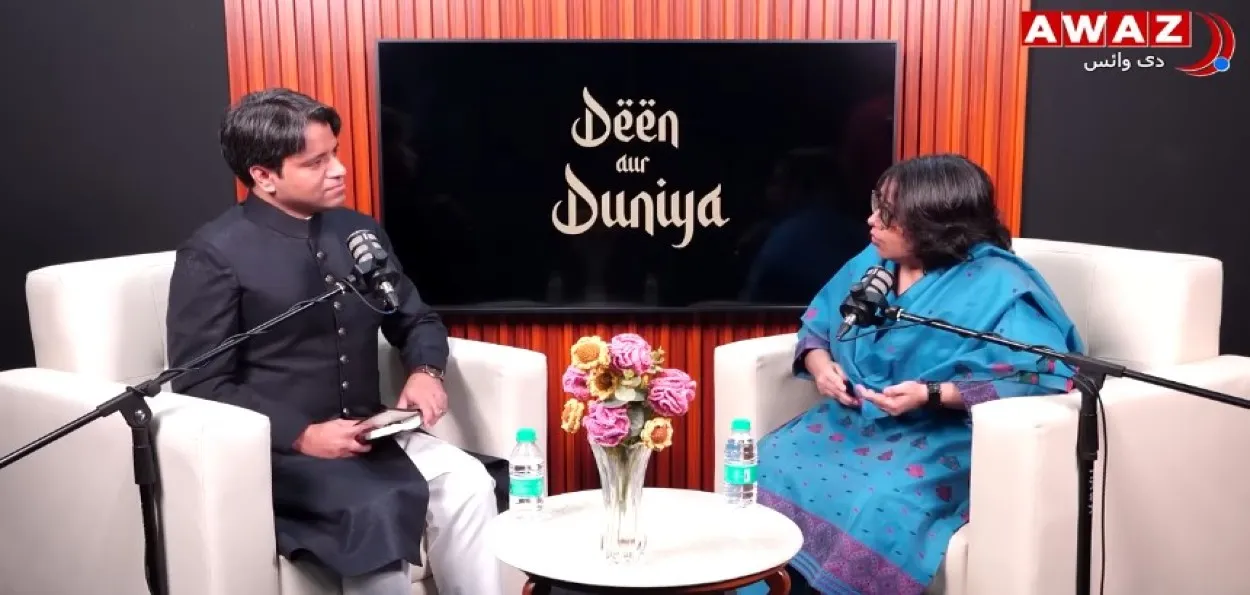 Saquib Salim and Prof Firdous Azmat during the Podcast
"Muslim women have had a very glorious history and played an active role in important periods of history."
She gives an example where Ara Shahnawaz participated in the Round Table Conference of 1930, 1931, 1932 and raised her voice for women's rights, especially voting rights and representation.
Professor Firdous Azmat said that the organisational activities of Muslim women have been very strong. Organisations like Anjuman Khawatan Islam and Anjuman Khawatan Hind were established at the all-India level in 1914 or 1916. Even before that, there were small groups of women in Lahore and Delhi around 1890 who were discussing issues like education and the veil.
When it comes to reform movements of the nineteenth century, Professor Firdous Azmat said that the name of Aziz-un-Nisa Begum, mother of Sir Syed Ahmed Khan, comes up prominently.
She played an important role in raising social awareness among women. During this period, three major issues related to women were discussed. The issue of sati, restrictions on widow marriage and early marriage. Aziz-un-Nisa Begum explained to women that widow marriage should be allowed and that it was not against Islamic teachings.
When women talked about their rights within the framework of Islam, they referred to the Quran and Islamic teachings. While living within this Islamic identity, it was made clear that Islam had given women many rights, the fulfilment of which was lacking.
That way, women raised their voices against the violation of their rights. Maulvi Mumtaz Ali and Muhammadi Begum are prominent examples of this. Maulvi Mumtaz Ali wrote an important book, "Women's Rights" during this period, in which the inheritance rights of women and other Islamic rights were discussed in detail.
This book was ahead of its time. Narrating an incident, Prof Azmat said Sir Syed Ahmed Khan disliked the book and reacted strongly against its contents. After being suppressed and ignored for a long time, the book later became popular. A key point in this was that since 124,000 prophets are mentioned in Islam, it is possible that women were among them.
This was an example of extraordinary intellectual courage at that time. The real problem was not Islam or the Quran, but their interpretation. Islam recognised women as full human beings and recognised their rights. But over time, these rights were limited, and women were marginalised. Therefore, there is a need to re-examine these interpretations.
About literature, Professor Firdous Azmat says that magazines like Tehzeeb Niswan gave women an opportunity to express themselves. Women expressed their views through diaries, fiction and autobiographies.
The magazine published under the editorship of Mohammadi Begum proved to be an important milestone for gender parity. It was a platform where women wrote and presented their voices. This magazine created a new awareness in the literary world. With the development of printing, awareness and creative expression among women also increased.
After the nineteenth century, there was a significant change in Urdu literature. Initially, Deputy Nazir Ahmed promoted novel writing, but later, women writers did revolutionary work in this field. Personalities like Rashid Jahan and Ismat Chughtai presented very bold writings that looked at social issues from a fresh perspective.
Muslim women in North India, Bihar and Bengal were particularly developed and active. In Bhopal, Begums have rendered significant services in the fields of education, health and social reform. Begum Shahjahan and Begum Sultanjahan worked extensively even while living behind the curtain. They established educational institutions, hospitals and social organisations and provided opportunities for women to move forward.
After independence, Muslim men also got involved in various issues. Issues like security, identity and the formation of a new India came to the fore. As a result, women's issues were pushed to the back burner. It is difficult to say whether this was deliberate or a result of circumstances, but the fact is that the intensity with which women's issues were raised had decreased.
Where did the women who were active during the colonial period go? Their voices were less heard after independence. The Shah Bano case once again breathed new life into the Muslim women's movement, but at the same time, this issue got entangled in the debate over cultural identity and a uniform civil code.
Organisations like the Indian Muslim Women's Movement emerged in 2007. Though it took many crucial steps to push women's issues, it faced backlash from within the community, especially on issues like marriage and the role of the judge.
Prof Firdous Azmat says that Muslim women are facing a dual patriarchy. On the one hand, there is pressure from the community and on the other hand, external interference. Each class wants to see a Muslim woman according to its own thinking, which affects her autonomy.
On Saquib Salim's question on the subject of the veil, Professor Firdous Azmat clarifies that the veil is not only a religious matter but also has social and cultural aspects. Every woman should have the right to decide for herself what she wants to wear. It is not right to make clothing a standard of progress or backwardness.

.webp "Representational Image")








.webp)