Dhaka
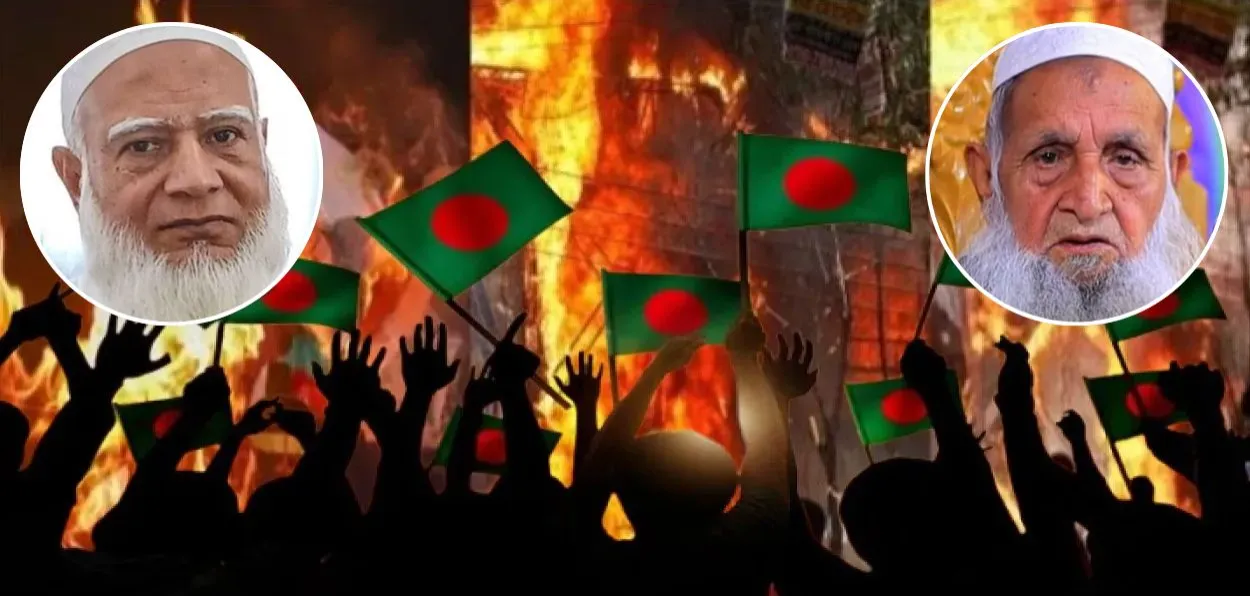
Islamic parties in Bangladesh are locked in a major ideological clash just days before the parliamentary elections scheduled for February 12. The Hefazat-ul-Islam Bangladesh has opened a front against the country’s major Islamic party, Jamaat-e-Islami, and declared it as 'forbidden’ and asked Muslims not to vote for it.
The Hefazat-ul-Islam Ameer, Allama Shah Mohibullah Babunagari, declared a jihad against the Jamaat, saying that this is not just an election but a struggle against the party. The Hefazat is currently supporting the Bangladesh Nationalist Party led by Tarique Rahman, son of the former Prime Minister, Begum Khaleda Zia.
Announcing his support for the BNP candidate in Chittagong, Babunagari said that Jamaat-e-Islami misinterprets Islam, and ‘we must unite to stop the rise of this false force.”
He said that voting for Jamaat is in no way permissible for all Muslims because there are fundamental and ideological differences between Jamaat-e-Islami and us, and they do not present a correct explanation of religion.
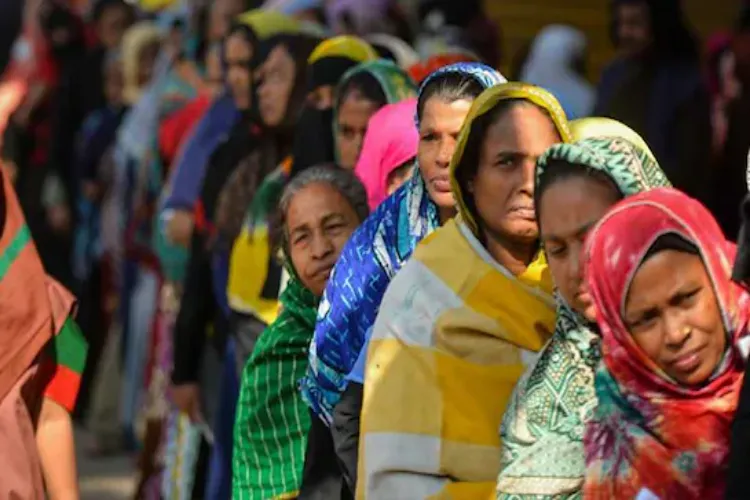 Women voters of Bangladesh (File)
This election is not just a question of power transition, but will also determine the direction Bangladesh will take in its democracy, constitutional reforms, and relations with its neighbors, especially India.
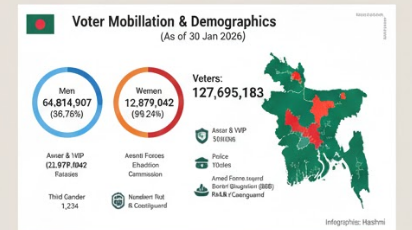
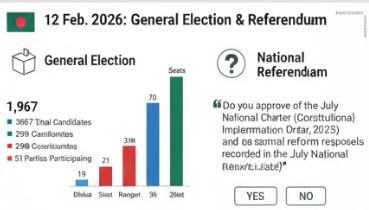
Under these circumstances, the general elections scheduled for February 12th assume extraordinary significance. Fifty-one political parties are participating, and approximately 1,967 candidates are contesting in 298 parliamentary constituencies. The total voter turnout is approximately 127.7 million, of which approximately 50.76 percent are male and 49.24 percent are female
According to the survey, Jamaat-e-Islami could emerge stronger than ever in the February elections and is giving the BNP a tough fight. It may be recalled that the Jamaat e Islami leader Shafiqur Rehman has said that in Islam, a woman can not become the Prime Minister.
A report published in September 2025 said that the BNP had enhanced its ties with the security forces. According to the report, the security forces had previously worked in alliance with the Jamaat, but now they have started opposing it.
On February 12, the people of Bangladesh will vote to elect a new government and also give a verdict on the July Charter, which is being linked to the birth of a new Bangladesh.
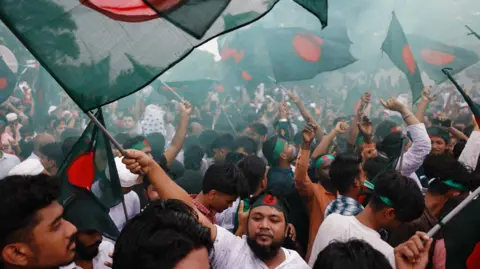
Students protesting in Dhaka
Babunagari has previously called Jamaat-e-Islami a hypocritical Islamic party. In August 2025, he had said that Jamaat-e-Islami is an unauthentic Islamic party and follows the Islam of Maududi, while we believe in the Islam of Medina and following Maududi's ideology can be a threat to faith.
Jamaat-e-Islami later rejected these statements as fabricated and baseless.
The Jamaat-e-Islami adheres to the political and ideological interpretation of Islam propounded by Abul-Ala Maududi, which sees Islam as a complete system where the sovereignty belongs to Allah and politics and religion are not separated. In contrast, the Islam of Medina is based on moral reform, social harmony, cooperation, and prophetic leadership, where governance emerges from moral leadership and social contracts, rather than from any political ideological movement.
Hafizul Islam is a Bangladeshi Sunni Deobandi organisation founded in January 2010 and affiliated with a wide network of Qawmi madrasas. It is headquartered at the Darul Uloom Moinul Islam Madrasa in Chittagong.
Although it calls itself a non-political organisation, it uses large gatherings and a thirteen-point demand to press for the Islamicization of Bangladesh's legal and social systems.
After coming to power after the fall of the Sheikh Hasina government, Muhammad Yunus met with the leader of the Hizb ut-Tahrir movement, Mamunul Haq, and his associates in Dhaka. Even in the last years of the Hasina government, efforts were being made to include the Hizb ut-Tahrir movement in its voter base.
In December 2025, when the Bangladesh police arrested 12 people who had targeted the Indian Assistant High Commission in Chittagong, senior Hizb ut-Tahrir leader Mufti Haroon bin Izhar reached the police station and had a stern talk with the officers, after which the men were released.
In November 2025, when the interim administration planned to recruit music and physical education teachers in primary schools, Islamic organisations, including the Hefazat, called it un-Islamic and threatened street protests. In December 2024, a member of Hefazat filed a case against Hindu sadhu Chinmoy Krishna Das and hundreds of his followers, demanding a ban on their settlement in Bangladesh.
بنگلہ دیش میں عام انتخابات ۔ ایک نظر #Bangladesh #BangladeshElections pic.twitter.com/TgOBZsjnjK
— Awaz-The Voice URDU اردو (@AwazTheVoiceUrd) February 5, 2026
The anti-India stance of the security forces was most prominent in March 2021, when Prime Minister Narendra Modi visited Bangladesh. On that occasion, the security forces called for a nationwide strike and attacked a train in Brahmanbaria, injuring ten people. Even after the abrogation of Article 370 and the implementation of the CAA, the security forces continued to hold anti-India rallies and called India a threat to the Ummah.
READ MORE: Why reviving Ganga-Jamuni culture is the need of the hour
Thus, this clash between security and party ahead of the elections is turning Bangladeshi politics into a battle over who represents true Islam, and these differences reveal the deep cracks in political Islam there.









_(1).webp)