Turkey is a country of traditions and the open air feasting during the month of Ramazan. This is the reason why many travel companies advise tourists to visit there during this period to see its rich tradition and culture at play.
The Turks are the best example of how to feast with dignity and poise followed by a feast to enjoy life – a perfect blend of religious duty and enjoying the bounties of the materiaol world.
Towns, cities and the villages across Turkey wear a festive look during the holy month. The majority of the people love to relive the old ways by observing traditions.
Turkey is called the land of mosques, where the traditions of Ramazan date back to the Ottoman Empire. It won’t be an exaggeration to say that the ways Turks celebrate Ramazan, no Arab country does.
This overwhelmingly Muslim country is a secular State and one of the most prosperous and progressive countries in the Islamic world. Modern-day Turkey, however, takes Ramazan as an occasion to celebrate its rich past and fascinating traditions and to perpetuate their customs and traditions.
In Turkey, colourful lights are lit inside the mosques during Iftar during Ramazan. The unique tradition of firing cannons from the highest hill nearby to a town or a city at regular intervals and before the opening of the dawn to dusk fast, the Roza, continues even today.
Turkey is located on the crossroads of Europe and Asia. However, like any other In Muslim country, the restaurants and hotels are mostly closed during Ramazan. In fact, Turkey is a major tourist destination and the travel advisory during Ramazan is that tourists must take care of local sensitivities and not eat food outdoors.
Some restaurants serving food do it discreetly by placing curtains on the windows and keeping the doors closed.
Although there is no law banning the opening of eateries or eating out, socially it’s considered impolite. In Turkey too, dervish or fakirs would give a wake-up call in the streets although this tradition is dying out fast as people find it intrusive and disturbing.
The tradition of firing cannons in Turkey came from Egypt. Not only Turkey but also various Muslim countries of the world have adopted it. This is an old tradition, but it is being readopted these days in sheer nostalgia.
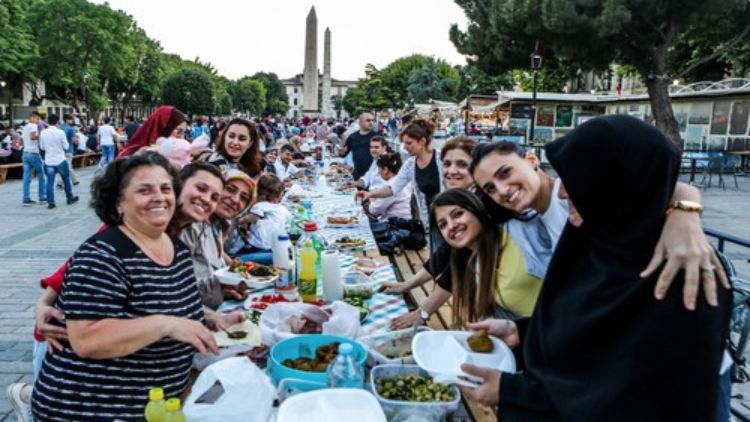
It is common in Turkey to play the drums with cannon and trumpet. The tradition of waking people by playing the drums at dawn is followed in many countries including Turkey. Turkey’s another unique custom is not to open the fast at home. People decorate the tables with food items at iftar and keep them in front of the house, in the street of the park to denote it is a feast for all. Tourists are encouraged and invited to join the feast.
Special iftar is arranged on the main highways of the city during Ramazan and it’s a sight to see hundreds of people breaking the fast together. The feast continues till late at night.
The municipality of each city decorates the city. Local festivals are organized that come alive after iftar on each day of the Holy month. There is a live performance by local singers who sing Anatolian and Sufi music.
Most of the cost of these cultural fests is borne by the local municipality of the city. The festival continues till dawn.
Women, children, old and young also listen to songs in the festival area, enjoy coffee and tea and play the popular Turkish towel game. A game played on a table. Overnight at the stalls, shopping for masterpieces by local artisans goes on.
Ramadan is a happy month in Turkey. It is a month of worship, celebration and equality. Ramadan is celebrated by both the people and the state in Turkey.
An interesting fact has now emerged that people from a village in Turkey have been opening their fast in the same restaurant during Ramazan for the last 15 years. As the holy month approaches, all men and women of Karli, a suburb of the Kingdom of Yujgat, come together to celebrate their mutual love and brotherhood and break their fast in one place for the whole month. .
Carly is a small town with 30 houses. All villagers gather before the iftar at the social welfare centre run of the local mosque. Village Mayor Rajab Jwigo says that there are 30 families in the village. One family is provided with food material to cook for all on each day; neighbours also help in cooking.
He hoped that in future also all the people of the neighbourhood will maintain the atmosphere of collective iftar, brotherhood and brotherhood. He said that it is a blessing of the collective iftar of the people helps to bridge mutual differences and grievances against each other.” We share each other's sorrows like family members,” he said.








_(1).webp)