
Dhaka (Bangladesh)
As Bangladesh prepares to vote on February 12, the Election Commission and security agencies have completed final arrangements aimed at ensuring a peaceful polling process. Results are expected to be confirmed on Friday, February 13.
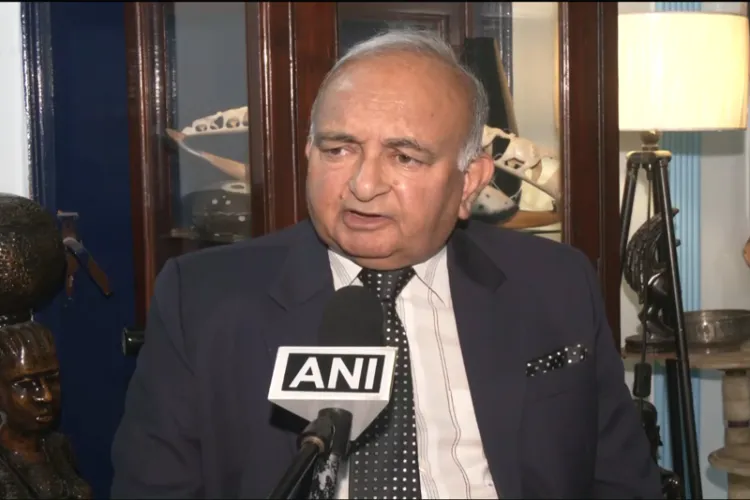
Ivars Ijabs, Chief Observer of the European Union Election Observation Mission (EU EOM) for Bangladesh's 2026 parliamentary elections, underscored the historic significance of the polls, emphasising the EU's neutral and fact-based approach to assessment.
"The European Union has gladly responded to the invitation of the Bangladesh interim government and the Central Electoral Commission to observe these elections, recognising that they are historic and important for Bangladesh," Ijabs said while speaking to ANI.
Outlining the mission's mandate, he stated, "The end result of that is to produce a report on those elections about what have been the strengths, what have been, if any, problems or weaknesses. Our task is not to get involved in the political game. We are non-partisan and neutral."
Placing the observation exercise within the broader framework of EU-Bangladesh relations, Ijabs noted, "This is one of the steps in expanding our cooperation with Bangladesh, given how important these elections are after a lengthy period without credible, competitive elections."
He added that the mission's final report would recommend improvements to democratic processes. "We really need credible partners, and Bangladesh is, of course, a close partner. We want to build and expand this partnership on the basis of democracy, the rule of law, and accountability in the exercise of political power, which is why we are observing the reform process."
Referring to the parallel referendum, Ijabs clarified, "We know that this election takes place together with a referendum on certain constitutional issues. We are not observing the referendum per se, rather, we are assessing how this process is advancing the country's reform agenda."
Highlighting the scale of deployment, he said, "There are 200 people involved in this mission here in Bangladesh, and they are trained. They are also receiving technical support to gain a full picture of this electoral process."
The elections come 18 months after a massive student-led uprising in 2024 forced the resignation of long-time Prime Minister Sheikh Hasina, ending the Awami League's rule and generating expectations of greater accountability and democratic reforms.
Following the conclusion of the official 20-day campaign period, over 12.77 crore eligible voters will cast ballots to elect representatives for 299 of the 300 parliamentary seats, with polling in one constituency postponed due to a candidate's death.
Alongside the parliamentary contest, voters will participate in a national referendum on the July National Charter, which proposes significant constitutional and institutional changes.
In a televised address to the nation, Chief Adviser Prof Muhammad Yunus called on citizens to turn election day into the "birthday of a new Bangladesh", emphasising the decisive role of voters, The Daily Star reported.
Authorities have established 42,779 polling stations nationwide. Voting will take place from 7:30 am to 4:30 pm without interruption. Of the electorate, 6.48 crore are men and 6.28 crore are women.
A total of 1,755 candidates representing 50 registered political parties are in the fray, along with 273 independents, including 20 women. Notably, 63 women candidates are contesting under party banners.
Ballot papers are being distributed to polling centres under stringent security measures. Authorities have stated that logistical preparations are complete.
Election Commissioner Brig Gen (retd) Abul Fazal Md Sanaullah expressed satisfaction with the prevailing law and order situation.
"We are satisfied with the law and order situation as it stands. It would have been better if the isolated incidents that occurred had not happened. However, we are in a better position now than at any time in the past," he stated during a press briefing, as reported by The Daily Star.
Inspector General of Police Baharul Alam outlined a three-tier security framework comprising static forces at polling stations, mobile patrols, and rapid-response striking units. He detailed that 1,57,805 police personnel will handle direct election security duties, with an additional 29,798 officers providing supplementary support, bringing the total deployment to 1,87,603.
Assessing the pre-poll climate, the EU EOM described the atmosphere as "very positive". "We have been speaking both to candidates and authorities in all districts and regions across the country, and the general atmosphere is very positive and hopeful," Ijabs remarked at a press conference in Dhaka, according to The Daily Star.
He observed that many stakeholders view the elections as a fresh start for Bangladesh's democracy. The EU has deployed its largest-ever mission to the country, with more than 200 observers, including long-term and short-term teams monitoring voting and counting.
Politically, the contest primarily pits candidates aligned with two major alliances -- one led by the Bangladesh Nationalist Party (BNP) and the other by Jamaat-e-Islami. BNP Chairman Tarique Rahman and Jamaat Ameer Shafiqur Rahman reviewed constituency-level preparedness.
Concerns, however, persist in certain regions over potential post-poll unrest, particularly among minority communities.
In Chattogram, minority voters voiced apprehension. "On one side BNP, on the other side Jamaat. If the BNP loses, they blame the minorities; Jamaat does the same. State, election, and persecution have become synonymous for us," a Hindu youth said anonymously, as cited by The Daily Star.
A farmer from Rangpur's Gangachara upazila, Manoranjan Shil, 56, recalled lingering trauma from an attack on his village last July. "We are still haunted by the terrifying experience of the attack. We are still in fear," he said, according to The Daily Star.
READ MORE: Khan Sir’s affordable hospital in Patna becomes lifeline for poor
However, minority voters in districts such as Faridpur and Rajbari reported feeling secure, reflecting varied sentiments across regions.
The elections are being closely watched as a critical juncture in Bangladesh's democratic trajectory, with implications for regional stability in South Asia, including relations with India.












_(1).webp)