Cologny (Switzerland)
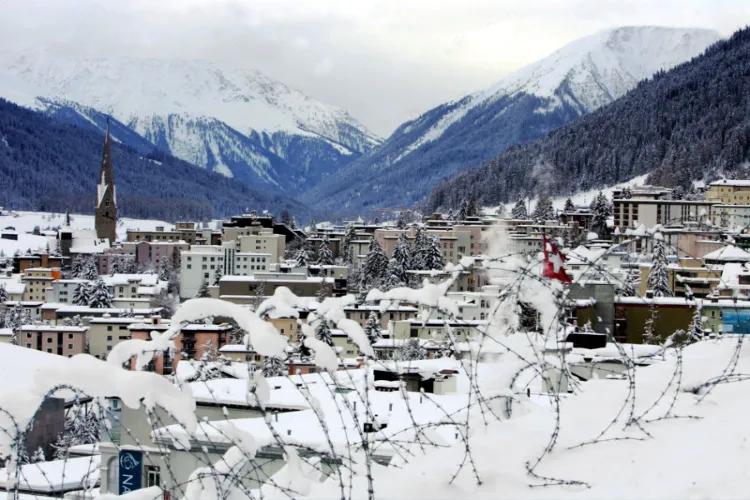
As world leaders prepare for the 2026 Annual Meeting of the World Economic Forum (WEF), leading economists and geopolitical thinkers are drawing attention to a series of complex paradoxes shaping the international landscape this year.
These contradictions, emerging at the nexus of geopolitics and the global economy, reflect the growing tension between competition and cooperation among major powers, according to experts consulted by the World Economic Forum.
According to these experts global stability in 2026 will be defined less by clear trends and more by conflicting forces pulling in opposite directions.
One of the strongest voices among the contributors, Mark Leonard of the European Council on Foreign Relations, highlights Europe's paradoxical transformation from a peace project to a security-driven bloc. Traditionally built on liberalization and open markets, the European Union now increasingly prioritizes "de-risking" and "diversifying away from the US and China and deepening the single market".
"Centrist politics is giving way to post-liberal populism. The so-called new right is on the rise in France, Germany and the UK. Whether it succeeds in taking over Europe will depend on whether centrist leaders can develop a counter-narrative, social base, agenda and communications strategy that allows it to hold its own. How well Europe manages these three tensions will shape not just the coming year, but the next decades," says Leonard.
Another paradox concerns migration and labour markets. Rachel Glennerster of the Centre for Global Development points out that although many wealthy nations are tightening immigration policies, they increasingly rely on foreign workers to fill skill shortages.
"Just when we need energetic young people, we are making it harder for them to come. The US and UK are tightening rules on foreign students despite education being a major export industry, a catalyst for growth in depressed regions, and an attraction for talent. In the US, immigration enforcement efforts target construction sites despite a housing affordability crisis (30 per cent of construction workers are migrants)" says Glennerster.
She suggests that in 2026, countries should look for "innovative solutions to the migration paradox such as Global Skills Partnerships for green skills or health migration."
Demographic change is also complicating the global picture.
Walter Russell Mead, a senior fellow at the Hudson Institute, notes that longer life expectancies are reshaping political and economic power structures, with older generations wielding influence for longer periods.
"The demographic shift means that each new generation will be smaller than its predecessors, a shift that inevitably means that older generations will remain politically dominant longer than in the past," says Mead.
From a broader geoeconomic perspective, Alexander Gabuev of the Carnegie Russia Eurasia Center explains how Western sanctions and export controls weaken some adversaries while inadvertently strengthening their resilience, particularly in states that develop alternative economic networks.
"For now, it's possible to treat the segment of global economic activity beyond Washington's control as a tumour in an otherwise well-functioning system. But the confluence with looming concerns over the overheated AI sector, the disunity of the West, Washington's newly discovered taste for foreign policy adventurism, and China's progress in self-reliance could hasten the end of America's economic pre-eminence, with a potential snowball effect as more players rush to hedge their bets," he explains.
Jeromin Zettelmeyer, Director, Brussels European and Global Economic Laboratory, Belgium says, "The first paradox is a variation on an old theme: the tension between Europe's common interests and the parochial interests of member states. The second is a new problem, because the pressure on Europe's industrial model has never been higher. How EU policymakers deal with these contradictions in 2026 will be worth watching. And we should let them know that we are watching."
Experts also warn that global cooperation is simultaneously more essential and more elusive than ever. As climate change, technology governance, and supply-chain vulnerabilities rise on the global agenda, the need for collective action becomes clearer. Yet geopolitical rivalries and inward-looking policies continue to undermine multilateral efforts.
ALSO READ: The scope of RSS and Muslim dialogue is expanding
The WEF experts stress that navigating these contradictions will be central to how 2026 unfolds. The paradoxes of economic interdependence, demographic change, and geopolitical rivalry are not mere intellectual curiosities, they are shaping the policies and alliances that will define the global order for years to come.



.png)