Ashhar Alam/New Delhi
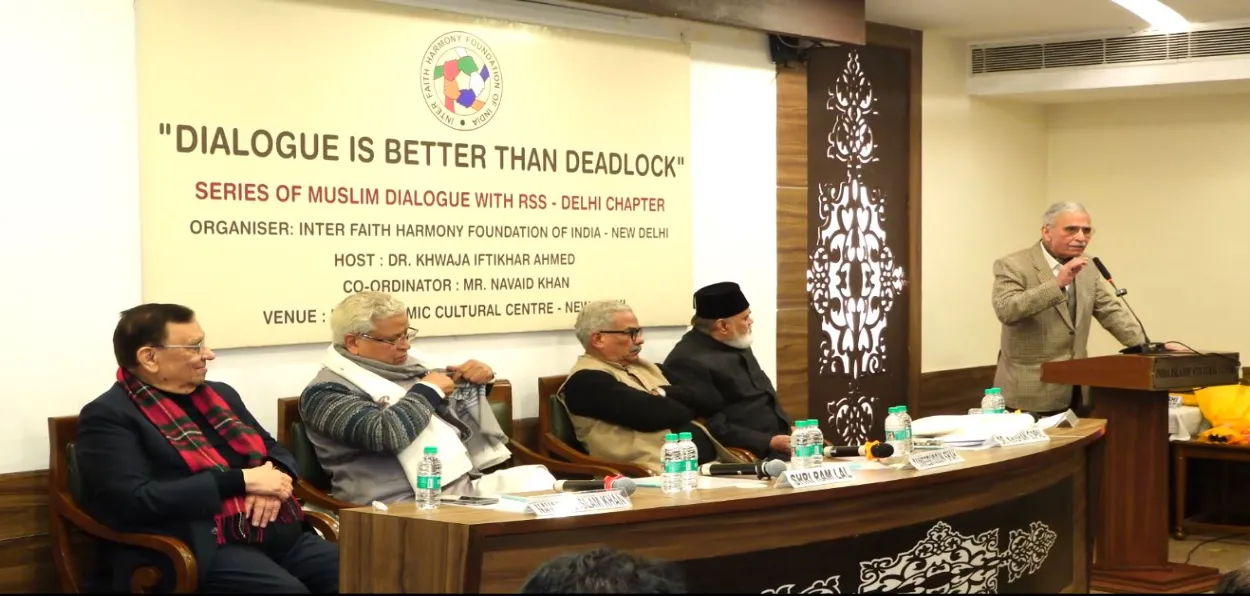
Occasional communal tensions reported from different parts of the country are merely symptoms of a deeper malaise, not the disease, speakers observed during a dialogue between RSS ideologues and Muslim intellectuals in New Delhi on Friday.
Four years after RSS chief Mohan Bhagwat’s interaction with Muslim intellectuals, another significant interaction took place, reflecting a trend that the environment is conducive to sustained dialogue.
The three-hour session brought together RSS leaders Dr Krishna Gopal and Ram Lal, and Muslim intellectuals like S. Y. Qureshi, former Chief Election Commissioner, Najeeb Jung, former Delhi Lieutenant Governor, and Lt. Gen. (Retd) Zameeruddin Shah, former Vice-Chancellor of Aligarh Muslim University.
Several contentious issues, such as Indian Muslim nationalism, identity debates around Hindus and Muslims, the “Kafir vs Malich” narrative, assimilation, uniformity, and extremism, were discussed in a free and frank manner.
The discussion was organised by Interfaith Harmony, led by Iftekhar Ahmad Khwaja, at the India Islamic Centre, and was titled “Dialogue is Better Than Deadlock.”
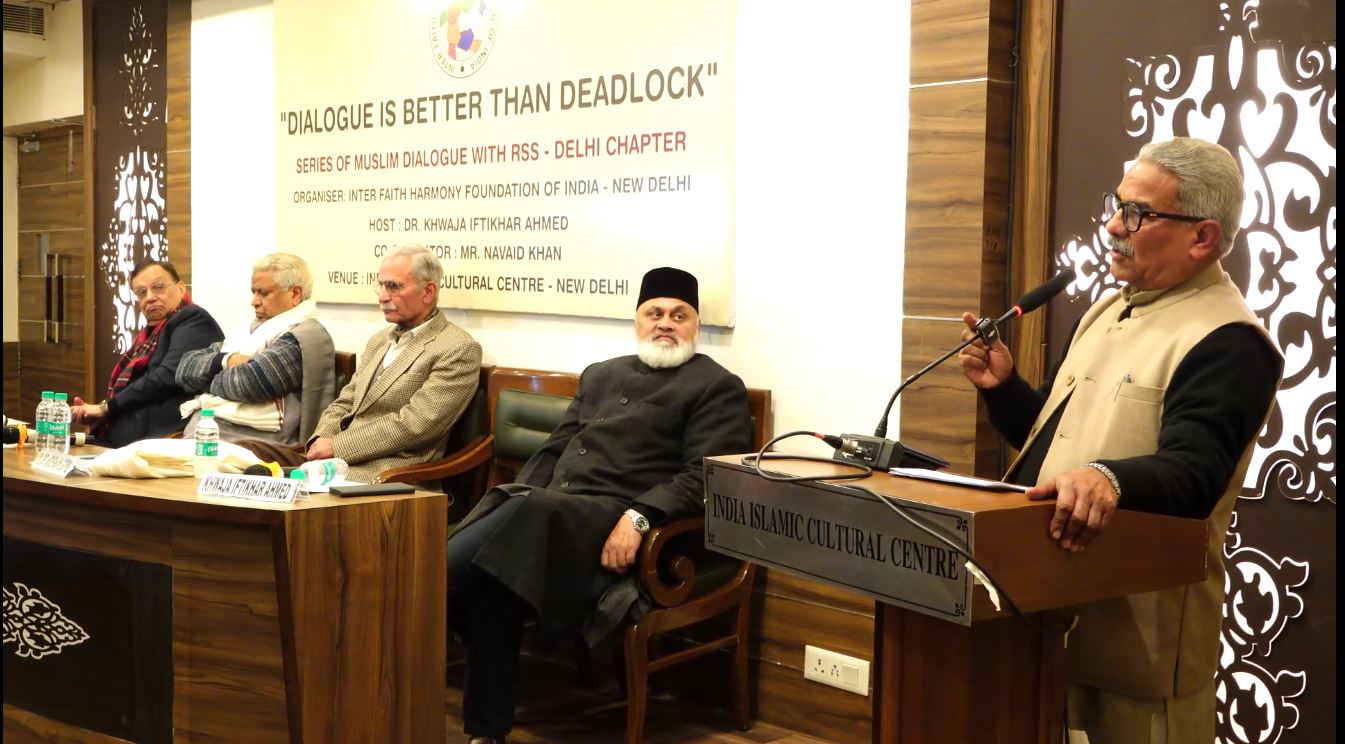 Dr Krishan Gopal of RSS speaking at the meeting
RSS leader Ram Lal said the dialogue was framed around two opposing narratives: the belief that Hindus and Muslims cannot coexist, versus the conviction that all communities are fundamentally one.
“Every such incident must be prevented,” he said, advocating the need for Tokna (criticising), Rokna (preventing), and Dekhna (observing). At times, he added, mere vigilance can prevent tension. At times, such incidents are also the handiwork of vested interests.
Ram Lal also observed that despite provocative political statements—such as recent remarks by the Pakistan Army Chief that upset both Hindus and Muslims—the scope for dialogue and mutual understanding between the two communities in India is expanding.
Lt Gen Zameeruddin Shah expressed concern over the role of social media and cinema in spreading hatred. He urged the RSS to take steps to curb hate speech against Muslims.
He stressed the importance of contextualising all religions across 1,400 years, saying that without such understanding, a faith cannot remain relevant for all times.
“True religion begins after prayers,” he remarked, adding that Indian Muslims have consistently worked for the unity and progress of the nation.
Some Muslim intellectuals objected to the description of all Indian Muslims as Hindus. In response, RSS representatives clarified that they had no objection to Muslims being described as Hindvi, Bhartiya, or Hindustani Musalman.
Former Chief Election Commissioner S. Y. Qureshi recalled that Hindus held a majority in the Constituent Assembly after Partition, yet consciously chose a secular framework for the nation. He noted that the RSS has emerged as one of the most powerful organisations in the world and is widely perceived as synonymous with the BJP, which, he said, cannot win elections without its support.
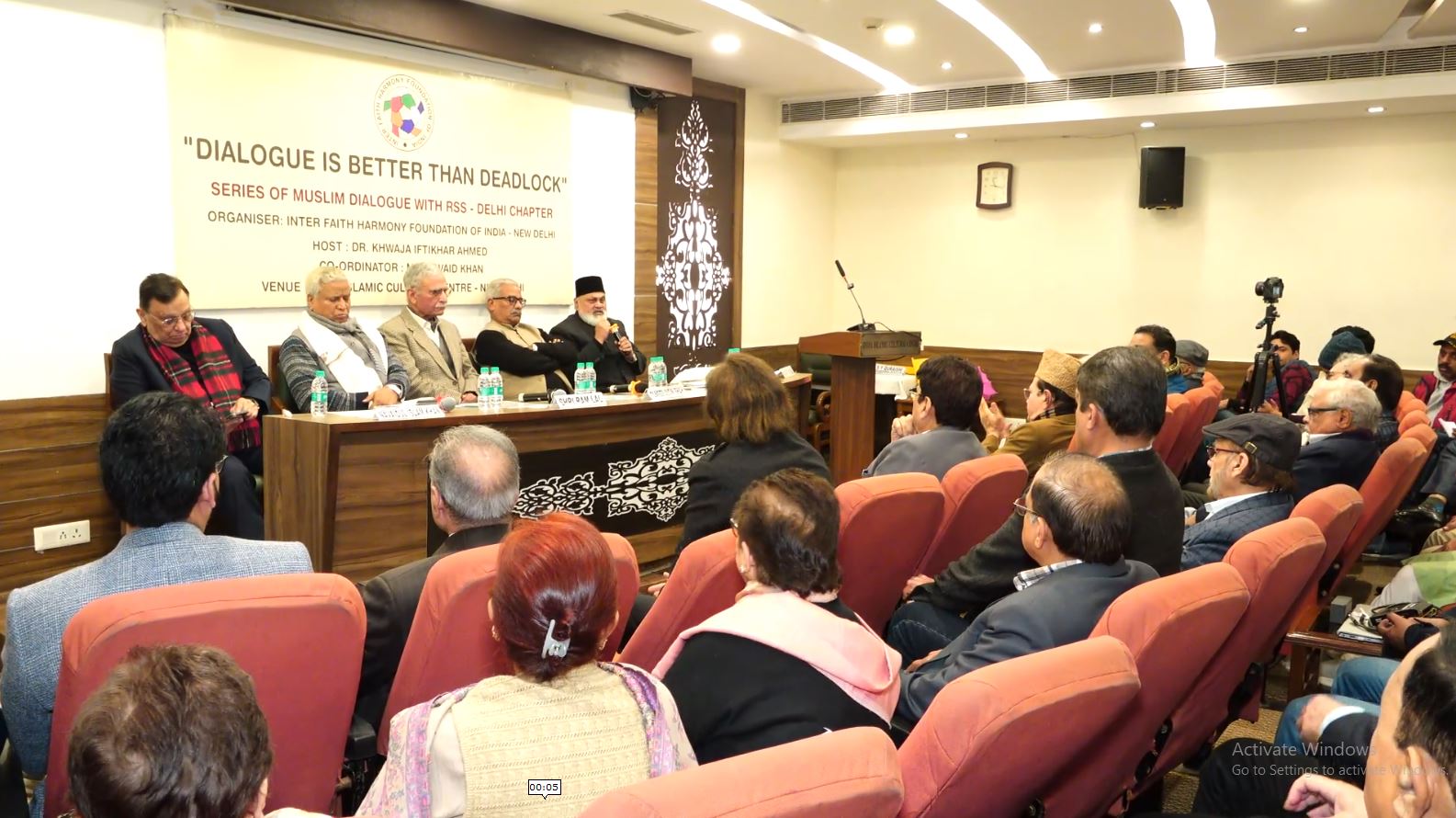 Dr Khwaja Iftikhar speaking at the meeting
Dr Krishna Gopal stated that the purpose of the dialogue was not to persuade Muslims to accept the RSS worldview, but to understand the community’s concerns. “India has a rich tradition of samvad (dialogue). Every argument carries some truth, and merely citing incidents of communal hatred on both sides will not lead us anywhere,” he said.
He noted that after such incidents, innocent Muslim professionals often face undue scrutiny, with hospitals verifying antecedents of young doctors and landlords denying Muslims rental housing. Such acts of extremism, he said, compel sections of Hindu society to revisit historical grievances.
While acknowledging that the vast majority of Muslims are nationalists, Dr Gopal pointed out that a small section does not publicly express its national identity. In this context, he cited Jawaharlal Nehru’s 1948 speech at Aligarh Muslim University, in which Nehru asked students whether they were proud of India’s cultural and intellectual heritage.
He also observed that over the past 1,000 years, there have been limited efforts toward Hindu-Muslim assimilation. While Hindus historically accommodated communities that did not practise idol worship, attempts at assimilation were often obstructed by rigid exclusivism and the tendency to label engagement as anti-Islam. At times, he said, even Muslim intellectuals preferred isolation.
“Though it may be desirable to forget unpleasant history, people do not forget it,” Dr Gopal said, adding that dialogue participants could at best act as catalysts. “Both Hindus and Muslims must come forward if this process is to succeed.”
ALSO READ: Lashkar admits to devastating attack on Muridke in Operation Sindoor
Former Delhi Lieutenant Governor Najeeb Jung remarked that Muslims, as a numerically weaker community, are engaging with a powerful majority. “The Hindu community, as the elder brother, must extend a helping hand to young Muslim graduates emerging from institutions like AMU and Jamia,” he said.

_(1).jpg "Visitors gather at the Santosh Mitra Square Durga Puja pandal, themed on the 150th anniversary of Vande Mataram and its historic role in India's freedom movement, ahead of the festival, in Kolkata")
.jpg "Gujarat’s women entrepreneurs bring their craftsmanship to life during Navratri")





_(4).webp)
_(2).webp)