Amir Suhail Wani
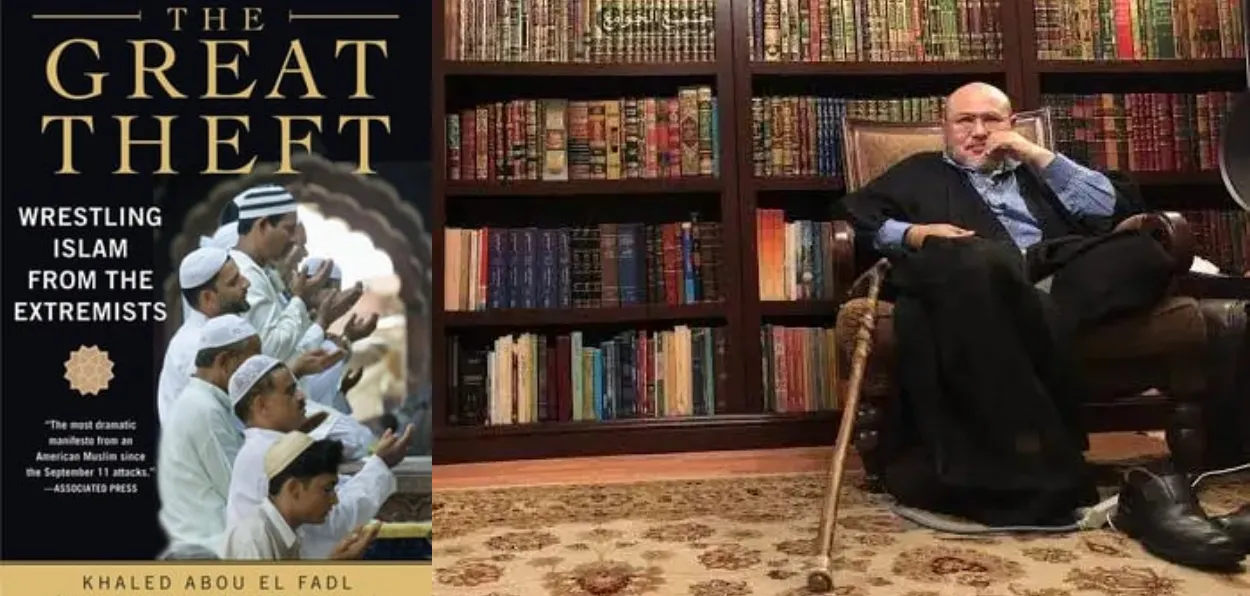
The Great Theft: Wrestling Islam from the Extremists by Khaled M. Abou El Fadl is a powerful and intellectually rigorous intervention in one of the most urgent debates within contemporary Muslim thought: who speaks for Islam in the modern world?
Written in the shadow of the post-9/11 global climate, the book is neither an apologetic tract nor a polemical denunciation. Instead, it is a deeply reflective, historically grounded, and morally charged attempt to diagnose what the author considers a profound internal crisis—an ethical and theological struggle between competing visions of Islam.
Book Review
Abou El Fadl argues that the faith has been “stolen” by puritanical movements that claim exclusive authority over religious truth, reducing a vast and plural intellectual tradition into a rigid, literalist, and often harsh ideology. The “great theft” of the title refers not merely to acts of violence committed in Islam’s name, but to the usurpation of the religion’s moral centre, its jurisprudential diversity, and its long-standing culture of interpretive humility.
At the heart of the book lies a conceptual distinction between what the author calls “puritan” Islam and “moderate” Islam. The puritan orientation, associated particularly with Wahhabi and certain Salafi trends, insists that divine law is a closed and complete code that leaves little room for moral reasoning, historical context, or interpretive plurality.
In this framework, obedience is elevated above ethical deliberation, and dissent is often treated as deviation. Abou El Fadl carefully traces the emergence of this historic orientation; how it gained financial and geopolitical backing in the twentieth century, and how it gradually expanded its influence through educational networks, religious institutions, and global politics. Yet his critique is not merely sociological; it is theological.
He argues that puritanism distorts the classical Islamic tradition, which was characterised by methodological discipline, epistemic humility, and an awareness of the limits of human understanding. For him, the classical juristic heritage did not claim infallibility; rather, it acknowledged disagreement as a sign of intellectual vitality and moral seriousness.
The book moves beyond general critique to examine specific areas where this divide becomes most visible. Abou El Fadl discusses how puritan interpretations approach law, often treating the Shari‘ah as a rigid blueprint detached from ethical objectives. In contrast, he presents a vision of Islamic law that is rooted in moral purpose, public welfare, and the cultivation of justice.
His reflections on gender are particularly pointed. He challenges interpretations that marginalise women or restrict their participation in public life, arguing that such readings reflect patriarchal culture more than divine mandate. Similarly, his discussion of jihad and violence dismantles the simplistic equation of militancy with religious authenticity.
He insists that classical Islamic jurisprudence developed elaborate constraints on warfare, emphasising proportionality, protection of civilians, and moral accountability. By revisiting these traditions, he demonstrates that extremism is not a faithful continuation of the past but a selective and often historical appropriation of it.
One of the most compelling aspects of the book is its moral tone. Abou El Fadl writes not as a detached observer but as a believer deeply invested in the ethical integrity of his tradition. He expresses concern that many Muslims, particularly in the face of global political pressures, have internalised defensive postures that either romanticise the past or react angrily to criticism. Against both tendencies, he calls for intellectual honesty and moral courage.
The Author speaking about Islam on the YouTube Channel of Usuli Institute :
He urges Muslims to reclaim their heritage of critical scholarship and to resist authoritarian religious voices that demand unthinking submission. At the same time, he addresses Western audiences, cautioning them against reducing Islam to its most sensational manifestations. His analysis thus operates on multiple levels: intra-Muslim reform, interfaith understanding, and global political awareness.
Stylistically, the book balances scholarly depth with accessibility. While certain sections delve into legal theory and historical debates, the prose remains largely clear and deliberate.
Abou El Fadl’s training as both a classical jurist and a Western legal scholar enables him to translate complex jurisprudential concepts into language that educated non-specialists can grasp. The argument unfolds methodically, building from historical context to normative critique, and culminating in a call to ethical renewal.
If there is a limitation, it may lie in the fact that the book focuses more on diagnosing the problem than on offering detailed institutional blueprints for reform. Yet perhaps this is intentional; the author’s primary aim is to awaken moral consciousness rather than to draft policy prescriptions.
For readers in societies like ours, where questions of religious authority, pluralism, and modernity remain intensely debated, this work carries particular resonance. It invites introspection about how traditions are preserved, who interprets them, and how power intersects with theology. Rather than presenting Islam as either inherently peaceful or inherently violent, Abou El Fadl insists on complexity.
He shows that the struggle over Islam’s soul is ongoing and that its outcome depends on the intellectual and moral choices of Muslims themselves. In that sense, the book is not only a critique of extremism but also a plea for responsibility.
Khaled M. Abou El Fadl himself is one of the most prominent contemporary scholars of Islamic law and theology. Born in Kuwait and trained in both traditional Islamic jurisprudence and Western legal systems, he serves as a distinguished professor of law at the University of California, Los Angeles. His academic work spans Islamic jurisprudence, human rights, and constitutional theory, and he has been involved in advisory roles related to religious freedom and civil liberties.
ALSO READ: Ten extraordinary Muslim women politicians of India
What distinguishes him is his insistence that fidelity to Islam requires ethical depth, intellectual rigour, and humility before God. Across his writings, he challenges authoritarianism—whether political or religious—and advocates for a morally grounded, pluralistic understanding of the Shari‘ah. In presenting The Great Theft to your audience, one may therefore describe it not simply as a book about extremism, but as a scholar’s heartfelt attempt to reclaim a tradition he believes has been misrepresented both from within and without.
The Great Theft: Wrestling Islam from the Extremists; Khaled M. Abou El Fadl; The Great Theft: Wrestling Islam from the Extremists; Khaled M. Abou El Fadl











.webp "First female space tourist, Anousheh Ansari")
.webp)