Kathmandu
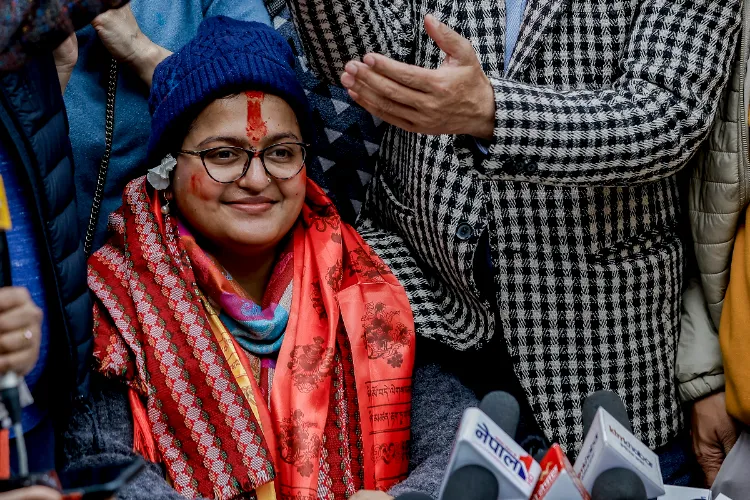
The newly formed Rastriya Swatantra Party (RSP), led by rapper-turned-politician Balendra Shah, appeared set for a sweeping victory in Nepal’s general elections on Friday, according to early trends from vote counting.
The elections are the first since mass youth-led protests last September forced the fall of the government headed by former prime minister K P Sharma Oli.
Data released by the Election Commission of Nepal showed the RSP leading in 70 of the 94 constituencies where counting was underway by Friday afternoon. In contrast, the Nepali Congress, Communist Party of Nepal (Unified Marxist–Leninist) and the Nepal Communist Party were each ahead in six seats.
India is closely monitoring the election outcome, hoping the new government will ensure political stability in the Himalayan nation and continue bilateral development partnerships. Commenting on the polls, External Affairs Ministry spokesperson Randhir Jaiswal said India looked forward to working with the incoming government to further strengthen ties between the two countries.
Shah, popularly known as Balen and the former mayor of Kathmandu, is contesting from the Jhapa-5 constituency where he is leading against Oli, the chair of the CPN-UML and a four-time prime minister. Early figures showed Shah securing 6,090 votes compared to Oli’s 1,248.
The Rastriya Prajatantra Party, Progressive Democratic Party, Shram Sanskrti Party and some independent candidates were also ahead in one constituency each.
So far, the Election Commission has officially declared one victory each for the RSP and the Nepali Congress. RSP candidate Ranju Darshana won the Kathmandu-1 seat with 15,455 votes, while Nepali Congress leader Yogesh Gauchan Thakali secured the Mustang constituency with 3,307 votes.
Meanwhile, senior Maoist leader Pushpa Kamal Dahal Prachanda was leading the race in Rukum East with 5,924 votes.
Media reports indicated that the RSP was ahead in all ten constituencies of Kathmandu, reflecting strong support in the capital.
The country recorded around 60 per cent voter turnout in Thursday’s elections for the House of Representatives. Vote counting began late that night and is expected to conclude by Friday.
Formed in 2022 and led by former television presenter Ravi Lamichhane, the RSP projected Shah as its prime ministerial candidate during the campaign.
On the other hand, the Nepali Congress has named party president Gagan Thapa as its prime ministerial candidate, while the CPN-UML backed Oli for the top post.
Nearly 18.9 million voters were eligible to elect 275 members to the House of Representatives. Of these, 165 are chosen through the first-past-the-post system, while 110 seats are filled through proportional representation. More than 3,400 candidates contested the directly elected seats and over 3,100 candidates ran under the proportional system.
Nepal’s political landscape has remained unstable for years, with the country witnessing 14 governments over the past 18 years.
The latest elections were triggered after large-scale youth protests on September 8 and 9 forced Oli’s coalition government out of power. Following the upheaval, President Ramchandra Paudel dissolved the House of Representatives and appointed Sushila Karki as caretaker prime minister until fresh elections were held.
READ MORE: J&K's only woman CM Mehbooba Mufti injected compassion into politics
The protests, largely driven by Gen Z activists, raised issues such as corruption, poor governance, nepotism and the demand for generational change in political leadership.











.webp)