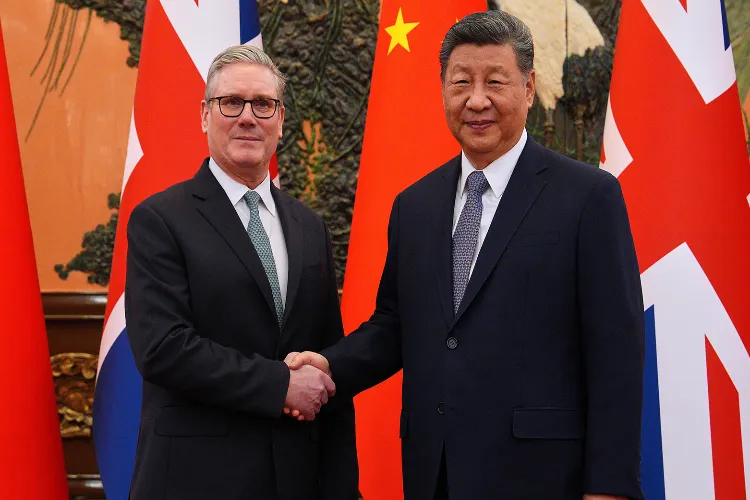
Beijing
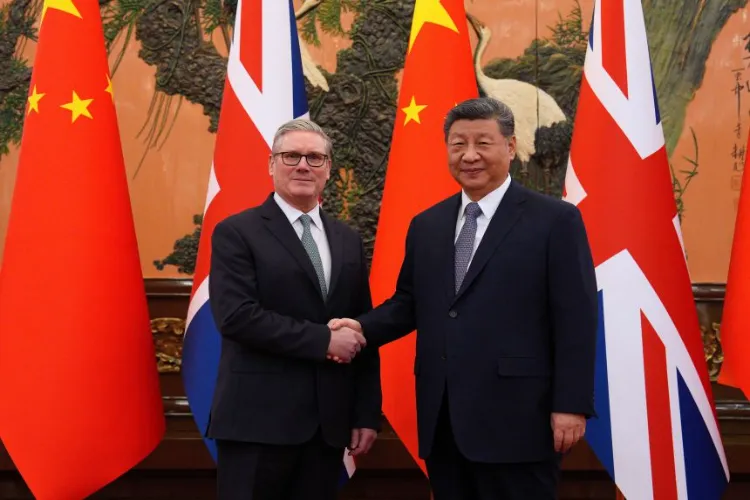
British Prime Minister Keir Starmer and Chinese President Xi Jinping on Thursday signalled a renewed push to strengthen ties between their countries, calling for a broader strategic partnership at a time when global politics and trade are facing growing instability.
While neither leader referred directly to former US President Donald Trump, the shifting international order and disruption to long-standing global arrangements formed a clear backdrop to their talks.
Addressing Xi at the outset of their meeting in Beijing, Starmer emphasised the need for cooperation on global challenges such as climate change and international stability, saying collaboration between major economies was essential during an uncertain period for the world.
The two leaders held talks for around 80 minutes at the Great Hall of the People — twice the time originally scheduled — underlining the significance both sides attached to the visit. Relations between London and Beijing have been strained in recent years over allegations of Chinese espionage in Britain, Beijing’s support for Russia during the Ukraine conflict, and China’s tightening grip on Hong Kong. Starmer is the first British prime minister to travel to China in eight years.
Xi acknowledged that bilateral relations had gone through a difficult phase, saying past tensions had not served the interests of either country. Against the backdrop of a volatile international environment, he said stronger communication and cooperation between China and Britain were necessary to support global peace and stability.
Chinese state media later reported that Xi had warned that if powerful nations disregarded international norms, the global system could descend into chaos — a remark widely interpreted as an indirect reference to current geopolitical tensions.
Following the meeting, Starmer said discussions had been constructive, pointing to progress on easing Chinese tariffs on Scotch whisky exports and steps toward visa-free travel for British citizens visiting China.
He described bilateral relations as being on a “strong footing”, suggesting momentum had returned to the relationship after years of stagnation.
Xi appeared to allude to domestic criticism faced by Starmer over his engagement with Beijing, particularly concerns related to security and human rights. Britain recently approved plans for a large new Chinese embassy in London, a move that eased diplomatic friction but drew objections from critics who fear increased surveillance and pressure on dissidents.
Xi said meaningful decisions often involve challenges, adding that leaders should not shy away from difficulty if actions are taken in the long-term interests of their people.
Starmer’s visit comes shortly after the conviction of Hong Kong media tycoon and British citizen Jimmy Lai under a Beijing-imposed national security law. The prime minister said he raised human rights concerns during his discussions with Xi, describing the exchange as frank but respectful.
Elected in July 2024, Starmer has pledged to balance national security concerns with diplomatic engagement. He noted that Britain had been absent from high-level dialogue with China for too long and reiterated his commitment to re-establishing the UK as an outward-looking global player.
He also linked foreign policy to domestic economic challenges, saying developments overseas directly affect household costs and national security back home.
Facing pressure to revive economic growth and ease the cost-of-living crisis, Starmer sees engagement with China as one avenue to support British businesses. More than 50 UK business leaders accompanied him on the trip, along with representatives from cultural institutions, as the government seeks to expand commercial opportunities and attract Chinese investment.
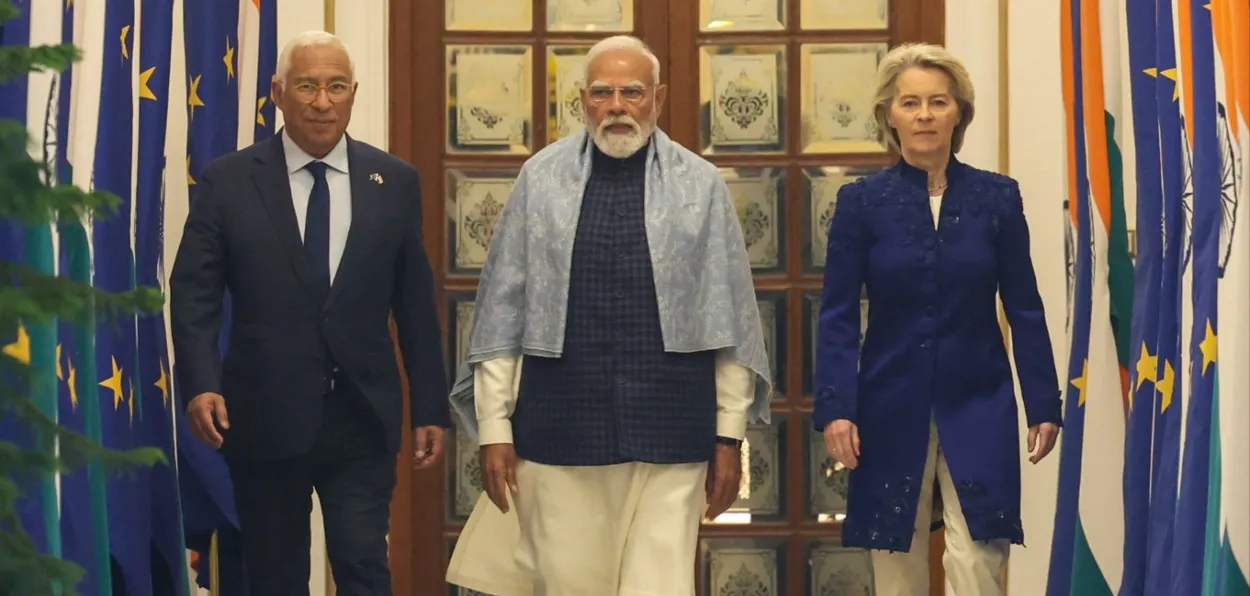
Global trade disruptions triggered by renewed tariff policies in the United States have prompted many governments to pursue alternative partnerships. On Thursday, Vietnam and the European Union upgraded their relationship to a comprehensive strategic partnership, shortly after India and the EU announced a free trade agreement.
European Council President Antonio Costa said international cooperation had become increasingly important as the global rules-based system comes under strain.
Starmer is the fourth leader from a US-aligned country to visit Beijing this month, following leaders from South Korea, Canada and Finland. Germany’s chancellor is expected to make a similar visit next month.
Earlier in the day, Starmer met Zhao Leji, chairman of China’s National People’s Congress. Several bilateral agreements were expected to be finalised during the visit.
ALSO READ: I received my wages for hard work of decades: Ghafruddin on Padma Shri
One such agreement focuses on curbing the supply of Chinese-made boat engines used by criminal networks to smuggle migrants across the English Channel. British officials say more than half of the engines used in such operations originate in China. Under the arrangement, British authorities will cooperate with Chinese officials and manufacturers to prevent the equipment from reaching trafficking groups.