London
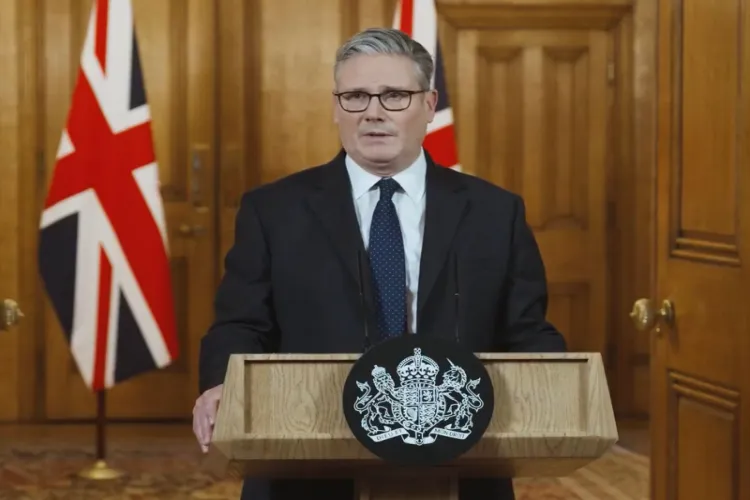
British Prime Minister Keir Starmer is set to travel to China this week in an effort to reset ties with Beijing, a move aimed at boosting Britain’s economy but one that could strain relations with Washington at a time when the United States is adopting a more confrontational global stance.
Starmer is expected to hold talks with Chinese President Xi Jinping and Premier Li Qiang during his visit to Beijing and Shanghai, which begins Wednesday. It will be the first visit to China by a UK prime minister since 2018. Accompanying him will be Business Secretary Peter Kyle and a delegation of senior business leaders, as Britain seeks Chinese investment and wider access to the world’s second-largest economy for sectors including financial services, automobiles and Scotch whisky.
Analysts say both sides are emphasising “pragmatism” as the defining principle of the visit, particularly as geopolitical uncertainty grows under the return of US President Donald Trump, whose aggressive tariff policies and rhetoric have unsettled many allies.
China’s government said the trip offers an opportunity to rebuild trust and expand practical cooperation. “In today’s complex and volatile international environment, maintaining dialogue and strengthening cooperation is in the shared interest of China and the UK,” Chinese Foreign Ministry spokesperson Guo Jiakun said at a briefing in Beijing on Tuesday.
Zhao Minghao, a professor at Shanghai’s Fudan University, noted that China is no longer just a manufacturing hub. “It is increasingly becoming a major global consumer market,” he said.
Relations between London and Beijing have fluctuated sharply over the past decade. In 2015, then-prime minister David Cameron proclaimed a “golden era” in ties, symbolised by President Xi’s high-profile state visit to Britain. That optimism faded as concerns grew over Beijing’s clampdown on civil liberties in Hong Kong, China’s backing of Russia in the Ukraine war, and allegations of espionage and political interference.
Subsequent Conservative governments moved to restrict Chinese involvement in sensitive sectors, banning firms from telecoms infrastructure and limiting participation in nuclear power projects.
Since coming to power 18 months ago, Starmer’s Labour government has conducted a review of China policy, describing its approach as one of “hard-headed realism” — defending national security while keeping economic and diplomatic channels open.
Kerry Brown, director of the Lau China Institute at King’s College London, said the visit reflects shifting global dynamics but warned that Starmer faces scepticism at home. “Britain’s China policy has swung between extremes,” he said. “That inconsistency makes rebuilding trust more complicated.”
Starmer’s outreach comes as his government struggles to deliver the economic momentum promised during the election campaign. Britain continues to grapple with high living costs, and Labour’s poll ratings have slipped, with some party figures privately questioning Starmer’s leadership.
Internationally, the trip also highlights growing unease among US allies as Trump reasserts an “America First” agenda. Although Starmer recently secured a trade deal easing US tariffs on British car and aerospace exports, tensions have surfaced. He has publicly criticised Trump’s comments on Greenland and condemned remarks downplaying the role of NATO allies in Afghanistan as “insulting”.
Starmer insists Britain does not need to choose between Washington and Beijing. His visit follows recent trips to China by Canadian Prime Minister Mark Carney, with German Chancellor Friedrich Merz due next month, signalling a broader recalibration among US allies.
Zhao said Trump’s policies have prompted many partners to “de-risk” their dependence on the United States. However, warmer ties with Beijing could come at a cost. Trump recently threatened steep tariffs on Canada after it reached trade agreements with China.
Critics of Starmer’s China engagement argue that the government underestimates the security risks posed by Beijing. Opposition has intensified following approval of a large new Chinese embassy near London’s Tower Bridge, which detractors warn could be used for surveillance or intimidation of dissidents.
The prime minister is also under fire for an agreement to transfer sovereignty of the Chagos Islands to Mauritius, a move the government says safeguards a key UK-US military base but which opponents claim could increase Chinese influence in the region. Trump last week criticised the deal.
Human rights remain another sensitive issue. Chris Patten, the last British governor of Hong Kong, urged Starmer to speak candidly about concerns such as the treatment of Uyghur Muslims and the detention of pro-democracy activist Jimmy Lai, a British citizen.
“You don’t have to be rude,” Patten said, “but you do have to be honest about where you disagree.”
ALSO READ: Padma Bhushan for Mammootty and Padma Shri for 4 more Muslims
Brown said Starmer will judge the trip successful if it delivers tangible economic gains while avoiding major diplomatic fallout. “The goal is predictability,” he said. “Cooperate where possible, disagree where necessary — and keep talking.”

.webp "Buddha statue")
.webp "Representational Image")








.webp)