New Delhi
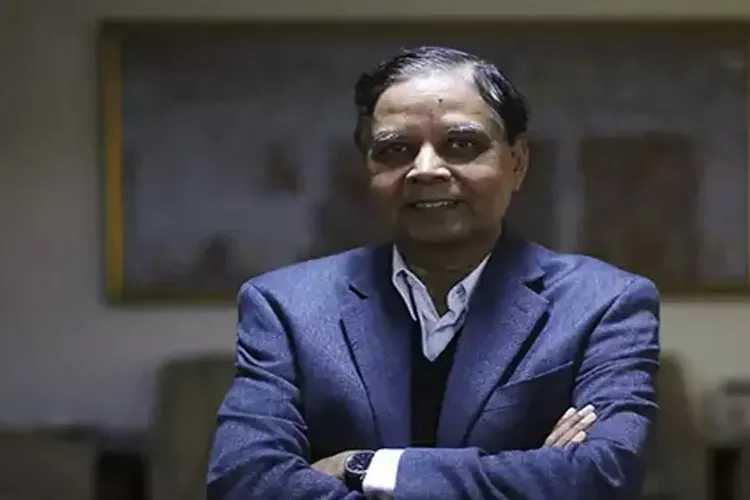
The government needs to resuscitate privatisation of public sector undertakings (PSUs) as well as public sector banks (PSBs) as it is integral to India's economic reforms, former NITI Aayog vice chairman Arvind Panagariya said on Monday.
Panagariya also advocated creating an independent privatisation ministry to accelerate the government's disinvestment agenda, as the Department of Disinvestment has been unable to maintain the pace of privatisation.
"I firmly believe that, regardless of fiscal pressures, the privatisation of PSUs and most public sector banks is integral to our economic reforms," he told PTI in an interview.
Panagariya said aggressive PSU and bank privatisation should proceed regardless of the West Asia crisis and geopolitical uncertainties.
"Modernisation of the economy as a part of our India@2047 movement, we need to resuscitate the PSU and PSB privatisation," he said.
Under Panagariya, the then NITI Aayog vice chairman, the government think tank had pursued the idea of disinvestment of PSUs. NITI Aayog's privatisation program was launched in 2016.
When asked whether he finds it odd that capital is leaving a country (India) experiencing growth rates of 6-7 per cent, much higher than anywhere else in the world, he explained that the gross FDI has been performing extremely well, as it rose from USD 71.3 billion in FY24 to USD 80.6 billion in FY25 and USD 94.5 billion in FY26.
"Clearly, foreign investors continue to see the long-run productivity of investments in India very positively," Panagariya, currently a professor of economics at Columbia University, said.
He explained that foreign investors withdraw a portion of the past gross FDI in any given year.
"A large part of gross FDI into India has come in the form of private equity. At some point, these investors decide to exit these investments. Typically, this happens when the privately-owned firm goes public through an IPO. In the past two years, IPO activity in India has accelerated, leading to more-than-usual exits by private-equity investors," the Chairman of the 16th Finance Commission said.
Also, according to him, in the last two years, FDI by Indian firms abroad have also accelerated, which has resulted in some outflow of capital from the country.
"If this is a short-term phenomenon, we have nothing to worry about regarding outflows. If it is a long-term trend, it is an excellent development. For it indicates that Indian firms are reaching a high degree of maturity as they are spreading their wings abroad," the eminent economist observed.
Finally, Panagariya said India has also seen foreign portfolio investment (FPI) exit on a significantly larger scale in the last two years, contributing to dollars flowing out.
"By all accounts, Indian equities had become overvalued, which accelerated the exit. But now a valuation correction has happened," he said.
Moreover, Panagariya said the rupee has seen a significant devaluation, making the equities further cheaper for foreign investors.
"Therefore, I expect this source of outflows to calm down in FY27," he said.
According to the latest RBI data, net FDI inflows stood at USD 7.7 billion in 2025-26, a sharp rise from USD 1 billion in 2024-25, though they remained below USD 10.2 billion in 2023-24 and substantially lower than USD 28 billion in 2022-23.
Foreign portfolio investment (FPI) flows remained volatile during the year, with net outflows of USD 16.5 billion in 2025-26, driven mainly by the equity segment.
On the recent depreciation of the rupee, he said it would be reasonable to think that the 'rupee is not overvalued now', as a lot of overvaluation has, no doubt, been corrected recently, he said.
The eminent economist said the fact that the rupee was at approximately 48 per dollar in 2002-03 and 47 per dollar nine years later, in 2011-12, left it massively overvalued in real terms at the end of that period.
Initially, he said from 2011-12 onward, the correction was slow, and the rupee remained overvalued despite significant nominal depreciation.
"The result was that India's merchandise exports fell from USD 310 billion in 2011-12 to USD 260 billion in 2015-16, and only rose back to USD 320 billion in 2019-20. "I think we have now turned a corner by letting rupee depreciation accelerate," the former NITI Aayog vice chairman said.
Panagariya reiterated that he still hopes, however, that the RBI will not fall into the psychological trap of refusing to let the rupee cross the Rs 100-per-dollar mark for too long.
Once considered among Asia's more stable currencies, the rupee has now become one of the worst-performing emerging market currencies this year, pressured by a toxic mix of expensive oil, capital outflows, widening trade deficits and a surging US dollar.
On below-average forecast for monsoon rains and its impact on inflation, he said over the years, India's reliance on rain has seen a steady decline.
READ MORE: Zeenat Pannah's enduring work to preserve India's textile heritage
"Our water reservoirs are in good shape, and, based on the increase in the area sown over last year, farmers seem to have taken a generally optimistic view of the situation. Our buffer stock is also robust," he said, adding that he does not see a compelling reason to be concerned on this account.


.webp "Rocks bearing inscription in ancient Arabic excavated in Saudi Arabia's Madina region")








.webp "Representational Image")
.webp)