Ashhar Alam / New Delhi
India and the European Union on Tuesday sealed the conclusion of negotiations for a long-awaited Free Trade Agreement (FTA), hailed by leaders on both sides as the “mother of all deals”, marking a decisive moment in India’s global trade strategy.
Under the landmark pact, over 93 per cent of Indian exports will gain zero-duty access to the 27-nation European bloc, significantly enhancing India’s competitiveness in one of the worlds largest and most affluent markets. In return, India will gradually lower tariffs on select European goods, including luxury cars, wines and spirits, making them more affordable for Indian consumers.
The agreement, negotiated over more than two decades, brings together two major economic powers India, the world’s fourth-largest economy, and the EU, the second-largest economic bloc creating a combined market of nearly two billion people. Together, the two account for around 25 per cent of global GDP and nearly one-third of world trade, estimated at about USD 11 trillion.
Following summit-level talks with European Commission President Ursula von der Leyen and European Council President Antonio Costa, Prime Minister Narendra Modi described the agreement as the biggest trade deal India has ever concluded.
“This is not merely a trade agreement; it is a new blueprint for shared prosperity,” Modi said, underscoring the strategic depth of the partnership.
Commerce and Industry Minister Piyush Goyal said the pact delivers unprecedented market access, covering more than 99 per cent of India’s exports by value. Calling it a strategic breakthrough, he said the agreement unlocks vast opportunities for Indian businesses in the USD 20 trillion EU market.
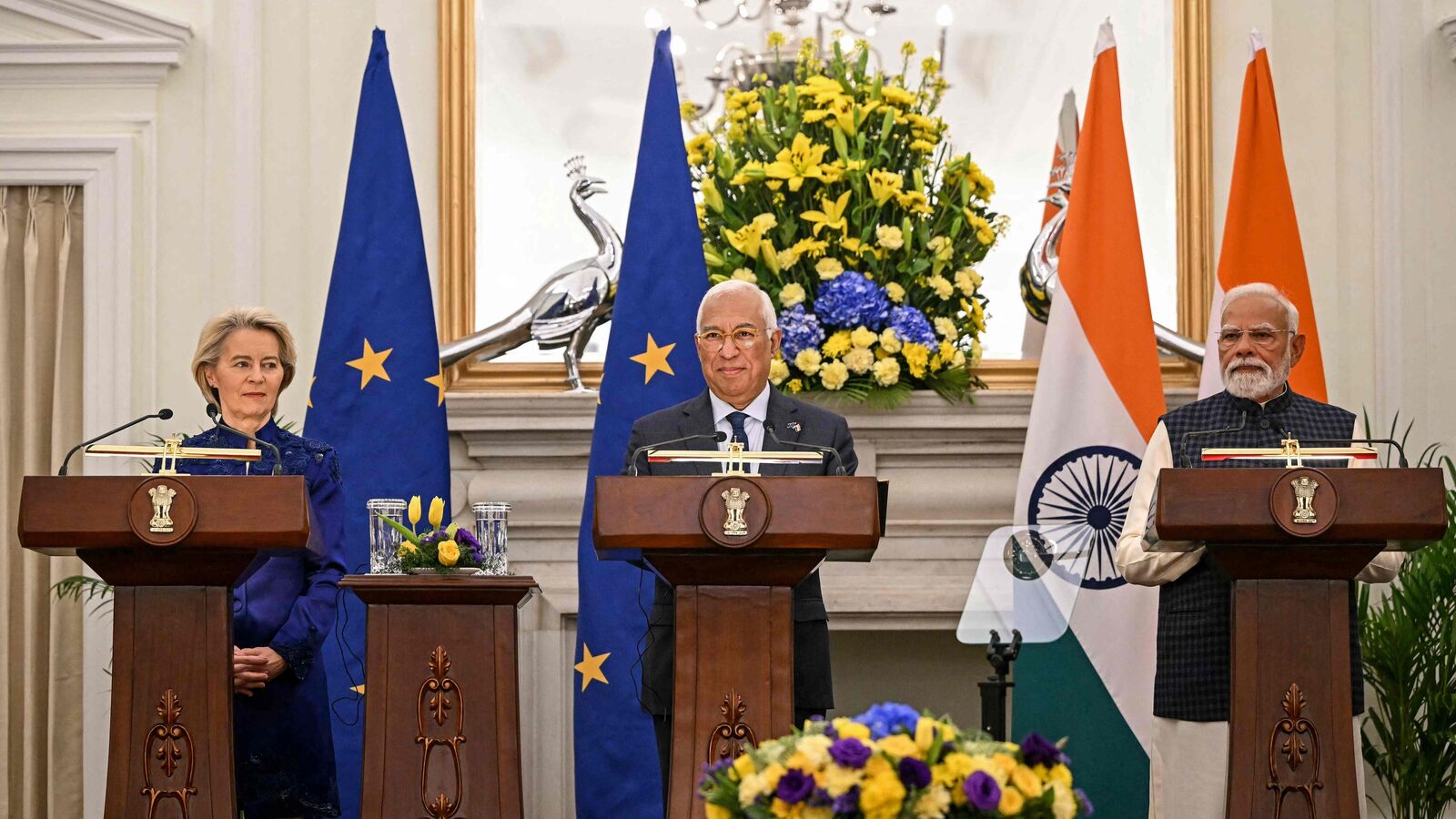 European Commission President Ursula von der Leyen during a joint press statement after a meeting with Prime Minister Narendra Modi at the Hyderabad House, in New Delhi
Once implemented likely in early 2027, following signing later this year almost all Indian goods, barring sensitive segments such as autos and steel, will enjoy duty-free access to the EU. For the remaining products, exporters will benefit from phased tariff reductions and quota-based concessions.
While average EU tariffs on Indian goods are already modest at around 3.8 per cent, the FTA will reduce them to near-zero levels. This is particularly significant for sectors where duties currently run high, including textiles, apparel, leather, footwear, marine products, chemicals, gems and jewellery, furniture, toys, sports goods, and light consumer products.
On the other side, the EU will gain duty-free access for over 90 per cent of its exports to India over a ten-year period. India will eliminate tariffs on around 30 per cent of European goods at the outset, with gradual liberalisation thereafter.
Key European products set to benefit include automobiles, wines, spirits, beer, olive oil, processed foods, fruit juices, meat products, and premium agricultural items. Import duties on many of these currently range between 33 per cent and 150 per cent.
Luxury European car brands such as BMW, Mercedes-Benz, Porsche, Audi and Lamborghini are expected to become more affordable, as India has agreed to reduce import duties to 10 per cent, subject to an annual quota of 2.5 lakh vehicles. The EU, in turn, will phase out duties on Indian automobiles.
Beyond goods, the pact delivers one of the EU’s most ambitious offers in services trade, opening 144 out of 155 sub-sectors to Indian firms, while India will open 102 sub-sectors. These include IT and ITeS, professional services, education, finance, tourism and construction.
The agreement also provides a predictable framework for business mobility, including short-term travel and professional movement, along with commitments on student mobility and post-study work visas.
On the sensitive issue of the EU’s Carbon Border Adjustment Mechanism (CBAM), the pact does not grant India explicit exemptions. However, it ensures that any flexibility extended by the EU to other countries will automatically apply to Indian exporters. The deal also includes provisions for technical cooperation, financial assistance and support to help Indian industry adapt to emerging carbon norms.
The timing of the agreement is notable, coming amid heightened global trade tensions. India is grappling with steep tariffs imposed by the US, while the EU faces threats of fresh trade actions from Washington.
ALSO READ: Padma Bhushan for Mammootty and Padma Shri for 4 more Muslims
With this agreement, the EU becomes India’s 22nd FTA partner. Since 2014, the NDA government has signed trade pacts with Mauritius, UAE, Australia, EFTA, Oman and the UK, and concluded negotiations with New Zealand, reinforcing India’s push to integrate more deeply with global supply chains.
For India and the EU, the deal is more than a commercial arrangement. It signals a strategic alignment aimed at reshaping global trade in an era of economic uncertainty.












_(1).webp)