Saniya Anjum/Karnataka
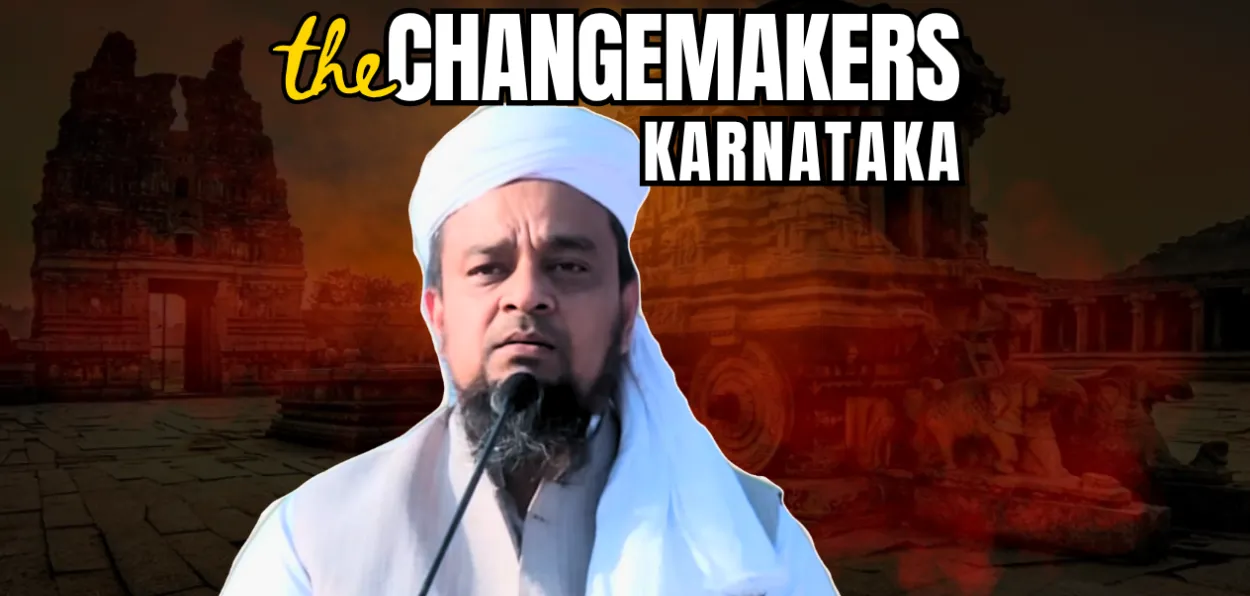
Moulana Dr. Mohamed Maqsood Imran Rashadi commands a following that transcends social media metrics—his 19,500+ digital followers are just a fraction of the thousands who pack Jamia Masjid's courtyard every Friday to listen to his bayan (Sermon). Each sermon becomes a catalyst for peace, rippling through KR Market's alleys where Hindu and Muslim vendors trade side by side, into homes where families choose dialogue over discord.
Amid growing social conflicts, this Imam does something radical: he listens. He listens to troubled youth seeking purpose, to neighbours fearing the "other," to Hindu swamis and Christian priests yearning for peace. His power lies not in commanding followers, but in understanding them. Every word he speaks plants seeds of change.
Moulana Maqsood removes the bait thrown for arousing communal passions and in his next sermon, he would speak of restraint. When loudspeaker debates threaten communal harmony, he sits with Hindu and Christian leaders, as fellow custodians of Bengaluru's soul, then returns to his pulpit to inspire thousands with stories of their cooperation.
His approach is disarmingly simple: dignity over defiance, conversation over confrontation. He teaches patience in the face of suffering, transforming potential violence into peaceful protest.
.jpg) Maulana Maqsood Imran Rashadi meeting Swami Belimath Sri Shri Udhay Ji during the grand Milad-un-Nabi gathering
Maulana Maqsood Imran Rashadi meeting Swami Belimath Sri Shri Udhay Ji during the grand Milad-un-Nabi gathering
Besides social harmony, Moulana Dr Mohamed Maqsood Imran Rashadi, Chief Imam and Khateeb of Jamia Masjid, one of Karnataka’s largest mosques, has changed the lives of many Muslim youth through his initiatives on education.
Born in Kolar, Karnataka, Moulana Maqsood’s grandfather, Alhaj Abdulgafoor Naqshbandi, a cloth merchant with a passion for life’s deeper lessons, would coax young Maqsood to deliver speeches before guests. “Speak with heart,” his nana (grandfather) would say, teaching him the art of "mamlaat"-navigating human connections with grace.
In Mulbagal, he pursued elementary education before diving into a remarkable academic journey: memorising the Quran in just one-and-a-half years after 10th grade, mastering the Aalim course with Farsi in seven years, and earning an MA in Urdu by 2001.
His PhD on “Moulana Mufti Ashraf Ali: Hayat aur Qidmat” delved into the poet’s soulful naats and nazms, reflecting Maqsood’s own blend of scholarship and artistry.
At age 24, he worked as a volunteer at Jama Masjid. In 2000, he became Naib Imam at Jamia Masjid and in 2011, Permanent Imam, Khateeb, and Principal of Jamiul Uloom Arabic College.
At Jamiul Uloom, Moulana Maqsood saw a generation yearning for opportunity. In a bold move, he founded a department from scratch, uniting Jamiul Uloom, Shaheen Group, and Khadim Moimon Trust on an honourary basis.
.jpg)
Maulana Maqsood Imran Rashadi representing India at the International Peace and Brotherhood Conference held recently in Tehran, Iran
This initiative today serves 200 residential students, 100 day scholars, and 100 NIO (National Open School) residential students, offering 10th, PUC, and degree programs via correspondence. The program achieved a 100% pass rate for four consecutive years, defying the odds in a community where dropout rates loom large.
One of the success stories is of Zainab, a 16-year-old from a KR Market slum, who joined Jamiaul Uloom. Her family, struggling to afford food, saw no future beyond early marriage. Moulana’s team provided free books and mentorship, and Zainab not only completed her 12th grade but now trains as a teacher. “Knowledge is the light Allah grants us,” he says, his eyes gleaming with pride. His educational revolution has turned dreams into reality for hundreds, proving that faith and learning can break poverty’s chains.
“Itihad mein hi taraqqi hai” (Unity is progress), he declares, driven by his mantra: “Allah ki raza aur qaum ki bhalai” (God’s pleasure and community welfare).
Standing as a pillar of peace in the city of Bengaluru, during the "I Love Mohammed" banner uproar across India, he acted decisively. As divisive banners risked fracturing harmony, he intervened. “Love isn’t shown by banners,” he declared. “But by unity and deeds.” His words defused anger; Neighbours, once on edge, embraced coexistence, proving faith thrives in compassion.
When loudspeaker debates threatened harmony, he met Hindu and Christian leaders, securing fair sound regulations for all faiths. “If rules bind one community, they must bind all,” he argued, earning respect across divides.
.jpg)
By enabling Muslim vendors to trade near temples and Hindu merchants near mosques, Moulana Maqsood helped turn potential conflict areas into shared spaces of coexistence, showing that unity requires deliberate effort.
As a mufti, Moulana Maqsood's fatwa against media sensationalism sparked #TruthInMedia, a youth campaign in KR Market for fair reporting. He advises legal solutions for Waqf disputes, and his 2025 protests against the Waqf Amendment Bill—peaceful human chains at Palace Grounds—united communities without conflict.
“Justice is our duty,” he says, blending Islamic values with modern advocacy to inspire change.
_(1).jpg)
Drawing from the Prophet’s Meesaq-e-Madina, Moulana Maqsood builds bridges that surprise even sceptics. During the loudspeaker row, his negotiations with non-Muslim leaders ensured equity. In the I love Mohammed matter, he united communities to teach that “love is proven by practice, not banners.” His open-door policy at Jamia Masjid welcomes Hindu, Christian, and Dalit leaders for dialogues on shared struggles, like urban poverty.
He urges regular police-community meetings, a practice now embraced locally, to counter misinformation. Invited by Saudi and American governments to share sermons, he draws from the Prophet’s life to teach youth: “Reject extremism with knowledge; build with unity.” His message resonates, inspiring young Muslims to embrace peace and patriotism.
ALSO READ: Theatre wizard Zafer Mohiuddin shattered stereotypes and taboos with his art
Moulana Maqsood isn’t just a leader—he’s a movement. His life challenges us to act with sabr (patience) and ihsan (excellence), turning faith into deeds. From Jamia Masjid’s vibrant pulpit, his voice echoes over Bengaluru’s skyline, proving one heart, one vision, can reshape a nation. Watch him lead, unite, and inspire—now, what will you do to change the world?













.webp)