Chandigarh
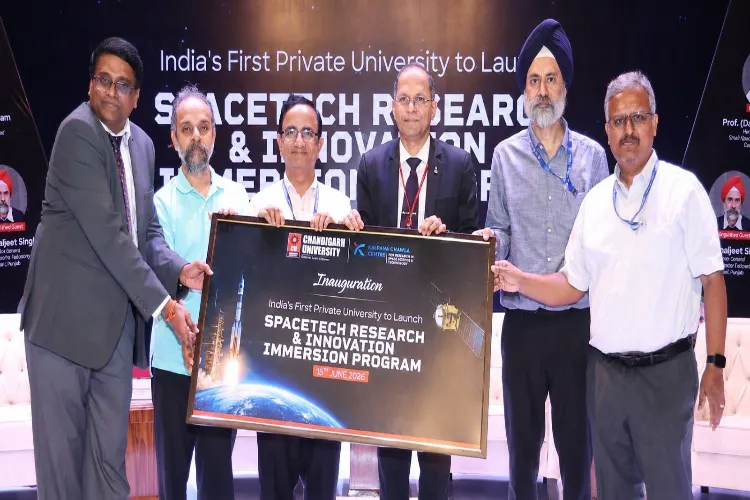
In a significant initiative aimed at advancing space education and research in India, Chandigarh University, through its Kalpana Chawla Centre (KCC), on Monday launched the KCC Space Technology & Research Program 2026 and the KCC Summer Internship Program 2026.
The month-long national programme, running from June 15 to July 11, has brought together experts from leading scientific institutions, including Indian Space Research Organisation, Indian Institute of Space Science and Technology, and the Semiconductor Laboratory, to mentor students and research scholars in emerging technologies shaping India's growing space sector.
The initiative seeks to provide participants with practical exposure, technical insights and opportunities to engage with cutting-edge developments in satellite systems, semiconductors, space applications and advanced research.
The inaugural ceremony was attended by senior scientists and technologists, including Dr S. Sudhakar, Deputy Director of ISRO's U R Rao Satellite Centre, who served as the chief guest. Prof. Priyadarshnam, Head and Project Director of SSPACE at IIST, was the guest of honour. Dr Kamaljeet Singh, Director General of SCL, and Sri Jothy Soman, Group Director at URSC, were also present.
Addressing the gathering, Dr Sudhakar said that science and technology would be central to India's aspiration of becoming a developed nation by 2047.
"Science will increasingly shape the future, and space technology will be among the most important drivers of that transformation," he said.
Drawing from ISRO's own experience, he highlighted the importance of developing indigenous technologies.
"Technology does not come free. Acquiring it externally often involves significant costs. When we build our own capabilities, we gain strategic advantages, reduce expenses and strengthen self-reliance. This approach has enabled India to achieve world-class outcomes despite limited resources," he noted.
Dr Sudhakar pointed out that sectors such as communication, navigation, surveillance and scientific exploration would become increasingly dependent on space-based systems in the coming decades. He also noted the growing role of the defence sector in developing space capabilities, both independently and in collaboration with ISRO.
He added that ISRO had already outlined an ambitious roadmap extending to 2047, encompassing advanced exploration initiatives and long-term human spaceflight missions.
Prof. Priyadarshnam emphasised that one of ISRO's greatest strengths has been its ability to maximise outcomes with limited resources.
He said mission success depends not only on automation but also on rigorous testing, precision and the commitment of scientists and engineers.
"This culture of frugal innovation and uncompromising validation has been integral to ISRO's achievements," he said.
Speaking about future technologies, he identified quantum systems and artificial intelligence as areas that would significantly influence national security and space applications.
"Quantum technologies, particularly cryptography and communications, will become increasingly important. Similarly, the vast amount of data generated by space missions will make artificial intelligence indispensable for analysis and decision-making," he said.
Prof. Priyadarshnam also underlined the role of space technology in economic development, stating that India must accelerate the integration of such technologies across sectors to maintain growth momentum.
Dr Kamaljeet Singh described semiconductors as the backbone of the digital economy and a critical component of India's development ambitions.
"Under the India Semiconductor Mission, multiple manufacturing and assembly facilities are being established. The objective is to build a comprehensive ecosystem that reduces import dependence and strengthens domestic technological capabilities," he said.
He noted that semiconductors are essential for sectors ranging from defence and telecommunications to artificial intelligence, advanced computing and space technologies.
Highlighting the growing importance of AI, Dr Singh said India should leverage its vast data resources to develop indigenous solutions and sovereign AI models.
According to university officials, the programme will feature nearly 15 eminent scientists, researchers and technical experts from institutions such as ISRO, IIST, NewSpace India Limited, Indian Institute of Remote Sensing, the Ministry of Earth Sciences and SCL.
READ MORE: Asra Anjum revived Dakni deserts to preserve culinary heritage
Participants will take part in technical sessions, laboratory demonstrations, mentoring programmes, expert lectures, workshops and research interactions designed to nurture innovation and strengthen India's future workforce in the space and semiconductor domains.

.webp "Rocks bearing inscription in ancient Arabic excavated in Saudi Arabia's Madina region")