Saquib Salim
“A Muslim Woman Preaches in the Mosque”, read the headline of an editorial in the Roshni, a quarterly bulletin published by the All India Women’s Conference (AIWC), in June 1940.
A Slice Of History
The editorial said, “We congratulate the Muslims of Trichinopoly (Trichunapalli) for being so broadminded as to ask Begum Sultan Mir Amiruddin not only to go to the Mosque, but also for requesting her to deliver a sermon there. This is a great step forward and a victory for the cause of Muslim women, who we understand are not supposed to be seen anywhere near the Mosque. It is significant to note that for the first time, Muslim women came out in thousands wrapped up in their ‘chadars’ to hear the sermon. The women assembled requested the Begum to address them in particular. We hope the other parts of India will follow the noble example set by the Muslims in Trichinopoly. Perhaps our readers would remember that Begum Sultan Mir Amiruddin is a very active member of the All India Women’s Conference and has done signal work along with Mrs Margaret Cousin in reorganising our Tamil Nadu Branch.”

Muslim Women showing support for ban on triple talaq in Ahmedabad
Who was Begum Sultan Mir Amiruddin?
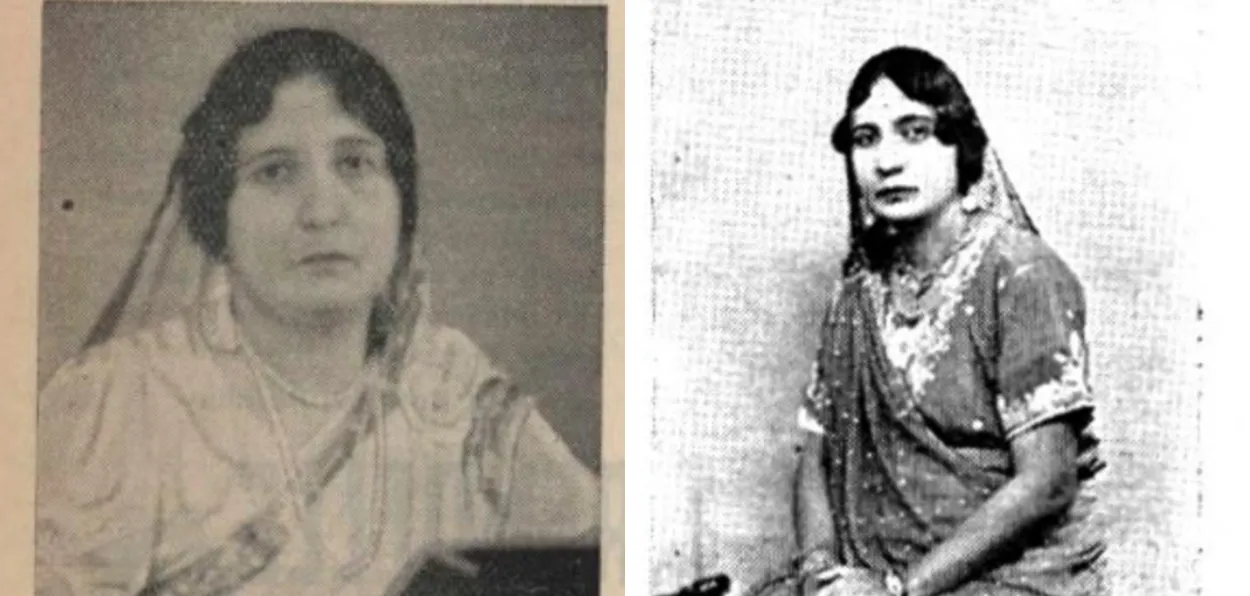
Begum Sultan Mir was born and brought up in Calcutta in an orthodox Muslim household. In 1920, she became the first Muslim woman to graduate from Bengal, Bihar, Odisha and Assam. Later, she became the first Indian Muslim Woman to study law.
In a biographical sketch published in 1935, Syed M. H. Zaidi wrote, “As she was in purdah, special arrangements had to be made by the (Calcutta) University for examining her. She was the only lady who appeared for this Examination, and she passed out first in the University and excelled the several hundred men students that had appeared along with her.”
After marriage, she moved to Chennai, where she became active with several women’s organisations. Begum Sultan Mir Amiruddin was a prominent figure in AIWC and raised a voice for women’s suffrage. She served on the senate of Madras University, represented India at several platforms, was awarded the title of M.B.E. and served as an MLA in independent India.
In the 1920s, Begum Amiruddin “raised an emphatic protest against the exclusion of Muhammadan girls by the Municipality of Madras from the scheme of compulsory education which they were introducing, and strongly worked on that behalf, and her efforts were finally crowned with success. She founded a Ladies' Club at Rajahmundry during her stay there and organised Women's Conferences, which have since become an annual feature in Andhra Pradesh and Telangana.
She founded an Education Service League at Salem, which she found to be very backward in education, and took steps for the introduction of compulsory education in that town, both among boys and girls. She was the President of the Tamil Nadu Women's Conference and also the President of the First Teacher Managers' Conference held in Salem in 1933.”
.jpg)
Women praying on occasion of Eid in Chennai
Begum Amiruddin’s essay, Woman’s Status in Islam, published in the Muslim Review (Lucknow) in 1937, became a talking point in India as well as Europe. She claimed, “The backward condition of Muslim society in genera1 and of women in particular during the past years is traceable not to the religion of Islam, which is dynamic and not static in character, as is wrongly conceived in the West but, on the other hand, to the disregard of Islamic precepts and, in the main, of the injunction with reference to the acquisition of knowledge and culture….. The stirrings among Muslim women today to hoist aloft the banner of culture and advancement is but a response to the strident call of Islam to progress and enlightenment, the outcome of a true appreciation of the teachings of the Holy Prophet Muhammad. May peace be upon this Great Teacher, the staunchest supporter of women's cause the world has ever known.”
The Western feminists believed that Begum Amiruddin and other Asian women thinkers were wrong in absolving their religion and culture of the causes of the oppression of women. However, most Indian women echoed the sentiments that feminism and cultural renaissance are not antithetical to each other.
In this much-acclaimed essay, Begum Amiruddin argued that Western culture had always “treated (women) as inferior and unworthy of consideration.” She argued, “So late as the 18th century, even Rousseau, the radical reformer of his day, regarded women as merely supplementary to the nature of man.”
AIWC and Begum Amiruddin were particularly interested in the rights of Muslim women. She constantly raised these points in conferences and public meetings. In an article, The Legal Status of Muslim Women, published in 1940, she wrote, “In this article I propose to deal with the legal status of Muslim women and the reforms necessary for them.”
In this article, she points out that though the share in inheritance is half of that of males for women under Islamic law, the system of dower compensates for it. Begum Amiruddin said, “What is of special note is that on marriage, a Muslim woman’s existence does not in law become merged in that of her husband. She is regarded as a separate entity. She, therefore, retains her own property, is empowered to alienate and dispose of it herself, enter into contracts and agreements on her own account and sue her debtors in her own name. In short, ever since the Prophet Muhammad (may peace be upon him) initiated reforms in women’s position, a Muslim woman has been regarded as a ‘femme sole’...... With regard to maintenance, the wife can claim to be provided with proper accommodation. Separate from the husband’s relations, and to be maintained in a manner compatible with the means and status of the husband. If he neglects to maintain her, she can pledge his credit.”
After detailing the rights granted in Islamic jurisprudence to women, Begum Amiruddin pointed out, “But the irony of the situation is that the injunctions of the Prophet of Islam are today being honoured more in their breach than in their observance, and most of the rights granted by him to women have been strangled into inertia by the iron hand of custom. Many families deprive their daughters of their due right of inheritance by making a gift of their properties to their sons, with the consequence that the dowry system has found its way in Islamic society also, the argument that is urged in its favour being that unless the parents are compelled to donate something to the daughter on her marriage, she will not receive any share in her parents’ properties. Similarly, with regard to ‘Mahr’ or dower, the amount fixed at the time of marriage is rarely paid, and on many an occasion the wife is compelled to release the husband of his obligations to pay her the amount. In the matter of marriage, the girl is seldom consulted, and, paradoxical though it seems, her sobs are usually taken to signify her consent! The urgent need of the hour is that Muslim women should bestir themselves to bring about an early revision of men’s mental attitude. The time-spirit demands that our women should rouse themselves from their age-long slumber and boldly focus the attention of the community on the necessity of ridding itself of the shackles of those customs which fetter its progress. Without this, no improvement in existing conditions can be hoped to take effect.”
Interestingly, in 1940, Begum Amiruddin asked for the laws that are being debated in 2025 as well. She wrote, “There are two points which demand the help of legislation so that the status of Muslim women may be improved, one being the restriction of polygamy and the other the curtailment of men’s arbitrary power of divorce.”
Voters showing their finger mark in Maharashtra
Demanding a law against polygamy, Begum Amiruddin, said, “if we carefully read the passage in the Quran which makes mention of men contracting four marriage, we find that it is immediately followed by a sentence which cancels the permission granted, for the verse, ‘And if you fear that you cannot act equitably towards orphans, then you may marry such women as seem good to you, two, three, and four’, is followed by the proviso, ‘But if you cannot deal justly and equitably with all, you shall marry only one’. The word ‘Adl’, which is used in the last sentence, signifies not only equality of treatment in the matter of food and clothing, but complete equality also in affection and esteem. This being not possible with human nature as it is constituted, except in the case of very special men, reading the above verse side by side with another verse that comes later on in the same chapter, And you have not the power to do justice between wives, though you may covet it’, it will be found that as early as the third century of the Hegira, the Mu’tazzalite doctors of law thought that the Quran enjoins monogamy and that polygamy is illegal in Islam. A similar view is entertained by some modern Muslim jurists. There is no gainsaying the fact that the hardships and miseries to which Muslim women are subjected by the unwarrantable practice of polygamy by means does call for legislation.”
Begum Amiruddin wrote, “The Muslim members of the Central Legislative Assembly have from time to time given expression to their opinion that they would not tolerate any modification in their code of law, which is based on religion. I wish to emphasise that in all cases where Muslim women seek the aid of the legislature, they intend merely to secure the restitution of the privileges granted to them by their Prophet over 1,350 years ago, some of which have become extinct by the force of custom and by the adverse attitude of the men. Muslim women claim equitable treatment not in contravention of Islamic laws but in consonance with these laws, and they wish to urge the necessity of a correct interpretation of these laws. Unless this is done, the injuries to womankind will not be repaired.”
She was not banished from the Muslim community for her radical thought; rather, she won the Legislative Assembly in pre-partitioned India from a Muslim Urban Constituency of Madras.
ALSO READ: Rukhsana's story inspires Mewati women to fly with education
As an MLA, Begum Amiruddin raised the issue of the debarment of women from several government posts, like judicial clerks and clinicians, in the Madras Legislative Assembly in March 1947. After a long and heated debate with the minister T. Prakasam, she asked, “In view of the fact that the Hon. the Premier has himself acknowledged that the rules that have been framed are most antiquated, will the Government be pleased to revise them and bring them into line with the time spirit, by removing the statutory bar to the appointment of women regarding the following posts - (1) Clerks and typists including Steno-typists in the Madras Judicial Ministerial Service (outside the City of Madras) (2) Sub-Registrars in the Co-operative department. (3) District Medical Officers and Civil Surgeons in charge stations, Personal Assistant to Surgeon-General, Assistant Superintendents, Ophthalmic Hospital, Madras and Assistant Directors, King Institute, Guindy. (4) Director of Tuberculosis Institute and Superintendent of Tuberculosis Hospital, Madras. (5) Research Officer, Pharmacological Unit, Medical College, Madras, and Professor of Pharmacology, Stanley Medical College, Madras. (6) Non-Clinical Professors. (7) Non-Clinical Lecturers. (8) Non-Clinical Tutors or Assistants. (9) Clinical Professor. (10) Clinical Lecturers.”

.jpg "Gujarat’s women entrepreneurs bring their craftsmanship to life during Navratri")