 Saquib Salim
"Scandalous, defamatory, seditious, obscene or otherwise prejudicial to the public interest". This is how Viceroy Lord Northbrook described the kind of theatre the British government wanted to censor in India through an ordinance issued on 29 February 1876.
A Slice Of History
It was never explained what constituted sedition. Police could stop any play and arrest actors.
The act was a result of something a few amateur Bengali actors had done in the 1870s.
The play was Nil-Darpan, (Meaning Indigo Mirror), written by Dinabandhu Mitra in 1860 in Bengali. Mitra was an employee of the British Post and Telegraphic Service, and his work had taken him through the rural stretches of Patna, Odisha and the Nadia district of Bengal. He had witnessed what colonial indigo cultivation actually did to the Indian peasantry.
Indigo planters, who were Englishmen, trapped illiterate villagers into their fields through dadan, an advance payment that looked like generosity but was a trap. A peasant who accepted dadan and then failed to grow enough indigo could be penalised through different ‘legal’ channels. Mitra watched this exploitation from close, and it disturbed him so much that he wrote a play criticising the British policies. Since he was a government servant, Nil-Darpan was published anonymously.
The play caught the public's attention and was almost immediately translated into English by Michael Madhusadhan Dutta. The translation reached English readership in Bengal, other Indian states and England through Reverend James Long, a missionary.
The reaction was immediate as well. The Landholders and Commercial Association of British India, representing the Indigo planters, dragged Long to court. Long was found guilty of treason against the government, sentenced to a month in prison, and fined a thousand rupees. His crime was that he tried to popularise Mitra's play. Kali Prasad Sinha, a Bengali, paid the fine on his behalf. Long’s imprisonment is testimony to how dangerous the British believed this play was.
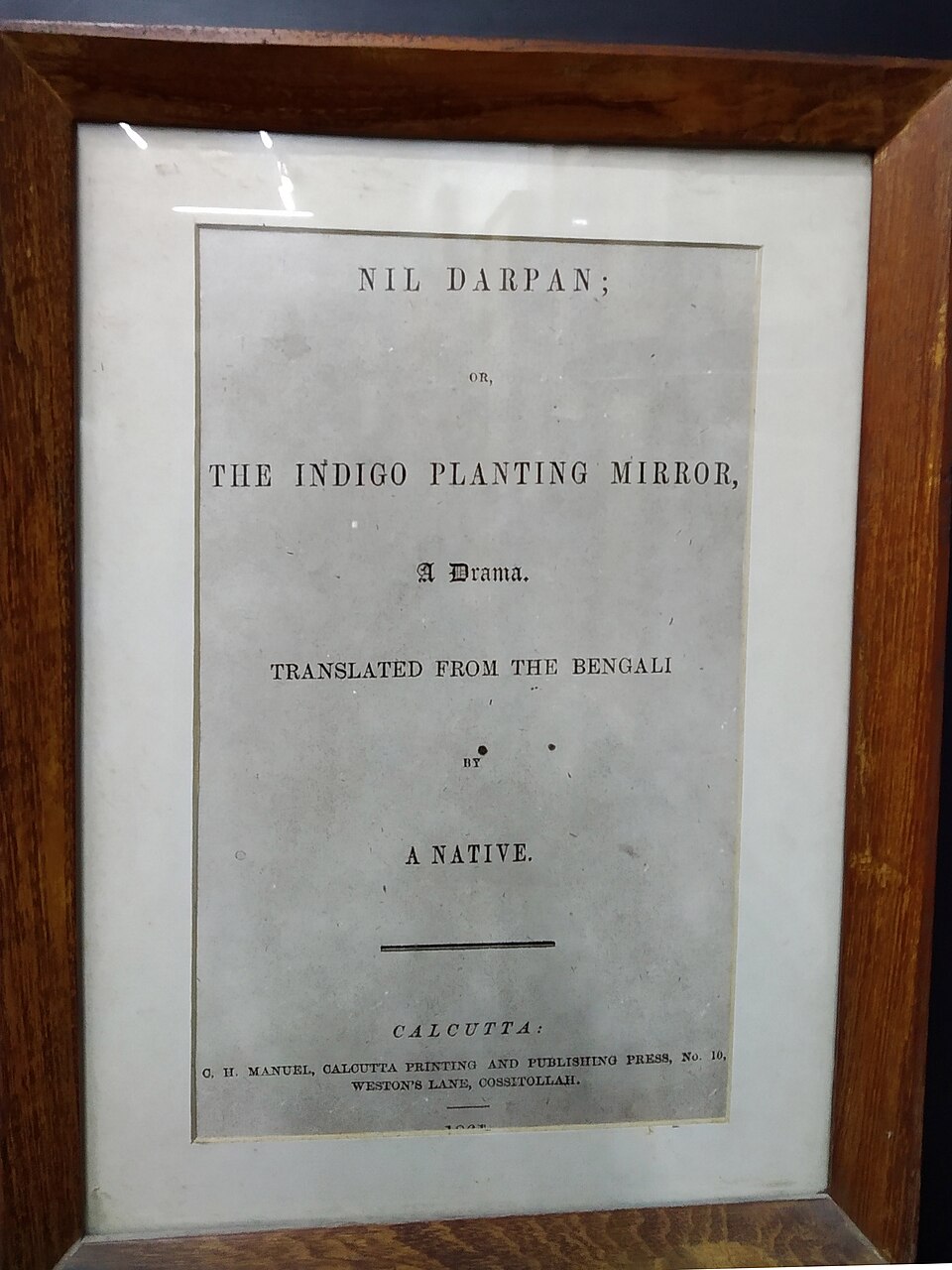
What was inside Nil-Darpan to provoke the government? The play follows the ruin of an Indian landowning family at the hands of two planters, Wood and Rogue. By its end, the landowner Golak Basu hangs himself, his wife Savitri dies mad with grief, and their son Nabin Madhab dies after Rogue fractures his skull. In one scene, two labourers who refuse dadan are kicked and flogged on stage. In another, Rogue corners a pregnant peasant girl, Kshetromoni, and tells her, "I want to be the father of your child. Come to bed, or I will kick your belly." Kshetromoni begs him for mercy in words that mistake her tormentor for kin, calling him father and pleading to be let go.
This sexual assault scene was the most moving part for the Indian audience.
For 12 years, nobody dared to stage this play publicly. The Great National Theatre in Calcutta produced Nil-Darpan in 1872 and sold out its first two performances, earning more than 500, a big amount. In fact, this was one of the first ticketed plays in India by the Indians.
The Englishman, in its issue of 19 April 1873, wrote that the conspicuous talent for histrionic art possessed by the Bengali could not be seen to better advantage than in this drama. The play that had sent Mr Long to prison was now being recommended to European audiences, and Neel-Darpan was being touted as the best native show.
But not all the Europeans agreed. When the Great National Theatre carried the production to Lucknow in 1875, the Europeans turned violent against the play.
Binodini Das, one of the actresses, recalled the evening in her autobiography Amar Abhinetri Juba. She wrote that as soon as the scene of Rogue assaulting Kshetromoni began, the European spectators grew agitated and crowded toward the footlights. "A few red-faced soldiers took out their swords and climbed on the stage," she recalled, certain they would all be beheaded before the curtain was finally pulled down. The Magistrate had to summon a company of soldiers from the fort before order returned, and before the actors could even be found, since the manager, Dharamdas Babu, was discovered sitting frozen underneath the stage itself. British soldiers had drawn actual swords against unarmed actors performing a play about atrocities their own countrymen had committed.
It is believed that this Lucknow disturbance led the colonial government to legislate against Indian theatre a few months later.
Rustom Bharucha, eminent theatre historian, believes there were other reasons as well. According to him, Gajadananda O Yubaraj, staged at the Great National Theatre on 19 February 1876, mocked a Bengali lawyer for allowing the visiting Prince of Wales to meet the women of his household. He argues that the government could not tolerate the caricature of a future emperor. Police stopped the second performance of this play, and Lord Northbrook issued the ordinance within ten days. The theatre retaliated the very next day with a fresh satire called The Police of Pig and Sheep, for which eight actors were arrested and charged.
ALSO READ: Thirty years on, India keeps faith with Palestine
If Bharucha’s version is more correct or the other reading, it is without a denial that the British Empire feared theatre much like it would later fear newspapers and cinema. They attacked performances physically, and when they could not stop them, they enacted laws. Yet, Neel-Darpan survived while the empire did not.











.webp)