




 Aditi Bhaduri
As Eid al Adha or the Feast of Sacrifice comes, my thoughts turn to Hebron or Al Khalil, a sprawling town in the southern West Bank in the Palestinian Territories. The Eid commemorates the sacrifice of Prophet Abraham or Ibrahim, a central figure in the three Abrahamic religions. So central that he even lent his name to the faith traditions that are said to be his legacy - Judaism, Christianity, and Islam. And it is in Hebron that Abraham left his seal when he moved from Mesopotamia to this place to settle down with his wife, Sarah, and son, Isaac, and his wife, Rebecca.
Reporter's Diary
I have had the opportunity to visit Hebron several times, beginning with the first in the aftermath of the Second Intifada.
Hebron is a unique place. The second most sacred site in the region after Jerusalem, it is hotly contested and tightly held on to by both Jews and Arabs, Israelis and Palestinians. Both peoples trace their genesis to Abraham - the Jews claim they are descendants of Isaac, and Arabs claim they are descendants of Ishmael, the other son of Abraham and Hagar.
Hence, Hebron, older than Nineveh and Babylon, is not just of great significance. The Jews call it Hebron or often Kiryat Arba (four villages in probably a reference to the original four villages now lost in antiquity). In contrast, Arabs call it Al Khalil, a reference to Abraham, who was called the Friend of God - Khalil Al Rehman.
Because of its religious significance to both Jews and Muslims, under the Oslo Accords, it became the only city in the Palestinian Territories to be divided into two - Palestinian Hebron of H1 under the control of the Palestinian Authority, and Israeli Hebron or H2 under Israeli control. Palestinians are denied entry into Jewish Hebron, and Jews are denied entry into Palestinian Hebron.
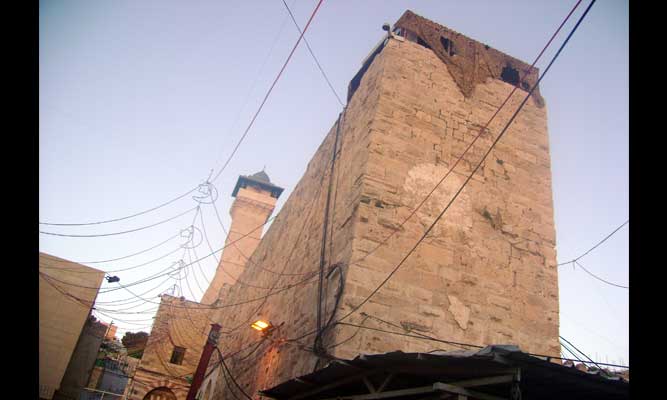 The Cave of the Patriarchs beneath the Ibrahimi Mosque where Prophet Ibrahim and his family members are laid to rest
I remember when I first drove into Palestinian Hebron. It was a crisp, cold December morning, and I found the place chaotic, a setting simultaneously biblical and Oriental. Creamy hills punctuated by green olive trees, which take generations to grow. Flat-roofed houses of two to three stories lined the winding streets and alleys. The souq or bazaar was the nerve centre of the city, which is the second-largest in the West Bank. And it was a town steeped in orthodoxy.
I was probably the only woman not wearing a hijab. Even little girls wore it, as did foreign women married to men here. Religious piety pervaded the town. Religious songs were invariably set as ringtones for mobile phones, and the azaan was set as an alarm signal to wake up each morning. Almost no one missed any of the five daily namaz or the Friday prayers in the mosque.
But for all this piety, there was also an atmosphere of warmth and gentleness. No one forced me to don a hijab, though I did get curious stares on the streets. On the contrary, it was always difficult to manage the huge numbers of invitations that poured my way for lunches and dinners.
Mixing between the opposite sexes was unthinkable, but almost every capable adult woman had a job, and men and women worked side by side in numerous institutions. There were no movie halls, no shopping malls, no fancy restaurants, just several small family cafes and a few men-only dens for smoking the hookah or Nargila, as it is called there. Most women did not venture out alone or without male company after 4 pm. But family evening outings were a common sight. Alcohol was strictly prohibited across the town, and so there were, of course, no bars and certainly no discos or nightclubs.
The focal point of the town, however, was the Tomb of the Patriarchs or the Al Haram Al Ibrahim. Tradition has it that when Abraham came to Hebron. He settled down near an oak tree, and he had brought the Cave of the Patriarchs to bury his wife, Sara. He was also buried there, as were his son Isaac and his (Issac's) wife Rebecca, and their son Joseph and Joseph's wife Leah.
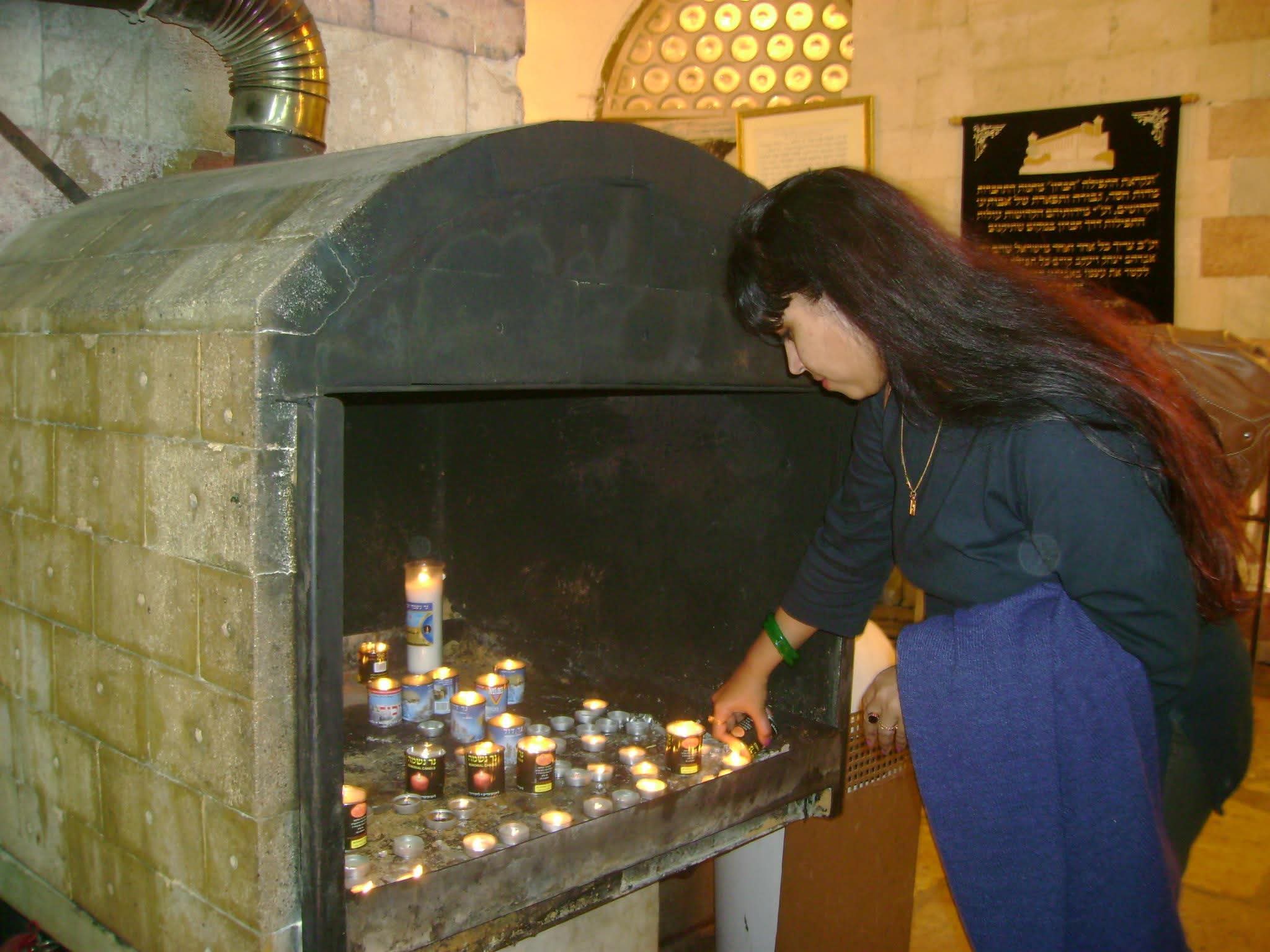 Author lighting a candle in the Jewish side of Al Ibrahimi mosque in Hebron
This is where Hebron began. It was here that Abraham marked the place forever, and here that David became King over Judah. Centuries later, this became the Mamluk capital of Palestine.
Resembling a fortress, the Haram, though situated in the old town, much of which is under HI, falls under H2. Part of the old souq, much of which is in H1, opens into a road that is lined with pottery shops and then leads further to the Haram. Security guards swarm the place. On my last visit, I found a checkpoint had been erected at the point where the souq exited to the entrance to the Haram.
Carrying the weight of so much faith, the Haram too has had a checkered history. Jewish King Herod built the structure over the caves, which are said to house all the holy tombs. During the Byzantine period, a church was built in it, which, after the Muslim conquest, was converted into a mosque. Crusaders reconverted the mosque to a church, only to have Saladin, the Great, turn it back into a mosque. The Mamluks built the minarets that tower over the fort-like structure. They also built the Hall of Isaac, one of the three main halls there, to Abraham, Isaac, and Jacob Hall.
And the Haram, arousing great passion in both communities, has sadly also seen violence between them. Jews reclaimed their right to pray here in 1967 and initially shared the place with Muslims, each praying at different times. After 1994, the place was divided into Muslim and Jewish sections. Muslims pray in the mosque, which is housed in the Hall of Isaac, while Jews use the Halls of Abraham and Jacob
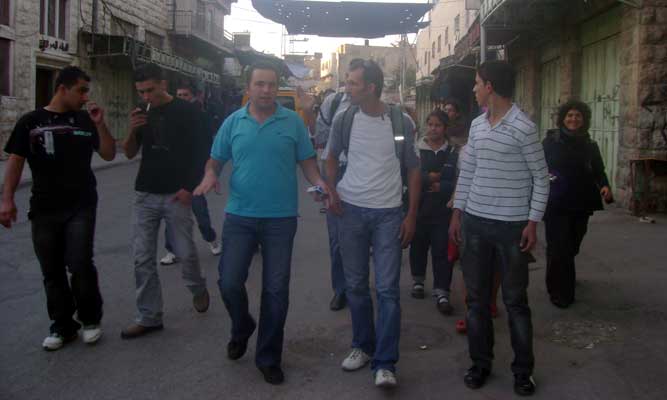 Youth in the Souk (market) of Hebron
My non-affiliation with the two religions ensured me access to both places. As a non-Jew, I could access the mosque, and as a non-Muslim, I could access the Jewish section.
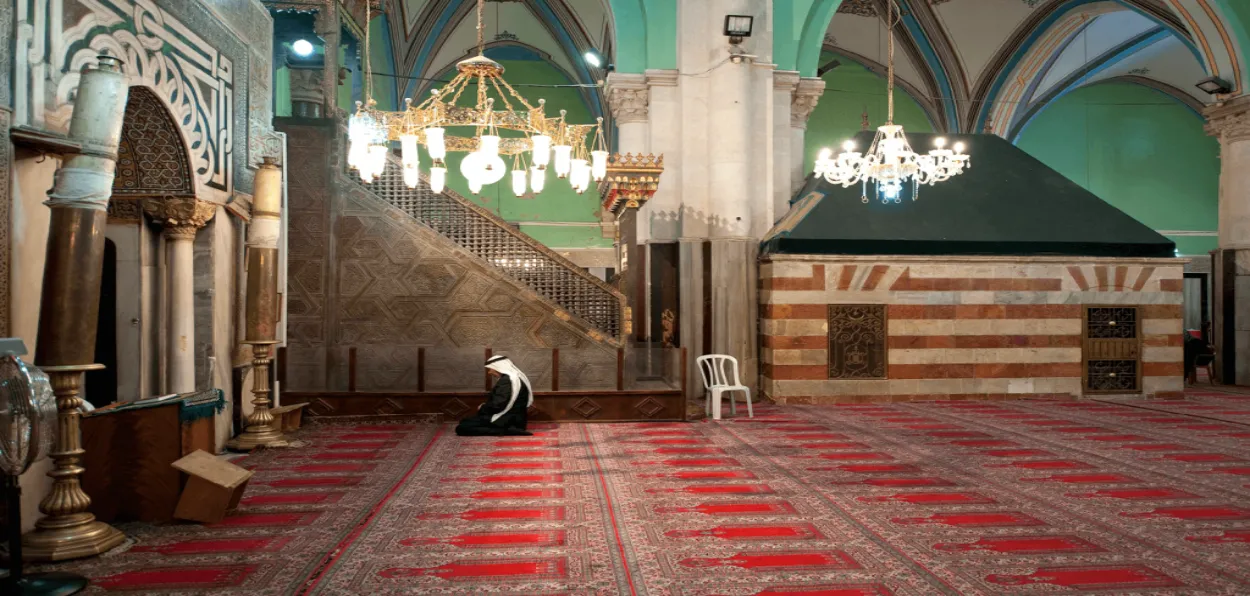
The Muslim section is beautifully adorned. The large hall has a uniquely crafted minibar, dating to Ottoman times, where on Fridays the clergy, or Sheikh as they are called there, delivers the Friday sermon. It also contains the cenotaphs of Isaac and Rebecca. Soft woollen prayer rugs covered the floor, muffling every footfall and making it an oasis of calm. The stained-glass windows muted the sunlight coming through so that it bathed the Hall in a soft and warm glow.
A metal gate at the sides opens into the caves, where the prophets and their wives are buried. Rarely does anyone go down there; instead, people drop their prayers there from the hall. I, too, knelt and dropped my prayers.
Young Palestinian boys sat on the carpeted floors, studying the Quran. They forgot their lesson as turned to peer curiously at me, then whispered to each other, breaking into little giggles as I smiled at them. Then, shyly, they returned my smiles. The serenity of the place made it hard to believe that a massacre had taken place there or that massacres could take place at all, even in its vicinity.
Entrance into the Jewish section required me to show my passport and go through metal detectors. The Hall of Abraham houses the cenotaphs of Abraham and Sara, while the Hall of Jacob houses those of him and his wife Leah. This section was divided further into a men's prayer section and a women's prayer section. There was also a library where religious students engaged in theological studies. A huge altar for candles commanded a central place. Here, candles burned almost throughout the entire day. A few Jewish men in the traditional kippahs stood reading the Psalms, swaying as they did.
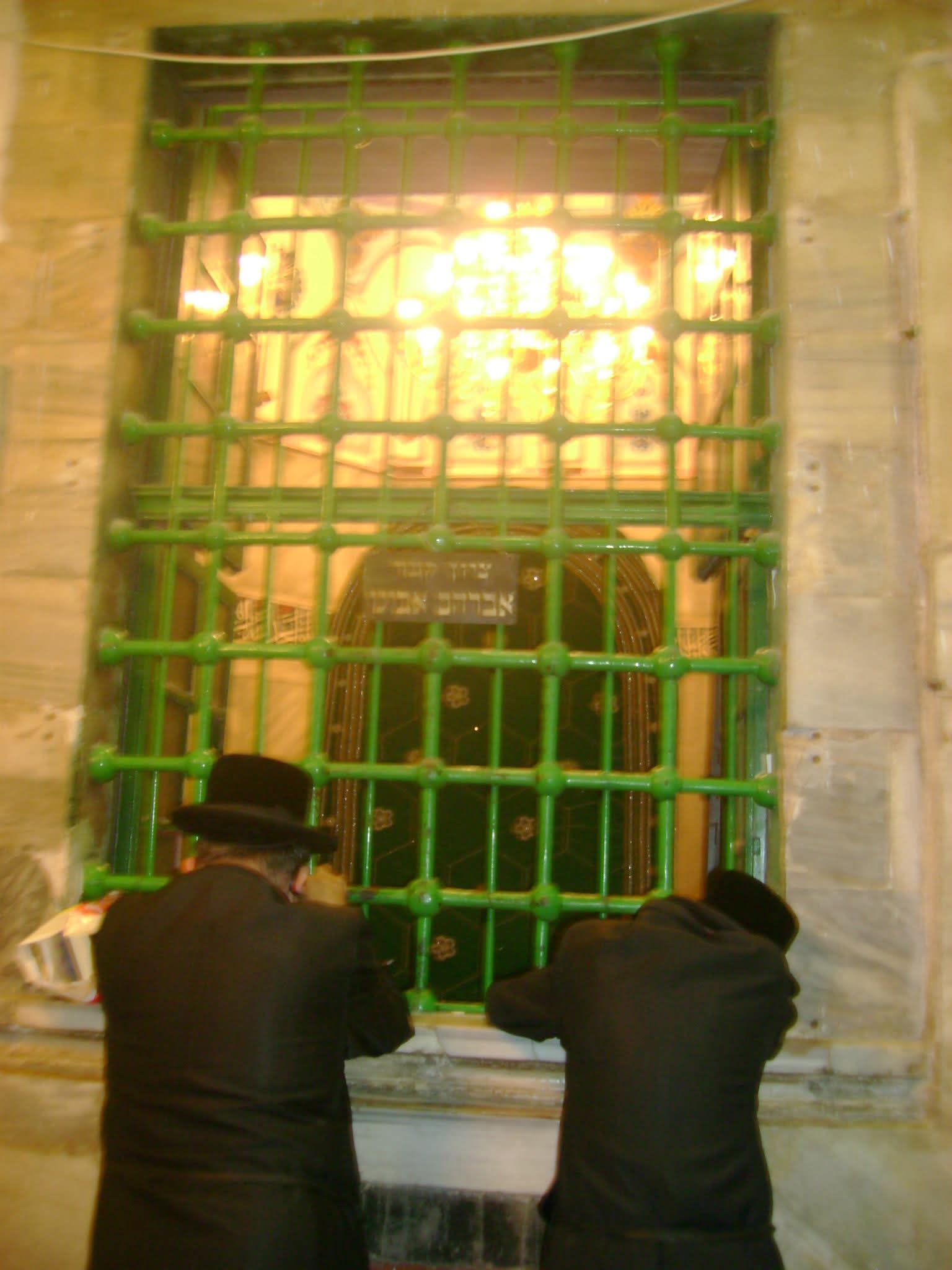 Jews paying obesiance at the Hall of Ibrahim
A couple of other men held the iron rails of the grate through which one peered down to try to see the tombs, eyes tightly shut, muttering prayers with an intensity, their faith and concentration shutting out all distractions of curious visitors like me.
Hebron Jews are as orthodox as their Arab counterparts. Almost all the Jewish women don their equivalent of the hijab and have large families. On the subsequent visit, I sat in the women's section saying my own prayers.
Over the years, on my next couple of visits, I found attitudes more hardened, the distance between the two peoples praying to the same God and tracing their lineage from the same Prophet even further. Even travelling to the place has become more difficult, with taxis no longer plying directly there from Jerusalem as they had when I first visited. Hebron is, I believe, a microcosm of the entire Israeli-Palestinian conflict. Currently, there may be, perhaps, no movement between the two places at all.
Yet I want to end with the memory of my last visit to that fabled yet sad place. I was part of a unique trip of an Israeli group that was entering the Palestinian town for the first time since the beginning of the second intifadah. The trip had been possible due to the untiring effort of a Jewish scholar, who is the director of an interfaith advocacy group and has been quietly championing interfaith dialogue in Israel over the years. In Hebron, we were met by a group of Palestinian Muslims who took us on a tour of the old city.
Despite Thursday being a working day, the market looked like a haunted place. The visitors learnt that most shop-owners had moved out because of the harsh realities of everyday life. Remarkably, there had been no anger, no feelings of recrimination amongst the Palestinians for their guests and friends.
Later, we gathered at a café in the city centre, where Israelis and Palestinians chatted, played backgammon, drank tea and smoked the nargila. It was good to see barriers break down and a spirit of friendship and fellowship engulf all. Most Israelis spoke Arabic, and a couple of Palestinians, studying in Israeli institutions, knew Hebrew. They translated for each other.
They spoke about the sanctity of Hebron in Islam and in Judaism. Most striking was that many of them believed that Hebron, which has been divided because of its sacred symbolism for both Jews and Muslims, can precisely emerge as the bridge between the two communities.
This small dome marks the place where Allah ﷻ tested the faith of Prophet Ibrahim (AS) by commanding him to sacrifice his beloved son, Prophet Ismail (AS).
— Just Want Peace (@justwantpeace31) May 27, 2026
With complete trust and submission to Allah’s will, Ibrahim (AS) prepared to fulfill the command, while Ismail (AS) also… pic.twitter.com/8DGfB6BmM3
It was with this reflection that I last left Hebron. On this day, as Muslims in India and elsewhere celebrate Abraham's sacrifice, so will the Hebronites. Perhaps one day, Abraham's descendants can sacrifice ego, fear and anger and come together again.
Aditi Bhaduri is an independent journalist and researcher specialising in Eurasian geopolitics.
_(1).jpg "Visitors gather at the Santosh Mitra Square Durga Puja pandal, themed on the 150th anniversary of Vande Mataram and its historic role in India's freedom movement, ahead of the festival, in Kolkata")
.jpg "Gujarat’s women entrepreneurs bring their craftsmanship to life during Navratri")






_(2).webp)
.webp)